


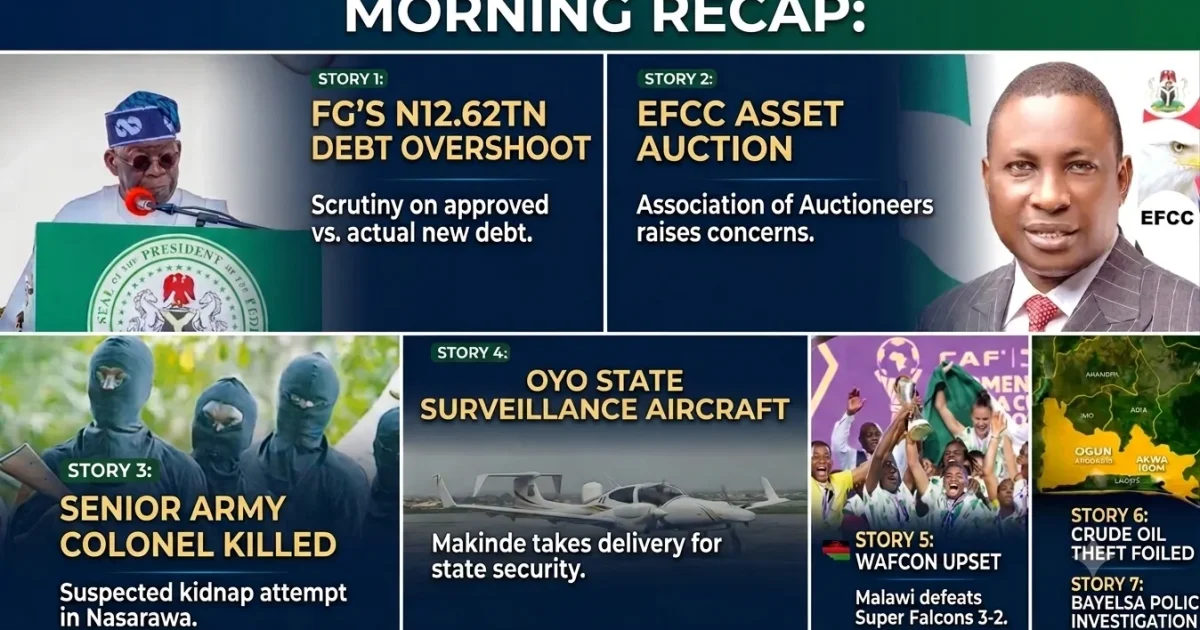
A Day of Financial, Security, and Sports Turmoil in Nigeria
The Nigerian morning unfolded with a series of high-stakes developments, from fiscal mismanagement and anti-graft controversies to deadly security incidents and a stunning sports upset. Below is a detailed breakdown of the most consequential headlines shaping the nation’s narrative.
1. Federal Government’s Debt Overshoot: N12.62tn Borrowing Exposes Fiscal Strain
The Federal Government’s 2024 borrowing spree has spiraled out of control, with total debt soaring to N12.62 trillion—a N4.79 trillion overshoot of the approved N7.83 trillion ceiling. This reckless financial maneuvering has pushed Nigeria’s fiscal deficit to N13.51 trillion, far exceeding the N9.18 trillion initially projected.
The Budget Office of the Federation attributed the shortfall to weak oil revenue, with crude oil prices averaging $77.96 per barrel—well below the $95 per barrel benchmark used for budgeting. Despite a surge in non-oil revenue, the government’s reliance on external borrowing has ballooned public debt to N144.67 trillion, inflating the debt-to-GDP ratio to 61.22%. This figure not only surpasses Nigeria’s 40% domestic debt threshold but also exceeds the 56% international benchmark, raising alarm bells over economic sustainability.
Economists warn that unchecked borrowing risks inflationary pressures, currency depreciation, and long-term debt servicing crises, particularly as Nigeria grapples with rising interest rates and dwindling foreign reserves.
2. EFCC’s Self-Managed Auction Plan Sparks Transparency Fears
The Economic and Financial Crimes Commission (EFCC) has faced renewed criticism over its controversial plan to auction seized vehicles through an in-house platform, a move that critics argue undermines transparency and due process.
The Nigeria Association of Auctioneers, led by President Benjamin Isibor, accused the anti-graft agency of abusing its custodial powers by acting as both seller and regulator of forfeited assets. Isibor cited past disputes during Ibrahim Magu’s tenure, when similar disputes erupted over the illegal sale of seized properties without proper bidding procedures.
The EFCC has yet to respond to these allegations, leaving the public skeptical about whether the agency’s self-managed auctions will adhere to legal safeguards or risk favoritism and corruption. The controversy underscores broader concerns about government asset management and the need for independent oversight in the disposal of recovered funds.
3. Senior Army Colonel Killed in Nasarawa State Kidnap Attempt
A brutal and targeted attack left Colonel Abdussalam Ude, a senior Nigerian Army officer, dead in a suspected kidnap-for-ransom attempt at his residence in Badna, Nasarawa State, on Monday night.
The assailants, described as heavily armed gunmen, stormed Ude’s home during a downpour, shooting him multiple times after he resisted their demands. The attack occurred in New Karu Local Government Area, a border community adjacent to the Federal Capital Territory (FCT).
The FCT Police Command clarified that the incident did not occur within Abuja’s jurisdiction, dismissing earlier reports of panic among residents. However, the killing has reignited fears of rising insecurity in northern Nigeria, particularly in border communities where kidnapping-for-ransom syndicates operate with impunity.
Military sources have not yet confirmed whether the attack was state-sponsored or criminal in nature, but the timing—just days after a high-profile abduction in Oyo State—suggests a pattern of escalating violence targeting security personnel.
4. Oyo State Secures Surveillance Aircraft Amid Insecurity Surge
In a long-awaited move to combat insecurity, Governor Seyi Makinde of Oyo State officially took delivery of two surveillance aircraft on Tuesday. The unmanned aerial vehicles (UAVs), first announced in July 2023, were procured under a Memorandum of Understanding (MoU) with the Nigerian Air Force (NAF).
The aircraft, piloted by NAF personnel, will monitor forests, border communities, and hotspots in collaboration with the Amotekun Corps, a state-backed security agency. The acquisition comes months after the abduction of 39 students and seven teachers in Oriire Local Government Area, an incident that exposed gaps in aerial surveillance and intensified calls for proactive security measures.
Makinde emphasized that the UAVs will enhance intelligence gathering, enabling preemptive strikes against bandits, kidnappers, and armed criminals. However, critics question whether state-level surveillance alone can counter transnational criminal networks operating across multiple regions.
5. Collapsed Building in Ogun State Claims Three Lives, 12 Rescued
A catastrophic building collapse in Ajuwon, Ogun State, during a heavy downpour on Monday resulted in three deaths and 12 survivors, prompting an immediate investigation by Governor Dapo Abiodun.
The victims included:
– An adult woman
– A baby
– A 75-year-old man
Preliminary reports suggest the lower floors of the mixed-use building sank into the ground, though officials have not yet confirmed whether poor construction, soil instability, or structural defects were the primary causes. The Lagos State Emergency Management Agency (LASEMA) assisted in rescue operations, highlighting the interstate nature of urban safety challenges.
Abiodun has ordered a full-scale probe, including structural and geotechnical assessments, to determine liability and prevent future tragedies. The incident underscores persistent concerns about shoddy construction practices in Nigeria’s rapidly expanding urban centers.
6. Nigerian Navy Foils N660m Crude Oil Theft in Akwa Ibom
The Nigerian Navy has intercepted a tanker allegedly carrying stolen crude oil valued at over N660 million under Operation Delta Sentinel, a counter-piracy and oil theft crackdown in the Niger Delta region.
Twelve crew members were arrested off Akwa Ibom State after the vessel, MT FILIA, was caught discharging approximately 650 metric tonnes of stolen crude into the sea. Naval patrols approached the tanker on July 23, forcing the crew to abandon the stolen cargo before being apprehended.
Investigations are ongoing to identify masterminds and accomplices involved in the large-scale oil theft, which has devastated Nigeria’s oil revenue and environmental sustainability. The navy’s success in this operation signals heightened enforcement, but experts warn that organized crime syndicates may adapt tactics to evade future crackdowns.
7. NYSC Corps Member Found Dead in Bayelsa Waterway
The Bayelsa State Police Command is investigating the murder of Stanley Okebaram, a 27-year-old National Youth Service Corps (NYSC) member, whose body was recovered from a waterway in Nembe Local Government Area days after he went missing.
Okebaram, a civil engineering graduate, was last seen on July 24 before his disappearance was reported by fellow corps members the following night. Police suspect he was attacked by unidentified assailants, though no arrests have been made.
The case has raised concerns about safety for NYSC members in high-risk states, particularly in rural and border communities where kidnapping and armed robbery remain rampant. Authorities have yet to determine whether the killing was random or targeted, but the incident underscores the persistent threat to young Nigerians serving their mandatory national service.
8. Super Falcons Receive Promised WAFCON Rewards Before Malawi Shock
Nigeria’s Super Falcons received their long-overdue 2024 WAFCON rewards from the National Sports Commission (NSC) just hours before their Group C opener against debutants Malawi.
NSC Chairman Shehu Dikko presented the players with:
– Title deeds to three-bedroom houses (as promised for winning the tournament)
– National honours certificates
– $100,000 cash rewards per player (already disbursed earlier)
The gesture came as a symbolic boost before Nigeria’s title defense, but the team faced an early humiliation when Malawi stunned them 3-2 in a historic upset.
The match saw:
– Temwa and Tabitha Chawinga scoring either side of a Rasheedat Ajibade penalty to put Malawi 3-1 up.
– Uchenna Kanu’s late equalizer narrowing the gap, but the debutant nation’s resilience marked one of the biggest shocks in WAFCON history.
Nigeria now faces Zambia and Egypt in Group C, with the defending champions needing a strong rebound to advance.
Final Thoughts: A Nation at a Crossroads
Nigeria’s morning headlines reflect a nation grappling with fiscal irresponsibility, security crises, and institutional challenges. From the debt crisis threatening economic stability to the EFCC’s transparency issues and rising insecurity, the country faces multiple fronts of governance failures.
Meanwhile, the Super Falcons’ defeat serves as a reminder that even the most dominant teams are vulnerable when facing unexpected competition. As Nigeria navigates these challenges, urgent reforms in finance, security, and governance will be critical to restoring stability and national pride.
End of Recap
