


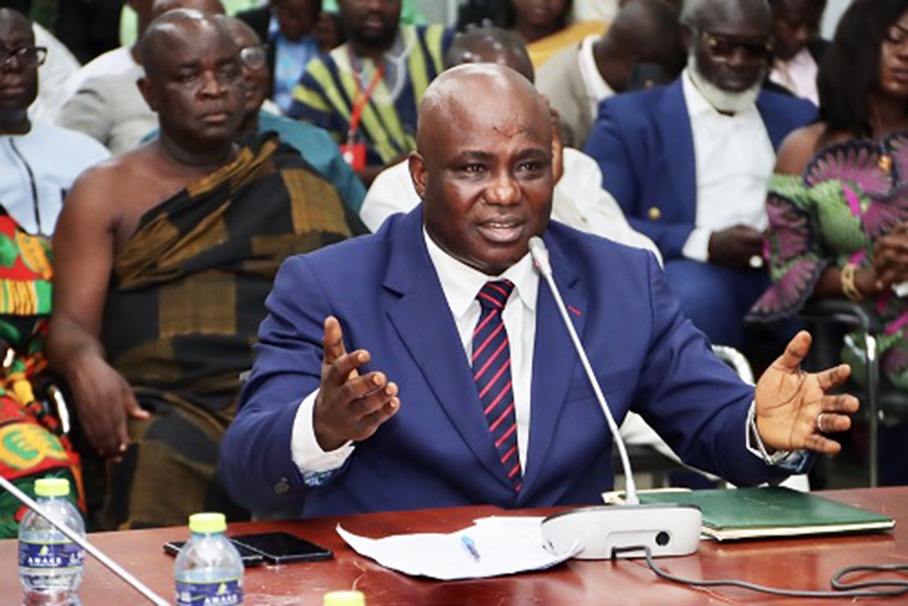
The Minister for Food and Agriculture, Eric Opoku, has said that the successful implementation of the first phase of the government’s flagship Nkoko Nkitinkiti Programme has paved the way for the commercialisation of Ghana’s poultry industry.
Speaking to journalists after briefing Parliament on the progress of the programme, the minister described the household and domestic poultry production phase as a success, saying its strong uptake and positive results had given the government the confidence to expand the initiative into large-scale commercial production.
“The successful implementation of the first phase has demonstrated that the policy is not merely an agricultural intervention but a practical blueprint for rebuilding Ghana’s poultry industry from the grassroots upward,” he said.
According to Mr. Opoku, the programme is laying the foundation for a self-sustaining poultry sector capable of creating thousands of jobs, improving household nutrition, reducing Ghana’s dependence on imported frozen chicken, and saving millions of dollars in foreign exchange.
He said the first phase had shown that many Ghanaian households were willing and able to engage in poultry production, making it possible for the government to shift its focus to commercial-scale production.
The minister said the second phase would seek to expand investment across the poultry value chain, including hatcheries, feed mills, processing plants, cold-chain logistics, packaging, transportation and retail distribution.
For decades, Ghana has relied heavily on imported frozen chicken, spending an estimated $350 million annually, according to the Ministry of Food and Agriculture.
Mr. Opoku said the Nkoko Nkitinkiti Programme is intended to reverse that trend by increasing domestic production and strengthening the country’s poultry industry.
He described the initiative as one of the government’s key import-substitution strategies, aimed at improving food security, supporting agribusiness, creating employment opportunities for women and young people, revitalising rural economies and retaining more wealth within the local economy.
Mr. Opoku expressed confidence that the commercialisation phase would transform the programme from a household poultry initiative into a major driver of industrial growth and economic resilience, while significantly reducing Ghana’s dependence on imported poultry products.
