


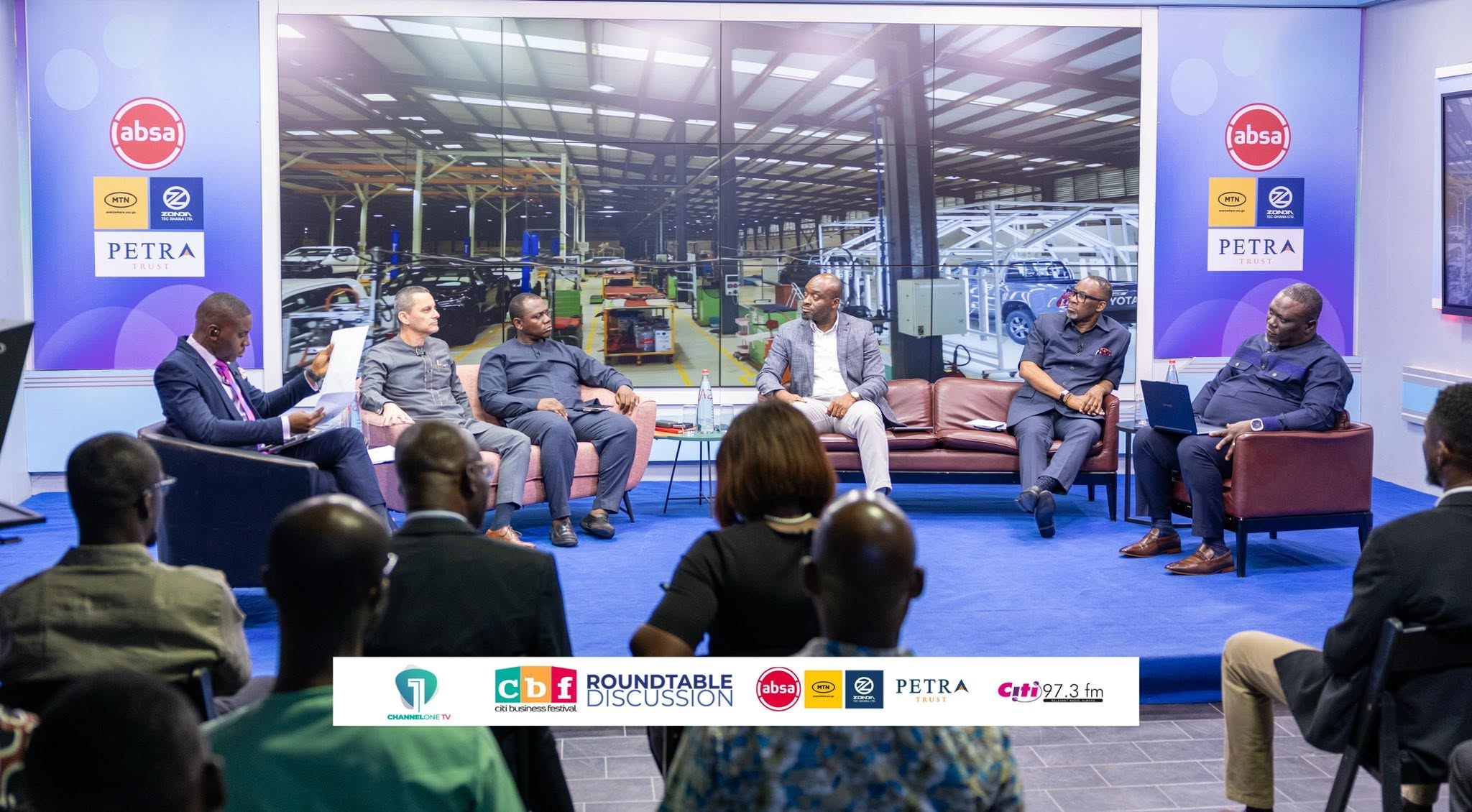
Unlocking Ghana’s automotive potential will require a transition from basic vehicle assembly to a fully integrated manufacturing industry underpinned by policy certainty and stronger domestic demand, industry players have said.
These top recommendations emerged during the final Citi Business Festival 2026 Roundtable Discussion, held under the theme “Driving Ghana Forward: The State of the Automotive Assembly Industry and Its Contribution to the Economy.”
The discussion brought together the Chief Executive Officer of Japan Motors Ghana, Salem Kalmoni; Head of Strategic Manufacturing at the Ministry of Trade, Agribusiness and Industry, Kwasi Ofori-Antwi; Team Lead of the Ghana Partnership for Jobs and Economic Transformation (JET) Programme, Eugene T. Sangmortey; Chief Executive Officer of Volkswagen Ghana, Jeffrey Oppong Peprah; and economist at the University of Ghana, Professor Ebo Turkson.
The panel assessed the progress of the Ghana Automotive Development Policy, introduced in 2019 to attract global vehicle manufacturers and establish Ghana as an automotive production hub.
While the policy has attracted investments from six major international vehicle brands and facilitated the establishment of seven assembly plants, participants said several of its long-term objectives remain unfulfilled.
Here are five ways to propel the prospects of the industry.
1. Restoring Fiscal Incentives
A key recommendation from the discussion was the restoration of tax incentives for locally assembled vehicles, particularly the reintroduction of VAT exemptions that previously helped improve the competitiveness of locally assembled vehicles against imported used cars.
Industry players argued that locally assembled vehicles continue to face stiff competition from used vehicle imports, which dominate Ghana’s automotive market due to affordability.
“We never hold any VAT. This was a VAT that was given to the end users because it put us in a very competitive position. Just last year, we are able to sell a brand-new vehicle [locally assembled], brand new vehicle, at a price of imported used car which is seven years. So it’s a low price. So this is the mathematics here. That incentive that we were giving to end users, they were really enjoying it,” Jeffrey Oppong Peprah said.
Government is currently considering the restoration of a 20 percent VAT exemption on locally assembled vehicles.
Salem Kalmoni noted that Ghana’s automotive assembly industry remains highly competitive, with multiple assemblers operating in the market, helping to moderate vehicle prices for consumers.
According to him, imported vehicles attract a cumulative tax burden of between 20 and 21.9 percent through VAT and related levies. He explained that recent VAT-related policy adjustments have contributed to lower vehicle prices, although they have also heightened competition between locally assembled vehicles and imported units.
“There are 10 bona fide assemblies in Ghana, with 7 assembly plants. We are competitors; it’s not like there’s a monopoly,” Kalmoni added.
“Our prices have come down significantly, and it has been passed on to the consumer,” he said.
2. Stimulating Demand through Financing
Panelists identified public sector procurement as one of the quickest ways to stimulate demand for locally assembled vehicles.
They argued that enforcing local content requirements in government vehicle procurement would provide assemblers with the production volumes needed to achieve economies of scale, thereby reducing unit costs and enhancing competitiveness.
“We need to enforce procurement of cars. As we speak, government should enforce that no state agency should import any car if they don’t buy the cars from the local. The point is that at times we complain about the costs, but the economies of scale will allow them to reduce their cost. So at times the demand, when it kicks in, would allow them to reduce their cost, and then they become competitive,” Professor Ebo Turkson said.
The panel also highlighted the importance of expanding access to vehicle financing through asset-backed lending schemes.
Such financing mechanisms would enable more Ghanaians to acquire new vehicles while supporting demand for locally assembled units.
“The Ministry now should be looking at bringing in the financial sector into the picture. How do you offer financing to workers to get cars from these plants that have been assembled here in Ghana, and I’m very certain that if the financing is right, you have Ghanaians opt for these cars,” Professor Ebo Turkson added.
3. Expanding the Supply Chain
Beyond vehicle assembly, stakeholders stressed the need to deepen local value addition through component manufacturing.
Kwasi Ofori-Antwi disclosed that the proposed Ghana Automotive Component Manufacturing Policy is currently before Cabinet for consideration and is expected to support the development of a domestic automotive supply chain.
“What we are looking at in terms of supporting this downstream sector is coming up with the Ghana Automotive Component Manufacturing policy which I can say, that it’s currently at cabinet for consideration,” he said.
The policy is expected to strengthen linkages between the formal automotive sector and Ghana’s extensive informal manufacturing base, particularly artisans and spare parts manufacturers.
“When it comes to the component manufacturing industry, where we believe that actors within the spare parts industry will be very critical, we have also engaged them,” Kwasi Ofori-Antwi said.
“We have an artisanal industry which will be very important to our automotive industry. When we brought those who are helping us develop the policy and we took them to Suame Magazine, they were very amazed to see the potential that we had at Suame Magazine.
“So for Suame Magazine, we are looking at establishing an advanced laboratory for them so that it can help them with the alloying of their metals, metal analyses and also post-component manufacturing,” he subsequently added.
In a related development, Eugene T. Sangmortey announced that Ghana is expected to commence local production of industrial fasteners, including bolts, nuts and springs, in the third quarter of 2026.
“One of the things we have done as a program is engaging with the informal sector and even some of the semi formal, including the formal sector, to support them with capacity building and opportunity and I am very excited to share that in Q3 of this year, we should be having the first production of fasteners in Ghana by a Ghanaian firm right here in Ghana, with the support of the JET program and the support of the UK investments,” Eugene T. Sangmortey remarked.
4. Improving the Operational Environment
Stakeholders also called for improvements in the broader operating environment to enhance the competitiveness of automotive assembly operations.
High electricity tariffs, exchange rate volatility and infrastructure constraints were identified as major impediments to industrial growth. Participants argued that reducing the overall cost of doing business would have a greater long-term impact than tax incentives alone.
They also advocated stricter enforcement of vehicle certification and homologation standards to ensure a level playing field between imported used vehicles and locally assembled new vehicles.
“People have gotten used to the fact that used vehicles come in cheaper and they always have a preference for used vehicles. So there is a whole system in place that we need to overcome to get us to the point where we are looking at building a competitive hub for the automotive industry from both a supply and a demand point of view.
“Infrastructure is key in all of this. The cost of electricity, the business environment should work conducive. Look, if your environment is conducive, the cost of business is doing low. You don’t need to give these private businessmen tax incentives because they’ll make more profits in a low cost environment than the tax incentives that you give them,” Professor Ebo Turkson said.
5. Leveraging AfCFTA
The discussion concluded with a call for Ghana to leverage its early-mover advantage under the Ghana Automotive Development Policy and position itself as a regional automotive manufacturing hub under the African Continental Free Trade Area (AfCFTA).
According to Jeffrey Oppong Peprah, Ghana’s automotive policy framework has become a reference point for several African countries seeking to establish their own automotive industries.
“Our neighbors are also watching us. They have learned so much from what we are doing. I mean, last week we had almost 23 countries, member states from the Africa continent in the country coming to learn. There was a workshop last week under auspices of AfCFTA and Afreximbank. 23 member states that are all interested in auto industry. Ghana is more like a model because our policy, we have it all. So we need to cross the bar,” he said.
The 2026 edition is powered by 97.3 Citi FM and Channel One Television in partnership with Absa Bank Ghana and sponsored by Absa Bank Ghana, MTN Ghana, Zonda Tec Ghana Limited and Petra Trust.
