


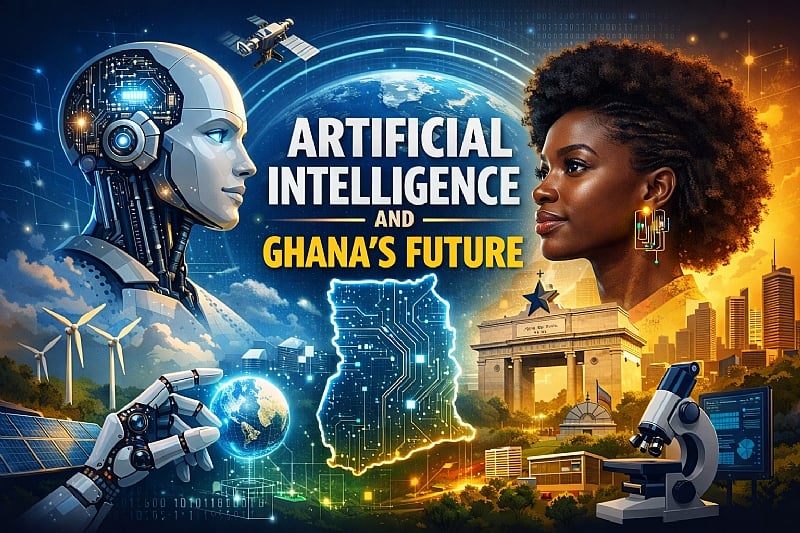
Ghana has always been good at excitement. We are excited when a new policy is launched, excited when a new digital platform is announced, excited when politicians speak beautifully about transformation, and excited when technology promises to solve problems that institutions have struggled with for years. But excitement is not readiness. A nation can celebrate innovation and still be unprepared for it. A country can launch strategies, hold conferences, take photographs, and use powerful words like “digital transformation,” yet still lack the systems, skills, discipline, infrastructure, and ethical safeguards needed to turn technology into real national progress. This is why Ghana’s conversation about artificial intelligence must move beyond applause. AI is not just another fashionable term to be added to speeches and policy documents. It is one of the most important technological forces of our time. It is already changing education, banking, healthcare, agriculture, journalism, public administration, security, business, and employment. The question is no longer whether AI will affect Ghana. It will. The deeper question is whether Ghana is preparing carefully enough to benefit from it, or whether we are simply excited by the idea of being seen as a modern digital nation.
Artificial intelligence refers to computer systems that can perform tasks that normally require human intelligence. These include learning, writing, translating, analysing data, recognising patterns, generating images, predicting outcomes, and assisting decision-making. In simple terms, AI allows machines to process information and produce useful outputs at a speed and scale that human beings cannot easily match. This is powerful. But like every powerful tool, AI can build or damage depending on how it is governed and used. For Ghana, AI presents enormous opportunities. In education, it can support personalised learning, help teachers prepare lessons, assist students with difficult concepts, and improve access to knowledge. In healthcare, it can support patient records, disease surveillance, diagnosis assistance, health education, and hospital administration. In agriculture, AI can help farmers understand weather patterns, detect crop diseases, improve irrigation, monitor soil conditions, and access market information. In public service, AI can reduce delays, improve records management, support decision-making, and make service delivery more efficient. In business, it can help small enterprises with customer service, marketing, bookkeeping, product design, and market analysis.
These possibilities are exciting, and Ghana should not fear them. No serious nation can afford to stand outside the AI revolution. The world is moving towards data-driven economies, automated systems, digital services, and intelligent technologies. If Ghana remains only a consumer of foreign technologies, we will continue to depend on other countries for tools, platforms, expertise, and solutions. But if we invest properly, AI can help Ghana build local innovations that respond to Ghanaian problems. However, there is a difference between adopting AI and being ready for AI. Readiness requires more than internet access and smartphones. It requires reliable infrastructure, quality data, skilled human resources, strong institutions, ethical regulation, cybersecurity, research investment, and inclusive education. Without these, AI may become another beautiful national dream that benefits only a few while leaving many behind.
One of Ghana’s biggest challenges is the digital divide. Many urban youth are already experimenting with AI tools, but many rural students still struggle with basic internet access, stable electricity, and digital devices. If AI education becomes available mainly to people in well-resourced schools, private universities, elite institutions, and urban centres, then the technology will widen inequality. A young person in Accra or Kumasi should not be more entitled to the future than a young person in Berekum, Wa, Nkwanta, Damongo, Sefwi, Kintampo, or any rural community. Ghana’s AI future must be national, not elitist. Education is another critical issue. We cannot build an AI-ready country with an education system that still rewards memorisation more than creativity, examination more than innovation, and certificates more than competence. AI will expose weak learning systems because it can easily produce essays, summaries, codes, and answers. If schools only ask students to reproduce information, AI will do that faster. The future of education must therefore focus on critical thinking, problem-solving, ethics, creativity, research skills, digital literacy, and practical application.
Teachers and lecturers also need support. It is unfair to expect students to use AI responsibly when many educators have not been trained to understand it. Ghana must invest in teacher training, curriculum reform, digital pedagogy, and AI literacy across all levels of education. AI should not be treated as a threat to teachers. It should be understood as a tool that can support teaching, reduce workload, and improve learning when used responsibly. The labour market also requires urgent attention. Many young Ghanaians already face unemployment and underemployment. AI will not simply remove jobs, but it will change the nature of work. Repetitive tasks, basic administrative duties, routine content production, simple data processing, and some customer service roles may increasingly be automated. At the same time, new opportunities will emerge in AI training, data management, software development, digital marketing, cybersecurity, robotics, content strategy, research, design, and technology-enabled entrepreneurship. The workers who will survive are those who can adapt. This means Ghana must stop preparing young people only for yesterday’s jobs. Universities, technical institutions, and training centres must connect learning to emerging realities. A graduate should not leave school only with theory. The graduate must have practical digital skills, communication skills, analytical ability, ethical judgement, and the capacity to use technology to solve problems. In the AI age, certificates may open doors, but competence will keep people in the room.
Another serious issue is data. AI systems depend on data. If Ghana does not manage its data properly, we cannot build strong AI systems. Poor data leads to poor decisions. Incomplete data leads to exclusion. Biased data leads to unfair outcomes. Weak data protection exposes citizens to abuse. Ghana must treat data as a national development asset. This requires strong data governance, privacy protection, responsible data sharing, institutional coordination, and public trust. AI also raises ethical questions. Who is responsible when an AI system makes a harmful recommendation? How do we prevent AI from spreading misinformation? How do we stop people from using AI to create fake images, fake voices, fake documents, or political propaganda? How do we protect children, students, workers, consumers, and citizens from digital manipulation? These questions cannot be answered by excitement alone. They require law, policy, education, enforcement, and moral responsibility. Local context is equally important. AI systems built elsewhere may not fully understand Ghanaian languages, cultural expressions, social realities, names, institutions, values, and development challenges. If Ghana imports AI without local adaptation, we may end up using systems that do not reflect who we are. Ghana must invest in local language technologies, African datasets, culturally relevant AI tools, and local research. The future should not only be about using foreign AI platforms; it should also be about creating Ghanaian and African solutions.
Still, the responsibility does not belong to government alone. Businesses, universities, civil society, religious institutions, media houses, and young people all have roles to play. Businesses must train workers instead of waiting for foreign consultants. Universities must conduct serious AI research instead of only discussing technology in seminars. The media must educate the public while resisting misinformation. Civil society must demand accountability and digital rights. Young people must stop using AI only for shortcuts and start using it for learning, innovation, and productivity. The real danger is not that Ghana is talking about AI. The danger is that we may talk more than we build. We may launch more than we implement. We may celebrate more than we prepare. AI will not transform Ghana simply because we mention it in speeches. It will transform Ghana only if we invest in people, institutions, infrastructure, ethics, and local innovation.
So, are we ready or just excited? The honest answer is that Ghana is becoming aware, but awareness is not the same as readiness. We have started the conversation, but conversation is not implementation. We have shown ambition, but ambition must now become action. Artificial intelligence can help Ghana leap forward, but only if we approach it with seriousness. The future will not reward nations that merely admire technology. It will reward nations that understand it, govern it, localise it, and use it to improve human life. Ghana must therefore move from excitement to preparation, from policy to practice, and from digital slogans to measurable transformation. AI is not waiting for Ghana. The world is not waiting for Ghana. The future is not waiting for Ghana. If we want to be ready, then now is the time to build.
Author:
Amponsah Clinton
University of Energy and Natural Resources-Sunyani
