


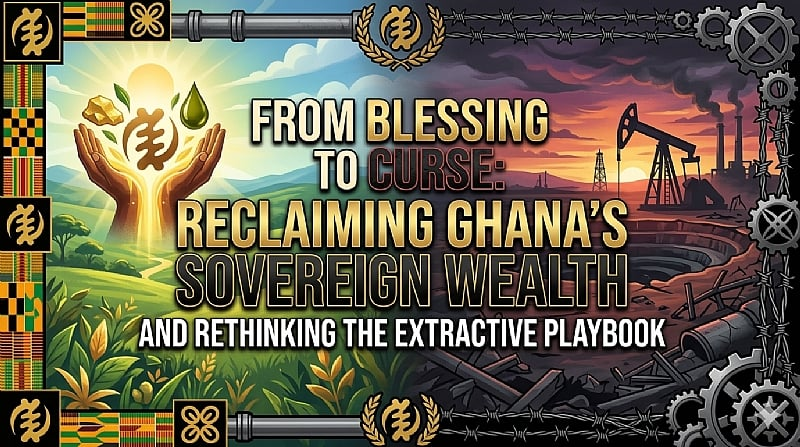
For centuries, Ghana has worn its title as the “Gold Coast” like an inherited crown. We stand mathematically blessed with an unparalleled abundance of geological treasure, yet a structural crisis resides within our economic architecture. We walk on gold, harvest lithium, and export crude oil, while our public ledger remains in a chokehold of foreign debt. This macroeconomic paradox is defined as the Resource Curse—a phenomenon where resource-rich nations experience developmental stagnation, inflationary vulnerability, and structural inequality.
The historical playbook of extractive capitalism has not changed since the legal battles of Sarah Rector in 1913. The core objective of the developed world remains absolute: to secure raw, unprocessed African commodities at minimal cost while outsourcing environmental decay to the host state. Compounding this external exploitation is a deeper internal tragedy: the systematic mismanagement of local corporations by self-seeking, greedy administrative leadership. If Ghana is to escape this cycle, our citizenries—particularly our youth—must confront these brutal figures, dissect the mechanisms of legislative exploitation, hold indigenous entities accountable, and aggressively champion a new era of value-addition resource nationalism.
The Legislative Trap: From PNDC Law 153 to Modern Reforms
The historical context of Ghana’s economic vulnerability is fundamentally rooted in its legislative evolution. A critical evaluation of past framework shifts reveals how our legal systems were shaped to prioritize foreign capital over sovereign accumulation:
- The PNDC Law 153 Trajectory (1986): Enacted during the structural adjustment era under the Provisional National Defence Council, the Minerals and Mining Law, 1986 (PNDCL 153) was widely praised by Western financial institutions as a groundbreaking framework. However, its core objective was to aggressively incentivize foreign direct investment at the expense of national retention. It granted massive tax holidays, allowed foreign mining entities to retain up to 80% of their foreign exchange earnings in offshore accounts, and slashed state royalty rates to a flat, minimal floor. This legally institutionalized the massive capital flight that kept Ghana as a passive tax collector rather than an active equity partner.
- The Act 703 Consolidation (2006): To address these historical gaps, the state enacted the Minerals and Mining Act, 2006 (Act 703). While Act 703 attempted to correct revenue retention deficiencies by adjusting royalty parameters and introducing stiffer regulatory overviews, it left the fundamental concessionary structure intact, failing to mandate localized processing plants.
- The Modern Local Content Revolution: Recognizing decades of structural loss, Ghana has recently instituted sharp corrections. The government introduced strict local content rules demanding that surface mining operations be conducted exclusively by wholly Ghanaian-owned firms, while underground operations must secure at least 50% domestic ownership. Furthermore, a proposed mining law was tabled before Cabinet to decentralized licensing powers, stripping central institutions like the Minerals Commission of absolute command and putting regulatory check-points into local district committees.
The Cold Facts: Ghana’s Extractive Ledger
The Gold Sector
- Production Volume: Driven heavily by small-scale domestic operations, Ghana’s total gold production surged by 23.41%, climbing to 5.94 million ounces.
- The Domestic Shift: For the first time in modern history, small-scale mining outpaced multinational firms, accounting for 52.4% of national output, signaling that the direct retention of extraction is increasingly returning to local hands.
- Export Earnings: Supported by global safe-haven price hikes, Ghana’s gold export revenues eclipsed an unprecedented US$20 billion, more than doubling previous cyclicalbaselines.
The Petroleum Sector
- The Revenue Crash: Conversely, Ghana’s petroleum revenue suffered a massive downturn, plummeting to US$769 million—a stark 43% drop caused by lower international prices and maturing oil fields.
- Production Decline: Crude oil extraction fell for its sixth consecutive year, halving from its historic peak as older wells face depletion.
- The Asymmetry: Despite being an oil-producing state, Ghana remains structurally vulnerable because our export profits are immediately erased by the exorbitant costs of importing foreign-refined petroleum products.
The Tragedy of Indigenous Management: The GOIL Case Study
Resource nationalism means nothing if state-backed entities are run down by internal mismanagement, cronyism, and corporate greed. The performance of the Ghana Oil Company (GOIL) serves as an intensive care unit (ICU) case study of this institutional decay:
┌─────────────────────────────────────────────────────────────┐ │ THE GOIL STRUCTURAL DISENFRANCHISEMENT │ ├─────────────────────────────────────────────────────────────┤ │ • STRANGLED BY DEBT: $110M ring-fenced liability to BP │ │ • CAPITAL DRIFT : Reliance on expensive short-term loans │ │ • LOSS OF LEADERSHP: Overtaken by Star Oil as market leader │ │ • ADMINISTRATIVE FAULT: Corporate/state defaults uncollected│ └─────────────────────────────────────────────────────────────┘
- The Star Oil Takeover: Once the undisputed market leader of Ghana’s downstream petroleum sector, GOIL was spectacularly overtaken by Star Oil. This loss of dominance was directly driven by aggressive pricing failures, rigid structures, and a slow response to market shifts.
- The Sourcing Bottleneck and BP Debt: Under heavily criticized administrative strategies, GOIL accumulated a massive, ring-fenced US$110 million debt to British Petroleum (BP). This liability effectively blocked the company from sourcing products from cheaper alternatives, causing widespread product shortages at pumps and heavily straining its banking relationships.
- The Working Capital Crisis: Due to uncollected debts from state institutions and defunct corporate entities, management left GOIL’s balance sheet vulnerable, forcing the company to rely on expensive, high-interest short-term loans to maintain daily operations.
- The PR Smokescreen vs. Reality: While current public statements celebrate a modest 7.05% increase in net profit to GH₵90.67 million and a GH₵1 billion bond issuance program, the reality remains that its massive short-term liabilities and corporate inefficiencies have kept our primary state-owned oil marketer operating in survival mode rather than expanding globally.
Cinema as a Mirror: Visualizing the Extractive Core
To look past corporate public relations, the African youth must analyze structural exploitation through the lens of independent cinema:
- Blood Diamond (2006): Exposes how international commodity markets demand luxury goods at the direct cost of local stabilization, weaponizing natural resources to turn regional wealth into community destruction.
- GLOBAL GRAB: Mozambique’s Coal and Jindal’s Extractive Curse (BBC Africa Eye): A documentary showing how foreign conglomerates extract mineral wealth from African soil while externalizing pollution, displacement, and economic disenfranchisement onto native communities.
- The Legend of Tarzan (2016): Captures the historical reality of King Leopold II’s rubber and mineral looting of the Congo Basin, showing how Western powers use forced labor to industrialize their home economies.
- Sarah’s Oil (2025): Serves as a historical lesson showing how institutional legal systems are weaponized to wrest financial autonomy away from Black landowners the exact second their property exhibits commodity value.
Action Plan: A Manifesto for the Ghanaian Youth
The historical cycle will not break through passive grievances; it requires structural intervention led by the next generation of Ghanaian minds:
- Seize Academic Command of STEM and Geosciences: We must stop outsourcing technical execution. The youth must flood the fields of metallurgical engineering, chemical refining, and resource law. True resource nationalism cannot exist if foreign expatriates retain an absolute monopoly on the intellectual data of extraction.
- Incentivize Local Value-Addition Value Chains: We must refuse to participate in an economy that exports raw, unrefined gold and unprocessed oil. Establish local jewelry houses, domestic chemical refineries, and component manufacturing operations to capture the secondary and tertiary financial margins of our commodities.
- Enforce Radical Transparency and Corporate Accountability: Use your digital leverage to scrutinize state mining leases and demand audits of public enterprises. The youth must aggressively call out self-seeking boards at state entities like GOIL, demanding performance-based tenure and transparent debt management.
- Wage an Uncompromising War Against Galamsey: Do not mistake illegal mining (galamsey) for economic liberation. Destroying Ghana’s water bodies and poisoning agricultural topsoil with mercury is an act of environmental self-sabotage that destroys our sovereign longevity.
The narrative that Africa is a mere resource warehouse for foreign powers must be dismantled. Our mineral assets are not historical curses; they represent the exact sovereign capital required to fund an industrialized, self-sufficient Republic. However, history teaches us that the greatest threat to resource nationalism is not always the foreign exploiter outside, but the greedy, self-seeking custodian within our own borders. When state institutions like GOIL are mismanaged into the corporate ICU while legislative relics like PNDCL 153 are left unchecked, we commit economic suicide. The resolution of this economic struggle will not be handed down by international financial institutions or comfortable boardroom executives. It requires the collective intellectual power, technical brilliance, and unyielding political will of the Ghanaian youth to declare that our wealth belongs to our people—now and forever.
✍️By A Concerned Retired Senior Citizen
For and on behalf of all Senior Citizens of the Republic of Ghana 🇬🇭
Teshie-Nungua
[email protected]
