


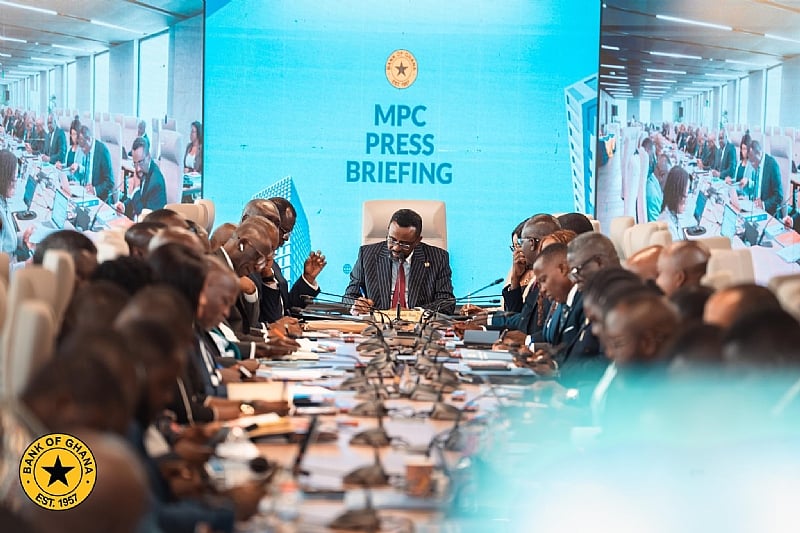
The Bank of Ghana (BoG) has explained why its Monetary Policy Committee (MPC) unanimously decided to maintain the Monetary Policy Rate (MPR) at 14% during its 130th meeting, although inflation remains below the target range of the Central Bank.
The six-member committee cited growing concerns over global economic uncertainty, rising crude oil prices and the potential return of inflationary pressures even as Ghana’s macroeconomic indicators continue to improve.
Per submissions by the MPC members, the key factor that influenced the decision was the escalating conflict in the Middle East, which has pushed global crude oil prices above $100 per barrel and increased risks to inflation worldwide.
Committee members warned that higher energy prices could quickly feed into domestic fuel prices, transport fares, utility costs and production expenses, potentially reversing Ghana’s recent gains in price stability.
Although headline inflation stood at 3.4% in April 2026, slightly higher than the 3.2% recorded in March, MPC members noted that the increase was largely driven by energy-related factors.
Policy decision submissions by MPC members
MEMBER 1 Recent macroeconomic developments broadly point to continued improvement in domestic conditions, underpinned by strengthening economic activity, improved external buffers, and sustained disinflation, albeit with a mild uptick in April 2026 following recent global shocks. Nonetheless, emerging global risks, particularly uncertainty regarding the ongoing geopolitical tensions in the Middle East, warrant a cautious policy stance to preserve the gains achieved.
Global economic conditions remain highly uncertain, driven by persistent geopolitical tensions. These developments are already pushing global inflation higher due to energy prices while simultaneously weighing on global growth prospects. Importantly, there remains considerable uncertainty regarding the duration, scale, and broader implications of these tensions. This poses significant risks to emerging market economies, including imported inflation and tightening global financial conditions, with the potential for sudden reversals in capital flows.
Domestic macroeconomic conditions continued to improve. Inflation declined consistently through the first quarter of 2026, with a marginal uptick to 3.4 per cent in April, reflecting early pass-through effects from rising global crude oil prices. Nonetheless, the disinflation trend remains intact, as core inflation continues to trend downward and inflation expectations appear broadly anchored.
Economic activity remains strong, supported by robust growth in key sectors, although business and consumer confidence indicators softened somewhat. The external sector has strengthened significantly, with elevated Gross International Reserves (GIR) providing strong buffers and supporting relative exchange rate stability. Monetary conditions have eased, supporting credit growth, and the banking sector remains sound, well-capitalised, and liquid.
Risks to the outlook are broadly balanced but slightly tilted to the upside. Key risks include prolonged geopolitical tensions, higher crude oil prices, commodity price volatility, and global financial uncertainty. These risks could reverse some gains in disinflation and undermine the recovery process. However, strong external buffers, improving fiscal conditions, a slightly narrowed output gap, and anchored expectations provide mitigating support.
Given the current balance of risks, I consider the existing monetary policy stance appropriate. While inflation has declined significantly, recent developments and external uncertainties warrant caution. I, therefore, vote to maintain the MPR at 14.0 per cent to consolidate disinflation, support sustained economic recovery, and allow for a clearer path to emerge from the geopolitical tensions in the Middle East.
MEMBER 2 Global economic conditions have become more uncertain since the last MPC meeting. Escalating geopolitical tensions—particularly the stalemate in negotiations relating to the US-Iran conflict—has dampened the global growth outlook, disrupted global trade routes, including the Strait of Hormuz, and exerted renewed upward pressure on crude oil prices. Crude oil prices remain elevated above US$100 per barrel, increasing the risk of inflation. In response, the pace of monetary policy easing globally has slowed, with most central banks recalibrating inflation projections and adopting a more cautious stance. These developments have heightened the risk of tighter global financing conditions, with potential adverse spillovers to emerging and developing economies, including Ghana.
On the domestic front, economic activity continues to recover, supported by improved macroeconomic conditions and easing financial conditions. In the first quarter, the Bank’s Composite Index of Economic Activity (CIEA) went up significantly by 12.6 per cent year-on-year (YOY), compared with 2.3 per cent growth a year earlier. Business and confidence sentiments, however, showed signs of moderation, reflecting uncertainty about the implications of the recent global developments.
The external sector position remained positive amid heightened global uncertainty. The trade surplus rose to US$4.5 billion in the first quarter of 2026 compared with US$3.3 billion in the same period last year, primarily driven by higher export earnings relative to import growth. The strong trade balance backed the continued improvement in the current account surplus to US$3.1 billion from US$2.4 billion a year earlier. As at mid-May, GIR increased to US$14.4 billion, equivalent to 5.7 months of import cover, from US$13.8 billion at end December 2025. The reserve accumulation programme provided strong buffers to the foreign exchange market.
Performance of the banking sector continued in the year underpinned by strong asset growth and was reflected in investments and net advances. The industry recorded sustained profitability on a YOY basis, and improved solvency, and asset quality, despite the elevated non-performing loan (NPL) ratio. Credit stance on loans to enterprises and households eased, alongside an uptick in credit demand by corporates and households in April. In real terms, private sector credit increased by 24.5 per cent, supported by disinflation, easing monetary policy stance, and declining lending rates. These trends point to improved financial intermediation, which should support growth going forward.
Monetary conditions remain mixed. While the policy rate is still high in real terms, excess liquidity in the banking system has dampened the monetary policy transmission, with interbank rates trading near the lower bound of the policy corridor. Therefore, higher liquidity injection could heighten medium-term inflation risks if not effectively sterilised.
Headline inflation went up marginally to 3.4 per cent in April from 3.2 per cent in March, driven by non-food inflation. Also, inflation expectations among households and businesses inched up slightly due to the potential increases in utility tariffs and expected fuel price adjustments. Core inflation, excluding energy and utilities, however, continued to ease, suggesting well-contained underlying inflationary pressures.
The latest forecasts showed that inflation will likely trend up into the medium-term target band. The main upside risks to the outlook include rising global energy prices, potential domestic supply side pressures, and supply chain disruptions linked to the geopolitical tensions. These could be moderated by the relatively tight monetary policy stance, continued fiscal discipline, and favourable exchange rate movements. Given these considerations, I submit that there is still a case for policy rate realignment over the medium term, especially with the increasing proximity of the interbank weighted average rate to the lower bound of the policy corridor. However, the current environment is characterised by heightened uncertainty and rising inflation risks which demand caution in the easing cycle.
My decision at this MPC is therefore underpinned by the following:
•Heightened external risks – ongoing geopolitical tensions and elevated oil prices present significant upside inflation risks; .Domestic cost pressures – pending utility tariff and fuel price adjustments could have immediate pass-through effects on inflation; .Anchoring inflation expectations – the early signs of rising expectations require a cautious stance to preserve policy credibility; .Trade disruptions – particularly concerning Ghana’s gold exports, notably to the UAE, could impact foreign exchange inflows and exchange rate stability; •Emerging foreign exchange demand pressures could feed into domestic price pressures; Weak policy transmission – excess liquidity implies that financial conditions are already accommodative, reducing the urgency for further easing; and •Weak policy transmission – excess liquidity implies that financial conditions are already accommodative, reducing the urgency for further ease.
Accordingly, I vote to keep the MPR at 14.0 per cent and note that this is a cautious pause in the easing cycle, aimed at safeguarding macroeconomic stability in an increasingly uncertain environment. Looking ahead, I will continue to monitor developments in global commodity markets, assess the persistence of domestic energy-related shocks, track inflation expectations closely as well as liquidity management operations to inform my policy decision at the next MPC meeting.
MEMBER 3 My vote is to hold the MPR at 14.0 percent. While the current inflation reading is below target, the forward-looking risk profile — particularly the trajectory of crude oil prices — argues decisively for caution. The task of monetary policy is not to respond to where inflation has been, but to where it is headed. My decision to hold the policy rate at this meeting round is founded in the details of the presentation, derived from the quarterly projection model, which clearly spells out the potential impact of the recent surge in crude oil prices, which could potentially remain above US$100 per barrel all through to the end of the third quarter of 2026.
Under this scenario, inflation jumps to above 10 percent by the end of the year, breaching the upper bound of the target band and approaching levels that would require some tightening. Reducing the policy rate at this meeting round, only to be forced into aggressive tightening within two or three quarters, would impose a far greater cost on the economy — in terms of both credibility and financial conditions — than the cost of simply maintaining the current rate. Prudence requires that the Committee remain cautious and delay the process of normalising the policy rate into the path of an oncoming inflation shock.
The upside risks underpinning this forecast are substantial. Petroleum price pass-through into domestic transport fares and utility costs is a near-certainty if oil prices remain elevated; Ghana’s administered pricing framework means the adjustment, when it comes, will be discrete and significant rather than gradual. The quarterly utility tariff review cycle adds further scheduled upside pressure. The Fuel Relief Measure remains under policy review and will eventually be lifted as the situation subsides, potentially adding some material inflationary impulse. Supply chain disruptions from the Middle East conflict continue to raise intermediate input costs, with a lagged pass-through into core inflation still working through the pipeline. These risks are not independent — they are correlated and could materialise simultaneously, compounding their inflationary effect.
Also, fertilizer prices are increasing abroad, and this could impact food prices in the near term. There are also downside offsetting effects to these risks. In my judgement, these are largely backward-looking and are diminishing. The disinflationary effect of the recent utility tariff decrease, and the lagged cedi appreciation have worked through the CPI basket positively and will fade over the coming quarters. They do not constitute a durable forward-looking counterweight to the structural upside pressures that are building. An honest assessment of the balance of risks does not yield equipoise; the distribution of outcomes is skewed to the upside, and the tail risk with inflation above 10 percent could pose challenges for monetary policy.
There is also a credibility dimension to my decision, which will have to be considered. Some hard-won progress has been made in restoring macroeconomic stability under the IMF ECF programme. The final disbursement of US$360 million is imminent, and the transition to the Post-Programme Policy Coordination Instrument framework will place Ghana’s policy conduct under heightened scrutiny. A rate cut that must subsequently be reversed in response to an oil-driven inflation surge would send precisely the wrong signal to markets, programme partners, and rating agencies — undermining the very confidence that has underpinned the cedi’s recent stability and the compression of sovereign risk premia.
Holding today preserves optionality; it commits the Committee to nothing except vigilance. While acknowledging that the current below-target inflation reading provides some policy easing, the forward-looking scenario analysis, based on the assumption of crude oil price above US$100 per barrel and the quarterly projection model forecast, show inflation rising above the medium-term target band in the near term. Under this scenario, especially with the uncertainty surrounding crude oil price movements, the appropriate policy posture at this moment is to hold, monitor, and preserve the capacity to act in either direction as more clarity to the risk profile emerges. I therefore vote to maintain the Policy Rate at 14.0 percent.
This vote should not be read as a signal that the current rate level is permanent or that I am indifferent to the growth consequences of prolonged restriction. Should the Middle East crisis abate in the near term — with credible, sustained de-escalation that reverses the upward pressure on crude oil prices — and inflation remain well-behaved, and on a trajectory consistent with a return to the target band, a reassessment of monetary conditions will be warranted. In those circumstances, I will stand ready to consider a calibrated easing of the Policy Rate.
MEMBER 4 The latest macroeconomic data showed that the Middle East war has dimmed the 2026 global growth outlook and will have uneven effects on countries. Though key macro variables in the domestic economy are broadly trending in the right direction, elevated risks of inflation from the external environment are gradually crystalising. My decision, therefore, reflects a cautious move, weighing the risks of inflation against the need to support economic growth.
Global growth projection by the IMF has been downgraded to 3.1 per cent in 2026 from 3.4 per cent in 2026, reflecting the heightened geopolitical tensions. The associated surge in energy prices has led to initial signs of a pickup in global headline inflation, which is expected to increase in the near term if the Iran war persists. Global financing conditions are tightening, but so far, remain broadly accommodative. Financing conditions may tighten further in the near term due to a possible surge in inflation. These developments may adversely impact the domestic economy through the trade and financial channels.
On the domestic front, the economy remains on a strong recovery path. The CIEA recorded a significant growth of 12.6 per cent YOY in March 2026, compared with 2.3 per cent a year earlier. The latest surveys conducted in April revealed that both consumer and business confidence softened, pointing to some potential downside risks for growth. Also, both consumers and business inflation expectations increased.
The external sector continued its strong performance in the first four months of 2026, with a trade surplus of US$5.3 billion, compared with US$4.2 billion surplus same time last year. GIR increased to US$14.4 billion on 18 May 2026, equivalent to 5.7 months of imports, from US$13.8 billion at end-December 2025. Despite the increased reserve buffers, the cedi, came under some demand pressures in the first four months of 2026 from the energy, commerce, and manufacturing sectors as well as seasonal dividend payments. Additionally, rising international crude oil prices almost doubled the foreign exchange demand for the same quantity of fuel products prior to the onset of the conflict.
Reserve Money and total liquidity increased on a month-on-month basis in April 2026, and private sector credit improved in both nominal and real terms. The interbank weighted average rate continued to trend close to the lower bound of the policy corridor, an indication of excess liquidity conditions in the market. The fiscal balance, on commitment basis, recorded a surplus of 0.1 per cent of GDP exceeding the target deficit of 1.2 per cent in the first quarter of 2026.The banking sector remained profitable, solvent, and liquid, and the industry capital gap further narrowed.
Headline inflation picked up marginally in April 2026, driven by non-food inflation, and is projected to move up within the target band in the near-term. All core inflation measures, however eased.My key takeaways during this MPC session include the following: •Headline inflation picked up marginally but eased on quarter-on-quarter basis; •Monetary conditions remain relatively tight; •Output gap is negative but closing indicating that economic activity remains below full potential; •The real policy rate is currently high at 10.6 per cent compared to peer central banks like Uganda, Kenya, and South Africa, with inflation readings close to Ghana’s. These peer countries have maintained a real policy rate of about 6 per cent; •The credit-to-GDP gap remains negative reflecting slower-than-expected credit growth; •The interbank market is reflecting excess liquidity conditions; and •The external sector remains strong with significant reserve buffers, despite some currency pressures.
A review of these external and domestic developments suggests some emerging risks to the inflation outlook. In the near term, inflation is projected to move within the target band, although current inflation at 3.4 per cent is below the lower limit of the target band. In view of the uncertainty created by the Middle East conflict and its potential impact on the Ghanaian economy, I vote to maintain the MPR at 14.0 per cent. In addition, I recommend a realignment of the current dynamic CRR regime to a uniform structure at 20 per cent, maintained in the domestic currency to address structural liquidity conditions.
MEMBER 5 On global developments, the ongoing war in the Middle East has necessitated a revision of global growth downwards, and there are initial signs of a pick-up in headline inflation due to rise in energy prices. In view of this, central banks have adopted a cautious policy stance as the war continues. Global financing conditions are tightening, and pressures are building in the foreign exchange market. Risks from the external environment are elevated and have implications for the domestic economy through the trade and financial channels.
On the trade side, the Iran war has pushed up energy prices and raised import costs, with implications for the balance of payments, stability of the cedi, and inflation outlook. The supply chain disruptions may impact goods transit, raise intermediate input, and other input costs, as well as slow the manufacturing sector. Also, exports may take a hit due to the projected slowdown of the global economy. On the financial side, higher borrowing costs, a stronger dollar, and lower equities may add to the recent pressures on the cedi.
On the domestic front, developments in the external sector showed robust performance with reserves adequate to cover 5.7 months of imports. The trade surplus for the first four months of 2026 increased to US$5.3 billion from US$4.2 billion in the same period of the prior year. The higher trade surplus was due to a 20.5 per cent growth in exports, primarily driven by gold, while imports increased by 16 per cent. The strong trade balance contributed to an improved current account surplus, which together with the financial account, recorded a net acquisition of assets position, placing the country in a net lending position.
Developments in the real sector showed a strong momentum in economic activity. However, consumer confidence softened driven by both the current situation and future expectations of consumers, while business confidence also moderated, due to concerns about company and industry prospects and realisation of short-term targets. Also, the Purchasing Managers Index (PMI) declined on the back of rising input costs.
Fiscal performance for the first quarter of 2026 was characterised by improved revenue growth, though it fell short of target, while expenditure remained within the budget target. On commitment basis, the primary balance recorded a surplus of 1.2 per cent of GDP, exceeding the fiscal anchor target of 0.2 per cent of GDP surplus. Monetary and financial developments reflected slower growth in reserve money relative to a year ago, due to active sterilisation.
Since the last MPC, reserve money growth, however, picked up through inflows from Net Foreign Assets. Growth in broad money supply moderated YOY reflecting the relatively tight monetary policy stance. Private sector credit improved in both nominal and real terms. The interbank weighted average rate trended close to the lower bound of the policy corridor signalling increased market liquidity. Performance of the banking sector improved with strong asset growth, increased profitability, and improved solvency levels. Though asset quality improved on a YOY basis, the NPL ratio remained elevated. The stock market performed strongly supported by improved macroeconomic indicators, increased investor appetite, and profitability of financial sector stocks.
On recent price developments, headline inflation picked up marginally in April, driven by non-food inflation. Core inflation measures eased, while inflation expectations went up marginally but remained anchored within the inflation target band. Headline inflation is projected to trend upwards from below into the medium-term target band in the near term. Upside risks to the inflation outlook include the quarterly adjustment in utility tariffs, petroleum price volatility due to escalation in Middle East tensions, and supply chain constraints. On the downside, the risks include the recent decrease in utility tariffs, strong reserve buffers, and the lagged impact of a stronger currency.
The growth momentum is expected to strengthen further in the near term. The upside risks include pickup in the high frequency indicators of real sector activity, improved fiscal discipline, implementation of the Big Push programme underpinned by massive allocations for road and transport projects, improved investor sentiment, and primary fiscal surplus ensuring debt sustainability. The downside risks to the growth outlook include decline in Ghana’s PMI, high cost of raw materials and utilities for businesses, adjustment in utility tariffs, commodity price volatility, spillover from global tariff wars, and rising global energy prices.
On the balance, the risks to the outlook are slightly tilted to the upside of inflation. This requires caution in the policy setting process, as I observe developments emerging from the global economy, as well as the recent pressures on the foreign exchange market. Therefore, at this MPC round, I vote to keep the MPR at 14.0 per cent since maintaining the relatively tight monetary stance at this point would be necessary to anchor inflation expectations going forward.
MEMBER 6 This meeting is taking place at a time when Ghana is exiting the 17th IMF reform programme, with significantly improved macroeconomic indicators, amid heightened global economic uncertainty, following the start of the US-Israel-Iran war, which has now escalated into a broader Middle East conflict. This has led to a surge in energy prices as world oil prices hover above US$100 per barrel. In addition, global supply chains have been partly disrupted by the Strait of Hormuz blockages.
Against the backdrop, the IMF has revised its growth projections for 2026 from 3.4 per cent to 3.1 per cent, indicating that the war has dimmed prospects for growth and in the severe scenario of oil prices doubling in the second quarter, global growth is projected to decline further to 2.0 per cent. Despite the heterogeneous effects of the war across regions and countries, it has impacted headline inflation globally. Consequently, most central banks in advanced economies and emerging market and developing economies have paused their easing cycles and are likely to raise rates in response to elevated inflationary pressures arising from the energy price surge. In view of this, global financing conditions are expected to tighten, which could trigger a slowdown in portfolio outflows to emerging market and developing economies and drive long-term bond yields and equity prices lower.
These developments have implications for the domestic economy through the trade and financial channels. On the trade front, expectations are that energy prices, which have surged above US$100, could increase import costs and exert pressure on the balance of payments position, with implications for the stability of the cedi and inflation in the near term. The projected global slowdown could reduce demand for exports, while supply chain disruptions could affect goods and intermediate input costs and slow domestic manufacturing output. The tightening of global financing conditions could put pressure on the cedi. If the conflict persists, monetary policy will need to tighten in response to inflationary pressures.
These developments, which indicate elevated policy uncertainty, have led to a dip in consumer and business confidence. In my estimation, this calls for caution, and thus, I will lean towards a policy decision that places a greater weight on the upside risks to the inflation outlook.
On the domestic economy, there has been a semblance of stability, though, for the first time in 15 months, headline inflation picked up marginally. Economic activity has strengthened, while monetary conditions, though easing, remained tight in the first quarter driven by a tight real interest rate and real exchange rate. Fiscal operations have shifted to a more growth-stimulating stance but remains consolidatory. The output gap has continued to narrow, although activity remains below potential. On the foreign exchange market, the cedi came under pressure due to increased demand pressures particularly from the energy sector and dividend payments to foreign investors.
The Bank’s high-frequency real sector indicators showed increased momentum in economic activity. The Composite Index of Economic Activity expanded by about 13 per cent, driven by credit to the private sector, port activity, and imports. But the surveys indicated a relative weakening of consumer and business confidence. While consumer confidence weakened because of households’ concerns about the current situation and future expectations, business confidence weakened due to the impact of rising input price pressures on company and industry prospects. The survey data also confirmed an uptick in consumer and business inflation expectations, which requires a policy response to ensure that inflation expectations do not become dislodged.
The external sector remained resilient, driven by a substantial trade surplus in the first quarter of 2026, exceeding that of the first quarter of 2025 by approximately US$652 million. This was on the back by higher export earnings, mainly from gold and cocoa, relative to import growth. Reserve accumulation continued as the GIR increased to US$14.4 billion, equivalent to 5.7 months of import cover by mid-May 2026, from US$13.8 billion at end-December 2025. Although global oil prices have surged above US$100 and the disturbance in the Middle East affecting Ghana’s export of gold, the outlook for the external sector remains broadly positive.
Fiscal developments in the first quarter indicated a consolidatory stance. Revenue underperformed, prompting expenditure compression measures that more than offset the revenue shortfall and led to under execution across expenditure categories. In response to the April 2026 revenue increase, the fiscal authorities allowed higher capital expenditure allocations, indicating a more growth-stimulating stance amid fiscal consolidation.
Regarding monetary and financial developments, the deceleration in annual reserve money growth reflects active liquidity sterilisation operations. Growth in broad money supply also moderated on a YOY basis, consistent with a relatively tight monetary policy stance. The level of broad money has also reverted to its estimated long-run trend, with implications for inflation and the exchange rate over the medium term.
Developments in the interbank market have been subdued, with the interbank weighted average rate hovering near the lower bound of the policy rate corridor, indicative of ample liquidity and potentially affecting the strength of monetary policy transmission.
The banking sector remains profitable, well-capitalised, and solvent. Broadly, all the financial soundness indicators improved YOY, with NPL ratio down to 18 per cent in April 2026 from 23.6 per cent in April 2025. As the macroeconomic environment continued to improve—characterised by lower interest rates and increased private sector credit, supported by strengthened credit assessment frameworks at banks—I expect to see further improvements in banks’ asset quality, financial intermediation, and overall financial depth. In the macro-financial stability assessment, it is refreshing to note that risks from both global and domestic environments to the banking sector have broadly moderated YOY, consistent with improved macroeconomic fundamentals and policy credibility.
The latest inflation assessment and outlook indicate a baseline projection under which the policy rate is maintained at its current level, reflecting the balance of risks surrounding the forecast. Key macroeconomic variables are gradually converging toward their estimated steady-state levels, while the policy rate remains below this underlying “gravitational” path. Considering the available policy space, recalibrating the policy stance at this MPC meeting to better align with its steady-state level is the ideal policy option. However, I attach significant weight to the elevated geopolitical risks associated with the conflict in the Middle East. In my view, the heightened uncertainty, together with upside risks to global inflation stemming from higher oil prices and renewed supply chain disruptions, warrants a more cautious approach to policy easing at this juncture.
I will therefore vote to keep the MPR at 14.0 per cent. This, I believe, will prevent the de-anchoring of inflation expectations, while I also support a unification of the CRR at 20 per cent to be kept in a single currency, the cedi.
The next Monetary Policy Decision will be published after the MPC meetings in July 2026.
—CitiNewsRoom
