


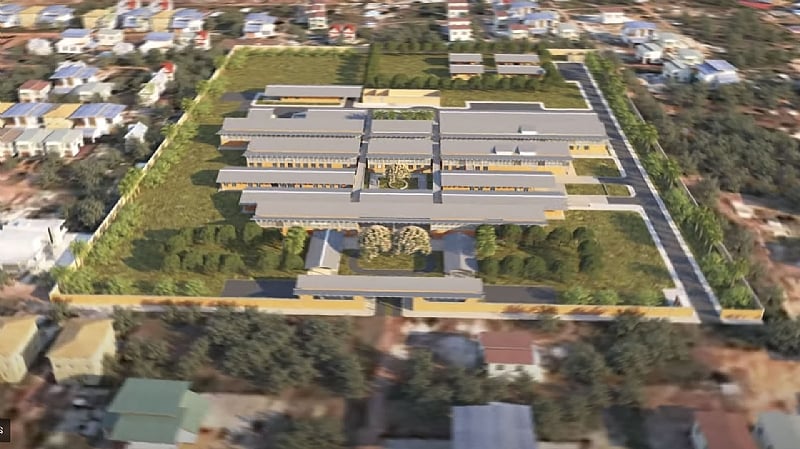
The $1.4 billion health infrastructure project is Ghana’s most ambitious hospital expansion drive. Four years after its launch, the focus has shifted from groundbreaking ceremonies to funding, political consensus, and the challenge of completing and operationalising the facilities.
The Vision Behind Agenda 111
Agenda 111 was launched in August 2021 by former President Nana Addo Dankwa Akufo-Addo as a nationwide healthcare infrastructure programme aimed at addressing gaps exposed by the COVID-19 pandemic.
The initiative proposed the construction of 111 hospitals across Ghana, including 101 district hospitals, six regional hospitals in the newly created regions, two psychiatric hospitals, and upgrades to the Effia Nkwanta Regional Hospital and the Accra Psychiatric Hospital.
Each district hospital was designed as a standard 100-bed facility with accommodation for health workers and modern healthcare infrastructure. The estimated cost per hospital was about $17.5 million.
At the time of its launch, Agenda 111 was presented as a transformational project intended to improve access to healthcare, particularly in underserved districts without hospitals.
Progress and Current Status
Nearly five years later, the programme has recorded mixed results.
By the time the Akufo-Addo administration left office in January 2025, none of the 111 hospitals was fully operational. Three facilities — Trede, Kokoben, and Ahanta in the Ashanti and Western Regions — were commissioned, but reports indicated they lacked critical equipment such as medical gas systems, imaging services, laboratories, theatres, and staffing arrangements. They had also not been formally handed over to the Ghana Health Service for full operations.
The current Mahama administration says approximately 90 hospitals remain unfinished and estimates that about $1.7 billion is needed to complete the projects nationwide.
In the Ashanti Region, however, three of the five Agenda 111 hospitals have since been made operational after equipment was supplied and staff deployed.
Government has announced that, in 2026, priority will be given to completing 10 Agenda 111 hospitals, alongside 35 others considered close to completion. The 2026 national budget also includes allocations for six new regional hospitals.
Major Challenges Facing the Project
Funding remains the biggest obstacle.
The original financing model, which relied partly on petroleum revenues through the Annual Budget Funding Amount (ABFA), has proven inadequate. The Ministry of Health now estimates that more than $1.5 billion is still required to finish the remaining projects.
Critics argue that the pace of funding is too slow. With only GH¢100 million reportedly allocated in 2026 toward completing 10 hospitals, some observers say the current rate of financing could significantly delay completion.
Implementation challenges have also emerged.
President John Dramani Mahama has criticised the decision to begin all 111 hospitals simultaneously, describing it as financially unsustainable. Audits and investigations have reportedly uncovered cases where contractors received mobilisation funds but failed to commence work, prompting investigations by the Economic and Organised Crime Office (EOCO).
Other setbacks include delays in land acquisition, logistical difficulties in remote areas, rising construction costs, and the absence of operational systems such as electronic health records and renewable energy integration.
Experts also point out that completing hospital buildings alone is not enough. Functional hospitals require trained personnel, medical equipment, reliable utility systems, maintenance plans, and sustainable financing for operations.
Political Debate Around Agenda 111
Agenda 111 has become one of Ghana’s most politically debated infrastructure projects.
The National Democratic Congress (NDC) government maintains that the project was poorly phased and underfunded under the previous administration. Health Minister Kwabena Mintah Akandoh has stated that promises to complete all 111 hospitals within four years were unrealistic, insisting that government must adopt a more practical and phased approach.
The New Patriotic Party (NPP), however, argues that the project was always intended to be completed in phases using oil revenues and insists that many of the hospitals were between 80 and 90 percent complete by January 2025.
NPP officials have accused the current administration of delaying operationalisation, while some NDC regional officials insist that several commissioned facilities were not ready for use when handed over.
The Way Forward
The Mahama administration says its new strategy is based on prioritisation, partnerships, and accountability.
Government plans to focus first on hospitals that are nearest to completion in order to deliver immediate healthcare benefits to communities.
At the same time, the Ministry of Health is exploring Public-Private Partnerships (PPPs) as a major financing option. Faith-based organisations such as the Christian Health Association of Ghana (CHAG) and private investors are being encouraged to participate in completing, equipping, and managing some facilities.
A new Private Health Sector Development Policy is also being developed to regulate such partnerships.
Meanwhile, EOCO investigations into defaulting contractors are expected to continue as government attempts to recover lost funds and improve accountability.
Health infrastructure experts are also recommending the integration of renewable energy systems, climate-resilient designs, and digital healthcare technologies to improve long-term sustainability.
However, critics warn that an overreliance on PPPs could shift attention toward urban centres where private investment is more profitable, potentially undermining the project’s original goal of expanding healthcare access in rural communities.
From Ambition to Pragmatism
Agenda 111 remains one of the most ambitious healthcare infrastructure projects in Ghana’s history.
While the vision of expanding healthcare access nationwide remains widely supported, financial pressures and implementation challenges have forced a shift from rapid expansion to a more pragmatic, phased approach.
For many communities still waiting for district hospitals, the political arguments matter less than the final outcome: hospitals that are completed, properly equipped, adequately staffed, and fully operational.
The success of Agenda 111 will ultimately depend not only on how many buildings are constructed, but on whether those facilities can consistently deliver quality healthcare services to Ghanaians across the country.
