


For more than a decade, Jeffrey Sarpong assumed that his education in Vermont would lead him to a career in health care. The 32-year-old native of Ghana was a teenager when his family moved to Montpelier in 2012; by the time the pandemic hit in 2020, he was on track to earn a nursing degree.
But in 2023, Sarpong gave up what could have been a respected and lucrative profession back in his home country to pursue a career in the cannabis business, an emerging Ghanaian industry. This fall, he will be the first Ghanaian to complete the cannabis studies certificate program at Vermont State University-Castleton. A second Ghanaian student has already followed him, and more are expected to enroll.
As advocates and businesspeople in the West African nation prepare to take advantage of the recent legalization of hemp growing, they have turned to Vermont to learn. The Green Mountain State, several said during a visit this month, is their model for regulating and growing a sustainable industry.
“Vermont is a small jurisdiction and is more community-centered,” said Mark Darko, president of Ghana’s Chamber of Cannabis Industry, a business advocacy group. “Vermont has a rich agricultural heritage, just like Ghana. So, we see a lot of similarities.”
Ghana’s parliament legalized the cultivation of hemp, derived from the cannabis sativa plant, in 2023 for a number of uses: making food; harvesting fiber for clothing, paper and construction materials; and producing therapeutic products such as CBD oils and supplements. Cannabis with high levels of THC, the compound in the plant that can be used recreationally as an intoxicant, remains illegal.
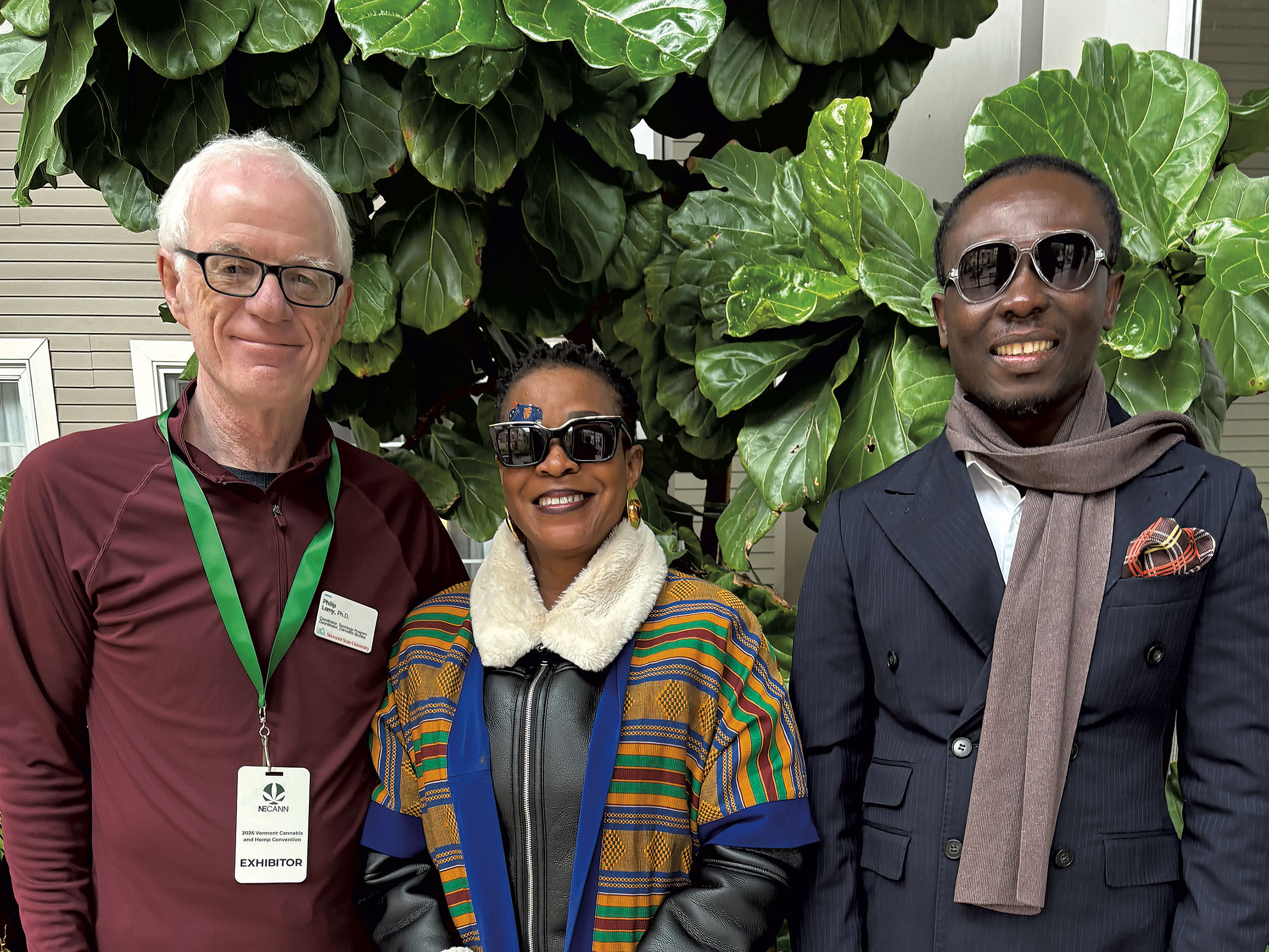
Darko and other representatives from Ghana’s Chamber of Cannabis Industry visited the state earlier this month to attend and speak at the New England Cannabis Convention in South Burlington. They toured dispensaries, farms and processing facilities and met with state lawmakers, the Cannabis Control Board, and representatives from the Vermont Agency of Commerce and Community Development.
Cannabis Control Board chair James Pepper “was very forthcoming about what worked and what didn’t and what they would do differently,” said Philip Lamy, who accompanied the Ghanaian delegation. He is cofounder of the cannabis studies program at VTSU.
On the surface, New England and West Africa couldn’t be more different. Whereas Vermont’s harsh winters require indoor cultivation for much of the year, Ghana’s equatorial climate allows cannabis to be grown outdoors year-round. And while tiny Vermont has a reputation for hippies, weed, secularism and progressive politics, Ghana, a country of 35.7 million people, is deeply religious and socially conservative.
Yet the Ghanaians were attracted to Vermont’s approach to sustainable cultivation, its regulatory framework for tracking products from seed to sale, and how the state gives priority to small producers over multistate operators.
Darko said he hopes that one specific provision of Vermont’s cannabis legalization law can become a model for future legislation in Ghana: the state’s social equity program, which makes it easier for previously disenfranchised groups, such as black-market growers and people of color, to get cannabis licenses and transition into the regulated market. Currently, Ghana’s legalization law largely prohibits former illegal growers with criminal records from obtaining licenses — though they are the most knowledgeable about growing the crop.
“They don’t have the voice. No one listens to them,” Darko said. His hope is to get Ghana’s laws amended to help his country’s legacy growers become legitimate businesspeople. But to do so, he said, many of them will need the business expertise that VTSU can provide.
That’s another reason Darko and his colleagues chose Vermont: Whenever he researched cannabis education programs around the world, VTSU kept popping up. So last year, the Chamber of Cannabis Industry signed a memorandum of understanding with the university to provide technical assistance on cultivation, processing and business best practices.
The agreement also provides for ongoing cultural exchanges between the two countries, according to Lamy. More Ghanaians are planning to come to Vermont to take the school’s cultivation class and do internships here. And several Vermonters, including Jonathan Kaplan, a botanist and plant pathologist who teaches VTSU’s cultivation class, will travel to Accra, Ghana’s capital, later this year to lead classes and workshops.
Among the many challenges facing Ghana’s emerging market is getting average citizens, especially small family farmers and business professionals, comfortable with the idea of growing, processing and investing in a crop with a long history of illegality. For decades, even a minor cannabis offense could result in a prison sentence of up to five years.
Nevertheless, Darko said, Ghana has a booming black market that produces some of the world’s most potent THC strains, much of which is sold illegally in Europe. To help change public attitudes, Darko has enlisted the help of some of his country’s biggest celebrities. They include Akofa Edjeani, a famous Ghanaian film actor, producer and entrepreneur who has won multiple Africa Movie Academy Awards. She accompanied Darko on his trip to Vermont. (Other Ghanaians who had hoped to join them were denied U.S. visas.)
We want responsible growth instead of rapid commercialization.
Mark Darko
“I wanted to lend my face and my voice to the cause,” Edjeani said. “Cannabis is the only plant that can feed you, can shelter you, can clothe you and can cure you.”
Edjeani sees the crop as a “game changer” for her country’s economy, potentially lifting millions of citizens, especially women and young people, out of poverty. Unemployment for Ghanaians under the age of 24 exceeds 30 percent.
Bismark Brown agreed. A Ghanaian journalist and media personality who has also joined the chamber’s public education campaign, he spoke by video call at the Vermont cannabis convention.
“For a country like Ghana, with huge youth unemployment on our hands and with more than 60 percent of our people in agriculture, this is one of the surest bets,” he said. “Cannabis is a plant that brings a lot of youth together.”
Brown has enrolled in VTSU’s cannabis studies program himself. He described it as “quite exciting and insightful. I’m getting to learn a lot about a plant I thought I knew.”
Because Ghana is the first country in West Africa to legalize any form of cannabis, representatives from neighboring countries have reached out to Darko for advice on legalizing their own markets and are watching Ghana closely to see how well it succeeds. Darko’s hope is to make Ghana a “cannabis center of excellence” in Africa, growing the industry slowly and sustainably, with the majority of profits flowing to average Ghanaians rather than wealthy foreigners.
Notably, Darko wants to avoid the mistakes that plague the production of cocoa beans, his country’s largest cash crop. Although Ghana is the world’s second-largest producer of the main ingredient in chocolate, most of the profits from the country’s $1.5 billion cocoa industry benefit international corporations and foreign investors, not its 800,000 small cocoa farmers.
When it comes to the cannabis business, Darko said, “We want responsible growth instead of rapid commercialization.”
Sarpong, the Ghanaian immigrant and cannabis student, said he hopes to be part of that growth. He connected with Darko when he contacted the Ghana Chamber of Cannabis Industry last year to learn how he could apply for a cultivation and processing license. Sarpong has inherited 200 acres in the Volta region of Ghana, land gifted to his great-grandfather by a Ghanaian chief. He plans to put them into cannabis production, in part to fulfill his great-grandfather’s dream of creating job opportunities for the community.
In preparation, and in addition to his formal cannabis studies, Sarpong moonlights in Vermont’s cannabis industry making infused pre-rolls, cigars and gummies for Pinnacle Valley Farms in Randolph. He also interns with botanist Kaplan and Vermont Compost to research the benefits of using potash made from dried cocoa husks as an organic fertilizer for cannabis cultivation. Thus far, the results have been very promising, he said. Utilizing the husks, which are a waste product of cocoa production, could provide additional revenue for cocoa farmers and also create jobs in Ghana.
Longer term, Sarpong said he wants to be part of Ghana’s effort to legalize recreational cannabis — already in common use, despite the country’s conservative culture. A 2014 United Nations report listed Ghana as the world’s largest per-capita consumer of cannabis, far outpacing such ganja-consuming heavyweights as the U.S., Canada and Jamaica.
Just last month, Sarpong noted, Ghanaians held their first-ever public 4/20 celebration, which would have been unthinkable even five years ago. Still, he knows it will take time to change public attitudes, as it did in Vermont.
He put it this way: “We have to go slow to go fast.” ➆
The original print version of this article was headlined “The Ghanaian Connection | A West African nation looks to Vermont as a model for its new legal cannabis market”
This article appears in May 27 • 2026.
