


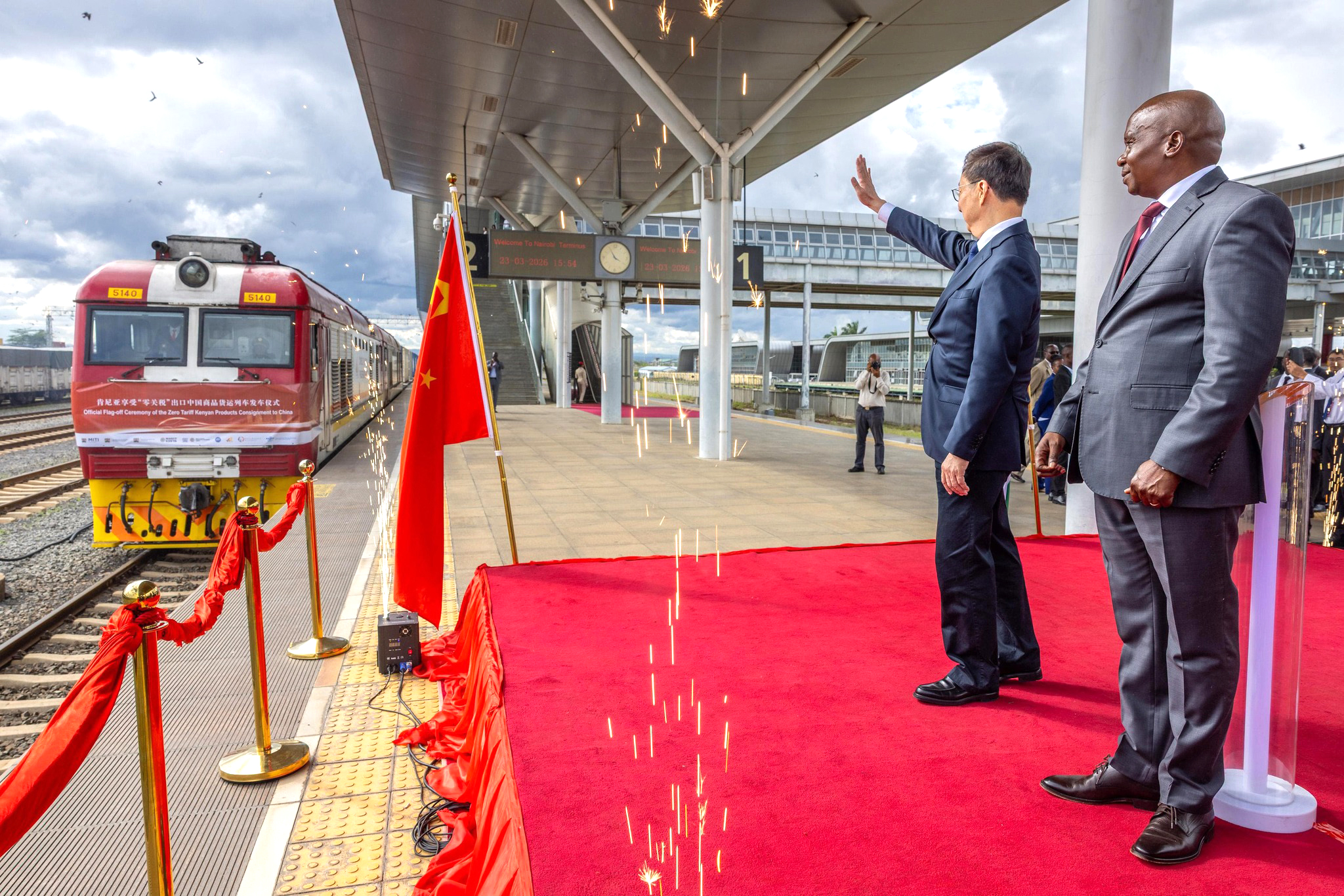
When Kenya and China jointly flagged off goods from Nairobi to China, it signalled more than just the movement of cargo. But it also marked what could be the beginning of a long-overdue shift of Kenya stepping into a market that, for years, remained largely out of reach.
For a long time, Kenya’s trade relationship with China has been defined by imbalance. Goods such as machinery, electronics and everyday products flow in, but far fewer make the journey the other way.
That imbalance is not small. Kenya’s exports to China in 2024 stood at $0.21 billion (Sh27.1 billion), while imports from China reached $4.32 billion (Sh558.1 billion), creating a trade deficit of around $4 billion (Sh516.8 billion). It is against this backdrop that the zero-tariff arrangement begins to make sense.
When the first consignment consisting of fruits, vegetables and minerals was flagged off at the Standard Gauge Railway Nairobi Terminus, it was framed as a turning point.
Deputy President Kithure Kindiki described it as symbolising “a new phase in Kenya-China cooperation,” one that focuses on expanding exports, supporting value addition and creating opportunities for farmers, manufacturers and entrepreneurs.
That framing matters. Because for long, access to this market has always been the missing piece. China, with her over 1.4 billion population, by any measure, is not a small market waiting to be explored. It is vast, complex and already central to global trade. And in recent years, it has been actively positioning itself as open for business not just as an exporter, but increasingly as an importer.
That intent was clear in Shanghai. At the eighth China International Import Expo (CIIE) in Shanghai last year, Chinese Prime Minister Li Qiang described the forum as a “mouthpiece of the world economy to the Chinese economy and an important bridge” connecting China to global markets.
The scale of that ambition is hard to ignore since more than 150 countries, including about 30 from Africa, participated in the expo, with over 4,000 exhibitors showcasing products in a market China itself describes as “huge” and growing.
For Kenya, the question is no longer whether the market exists. But whether Nairobi is ready to take advantage of it.
The zero-tariff policy significantly lowers the cost of exportation, which has long been one of the biggest barriers. The net impact is that it makes Kenyan goods more competitive in China. But it also opens a door that, until recently, was difficult to access.
But, as with every endeavour, access alone does not guarantee success. Exporting to China requires more than opportunity. Having spent the last quarter of 2025 in China understanding the vast East Asian country, I came to learn that the Chinese market demands consistency, quality and an understanding of the market. Chinese consumers are discerning. They expect value. They reward reliability.
Being the world’s most populous country and geographically the fourth largest nation with a vast landscape ranging from deserts and plateaus to mountains and coastlines along the Pacific Ocean, this opening provides Kenya with an opportunity to diversify its export markets.
And there could never be a better time to do so than now, when the US-Israel-Iran war has the entire Middle East region on edge. This shift toward China easily becomes Nairobi’s surest bet to reducing reliance on traditional markets, particularly in the Middle East.
If not for anything else, that uncertainty makes the China option not just attractive, but necessary. China itself is recalibrating its global trade posture. In 2024, China’s imports from Africa reached 626.74 billion yuan (about $87 billion), representing a 10.3 per cent year-on-year increase. That growth reflects a deliberate policy direction that now extends to Africa through expanded market access.
With China announcing a zero-tariff treatment for 53 African countries with diplomatic ties in February, the move signals a wider opening of its market to the continent.
For Kenya, this moment should not just be about selling more tea or coffee but about rethinking what the country can export.
Kenya’s coffee is “the best coffee in the world”, Kenya is Africa’s largest avocado producer and the second-largest exporter of macadamia, Deputy President Kithure Kindiki said while flagging off its first consignment of goods to China under a zero-tariff arrangement. But the opportunity lies in scaling these strengths, adding value and positioning them for a market that is both large and evolving.
There is also potential beyond agriculture. Manufacturing, agro-processing, digital trade and renewable energy are emerging areas where Kenya could deepen engagement with China.
But again, potential is not the same as progress. Without deliberate effort from government, industry and exporters, the zero-tariff window risks being underutilised.
A robust support system must follow the policy so that Kenyans can make the most of this opportunity.
Exporters need guidance on standards and certification. Producers need support to scale. Trade linkages must be strengthened. Awareness must be built. Otherwise, the structural challenges that have long limited Kenya’s export capacity will persist.
China’s Vice President Han Zheng described the relationship as one that continues to grow, with both countries working toward “a shared future for the new era.” Such statements often sound diplomatic. But in this case, they reflect a tangible shift from infrastructure-heavy engagement to trade-focused cooperation.
For Kenya, that shift is timely and could not have come at a better moment than now, when the country is seeking new economic pathways.
In my humble submission, the zero-tariff arrangement will not solve everything. But it offers something Kenya has long needed. It gives Kenya a real chance to participate more meaningfully in one of the world’s largest markets.
The flagging off of that first consignment was symbolic. What matters now is what follows.
