


Kenya’s tech sector grew in 2025 as mobile connections crossed 78 million and internet subscriptions hit 64.4 million. Mobile money subscribers jumped 21.4% to 51.4 million; Konza Technopolis welcomed 8 new investors, and its data center more than doubled available storage.
And yet, for the people working in and around that sector, the cost of getting through the month got harder in specific, measurable ways.
The same survey that tracks Kenya’s digital growth also tracks what a kilogram of sukuma wiki costs, how much a worker in the ICT sector earns in real terms, and what it costs to run a company on electricity. Those numbers tell a very different story.
The ICT Sector Is Growing, But More Slowly
The Information and Communication sector grew by 4.8% in 2025. That sounds fine until you see it was 7.1% in 2024. Output value for the ICT sector reached KES 728.2 billion, and value added grew from KES 374.9 billion to KES 404.7 billion.
The sector is bigger, but the pace of expansion has clearly decelerated.

.
Part of the reason is that the big, easy growth numbers such as mobile connections or voice call revenue are starting to plateau or decline. Total domestic telephone traffic fell 3.5% to 100.1 billion minutes. People are calling less.
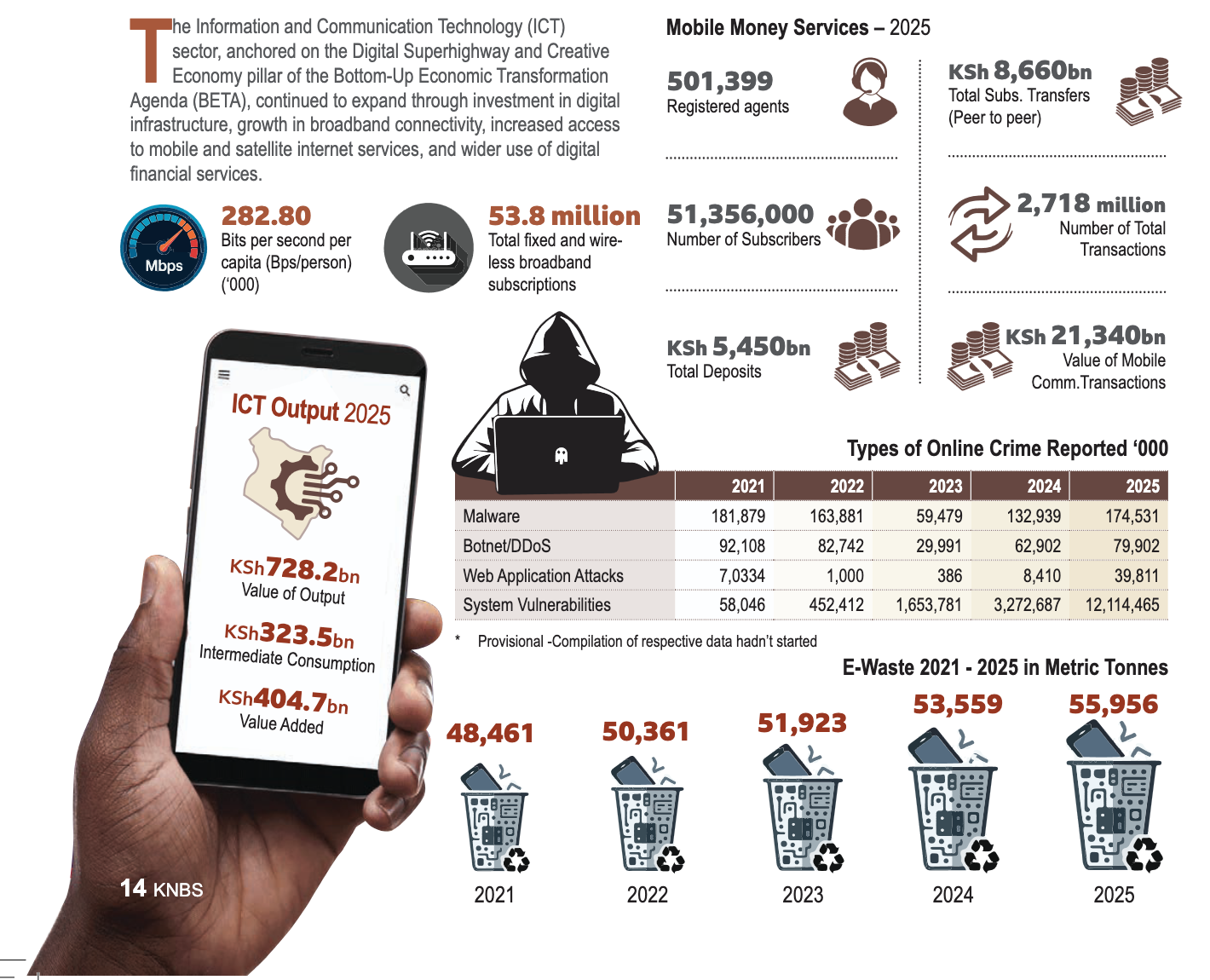
The value of mobile money transactions declined from KES 8,698 billion in 2024 to KES 8,236.5 billion in 2025, even as the number of transactions ticked up 1.3%.
These are signs of a maturing market where volume keeps growing but average transaction sizes and revenues are under pressure.
What Tech Workers Actually Take Home
The economic survey by the Kenya National Bureau of Statistics (KNBS) publishes average annual earnings by sector. In 2025, the average person in the ICT industry earned KES 1,438,060 in nominal terms, the highest outside of the energy and financial services sectors.
On paper, ICT workers are well paid relative to most of the economy.
However, what matters is real earnings, not nominal ones. Across the economy, real wage gains in 2025 were thin as overall real average earnings rose from KES 665,400 to KES 678,800, a 2.0% increase.
Public sector workers, which includes those at state-owned ICT entities and parastatals, saw real earnings decline by 2.2%. Nominal pay went up; inflation outpaced it.
READ: Government Creates Four New ICT Directorates in Major Reform
The minimum wage picture is relevant for the support staff, junior roles, and outsourced workers that underpin any large tech operation. Urban minimum wages in Nairobi were frozen, unchanged from 2024, averaging KES 25,300 per month.
Given that food inflation ran at 7.2% last year with staples like sukuma wiki up 20% and fish up 16%, those wage floors are getting further from adequate in real terms, even when they look stable on paper.
Internet Is Getting Cheaper, But Coverage Gaps Still Remain
One of the more direct cost-of-living figures relevant to anyone who works online or builds digital products is what the internet actually costs. Mobile on-net call rates fell 16.4% to KES 3.27 per minute, off-net rates dropped 11.3%, and SMS fell to KES 1.18 per message.
READ: Kenyans Are Using More Data Than Ever as 4G and 5G Take Hold
Broadband connections grew substantially. Total fixed and wireless broadband subscriptions rose 19.6% to 53.9 million. Satellite broadband, powered by LEO (Low Earth Orbit) services, grew from 19,284 to 19,646 subscriptions.
Terrestrial fixed wireless broadband surged 80.8% to 750,800 subscriptions. Fiber-to-the-home grew from 973,749 to 1,258,019 connections.
Mobile broadband data traffic jumped from 1.9 billion GB in 2024 to 2.6 billion GB in 2025. Fixed broadband traffic nearly doubled to 5.2 billion GB. In simple words, Kenyans are using significantly more data.
Yet, total utilized bandwidth barely moved, growing from 14.14 million Mbps to 14.38 million Mbps, a 1.7% increase. More users, more data consumed, similar bandwidth. Bits per second per capita effectively flatlined: 282.84 thousand in 2024 to 282.80 thousand in 2025.
For anyone running a business that depends on reliable fast connectivity, the growth in subscriptions is not automatically translating into a better experience.
Electricity: A Real Win for Tech Businesses
One area where the cost burden clearly eased in 2025 was electricity, which matters enormously for tech companies running servers, cooling systems, and data infrastructure.
The average cost of a 200 kWh block of electricity fell 7.6% from KES 6,156 to KES 5,686. A 50 kWh block dropped 3.6% to KES 1,282.
READ: How Kenya Ranks in Global Electricity Prices
This wasn’t a policy gift. International crude oil prices fell from an average of USD 79.86 per barrel in 2024 to USD 69.63 per barrel in 2025, feeding through to lower fuel and electricity costs.
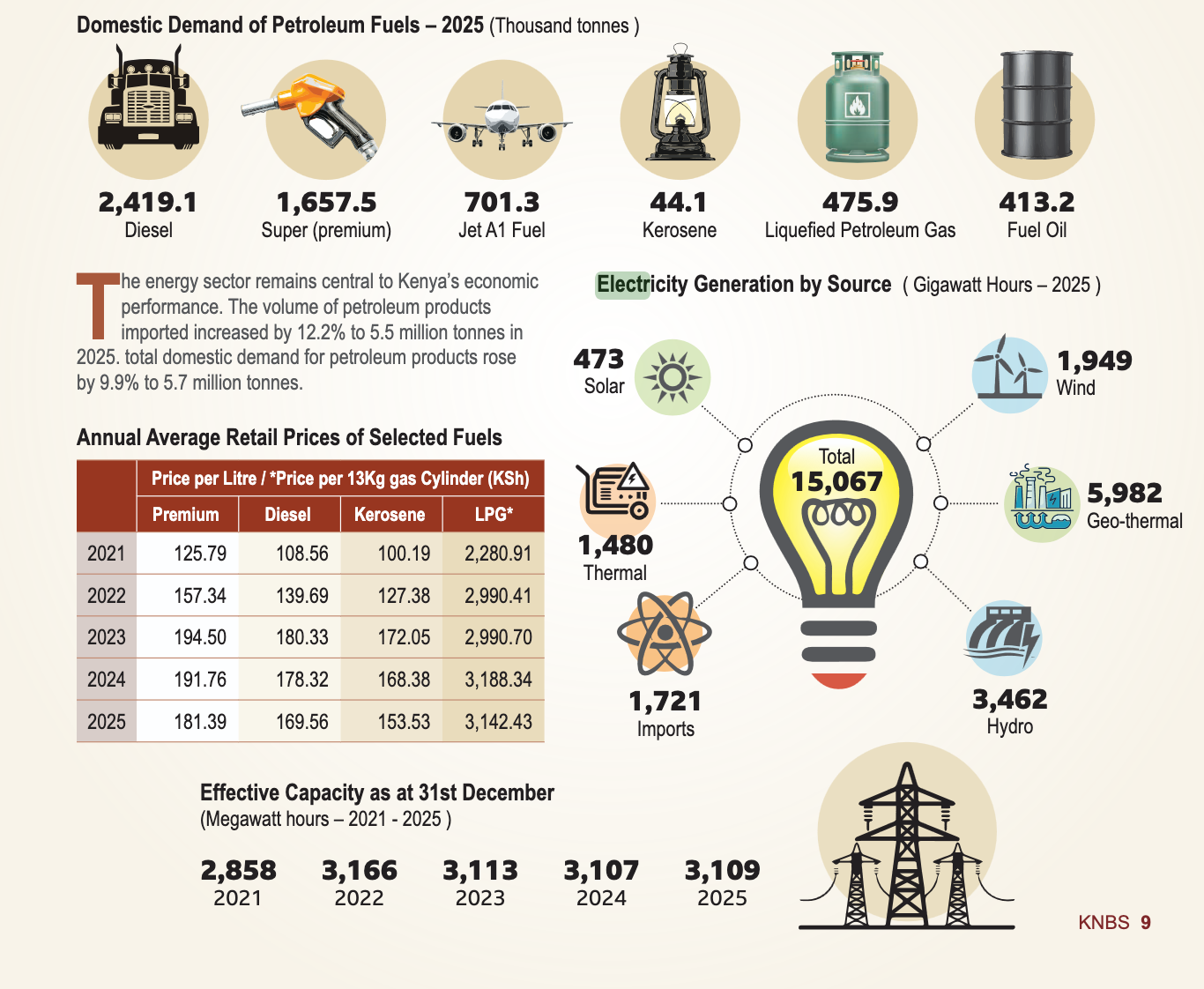
Kenya’s petroleum import bill shrank from KES 575.5 billion to KES 528.8 billion.
For data centers, server farms, and businesses running heavy compute loads, lower electricity costs reduce one of the biggest operational line items.
Konza Technopolis’s power utilization increased from 5 MW to 6 MW in 2025 following completion of a 66 kV substation, a capacity expansion that would be far more expensive to run if electricity prices had risen instead of fallen.
Konza Technopolis: Investment Up, Revenue Down
Konza continues to grow as a physical entity. Phase I horizontal infrastructure was completed and commissioned in 2025 with roads, power, water, and sewerage. Investors rose from 70 to 78. Total cumulative investment increased 19% to KES 99.4 billion.
Buildings completed on-site jumped from 9 to 17, with another 26 under construction. Startups based there increased from 20 to 51, and supported innovations grew from 22 to 55.
READ: Konza City Explores Bonds and PPP Option to Fund Phase 2
Some of the operational numbers run in the opposite direction. Total revenue generated by the Technopolis fell from KES 252.4 million in 2024 to KES 202.9 million in 2025. Cloud revenue fell 16.4% to KES 126.7 million due to outstanding bills from hosted institutions.
Parcels leased declined from 33 to 21. Direct jobs within Konza fell from 3,000 in 2024 to 1,137 in 2025, largely because the heavy construction phase wound down.
The Jitume Digital Programme, which trains youths and links them to online work, saw jobs linked drop from 8,062 to 6,200, despite the number of equipped digital hubs growing 35.2% to 261. More infrastructure, fewer jobs.
That gap is important for anyone thinking about whether Kenya’s digital economy is broadly improving livelihoods or concentrating gains.
Cybercrime: The Hidden Tax on Digital Business
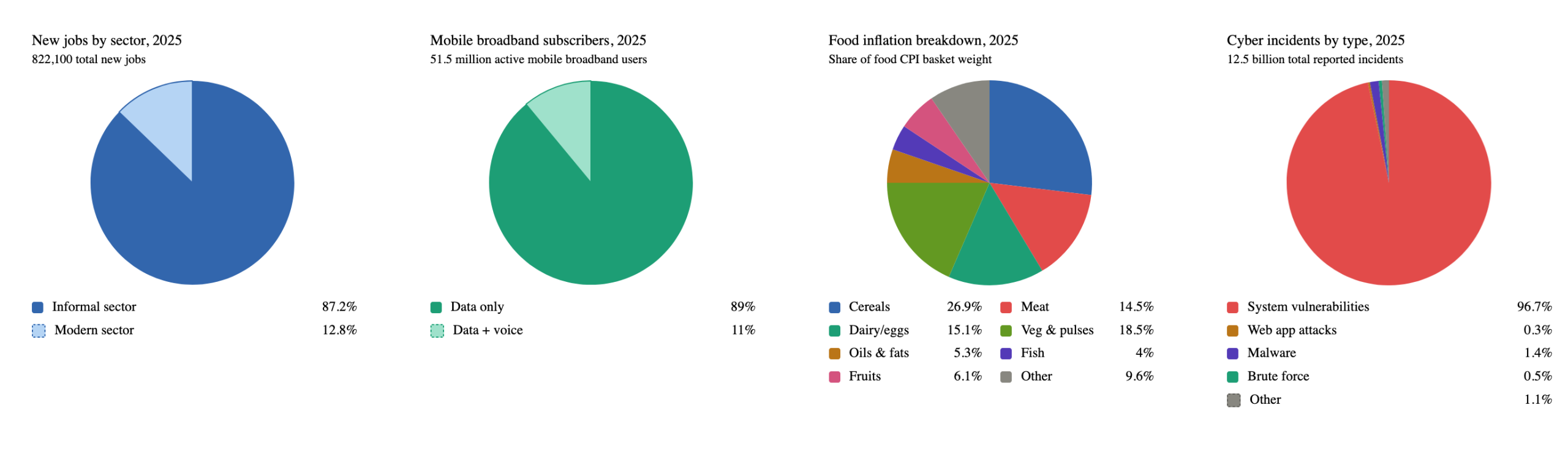
One number in the survey that deserves more attention is that reported online crime incidents almost quadrupled from 3.6 billion in 2024 to 12.5 billion in 2025.
READ: Cyber Attacks in Kenya Jump 441% in Just Three Months
The surge was driven primarily by system vulnerability exploits, which jumped from 3.3 billion to 12.1 billion cases, and web application attacks, which rose from 8,410 to 39,811.
DDoS-related advisories grew from 542,600 to 4.3 million. Brute force attacks increased from 4.1 million to 6.7 million.
This is not an abstract statistic. Cybersecurity incidents cost businesses money, be it in incident response, in lost data, in downtime, in insurance, and in engineering hours spent patching vulnerabilities.
For smaller tech companies operating on thin margins, a single serious breach can be existential. The explosion in reported attacks suggests that Kenya’s digital growth is happening faster than the security culture and infrastructure are maturing to protect it.
Any honest accounting of the cost of doing business digitally in Kenya in 2025 has to include this.
Kenya’s digital economy is real and growing, but the cost of living for the people who work in it and the cost of running businesses within it do not exist in a separate bubble from the rest of the economy.
Food costs more. The cheapest vegetables at the market saw 20% price increases. For tech workers earning well above the median, this is a budget irritant.
For the support staff, cleaners, transport workers, and junior employees that every company employs, it materially reduces what their salaries actually buy.
Housing is branching in ways that affect where employees can afford to live. Stand-alone houses are 32% more expensive than in 2022.
READ: Airbnb and Short-Term Rentals to Pay 2% Tourism Levy From June 2026
Apartments have gotten cheaper as the price index fell to 88.9 from a base of 100 in 2022, which is real relief for anyone renting or buying a flat in Nairobi.
The ICT sector’s slower growth in 2025 is not alarming on its own. Markets mature. However, when it’s combined with stagnant minimum wages, food inflation running nearly twice the headline rate, a cybercrime explosion, and bandwidth that is not keeping pace with usage growth, the picture is more complicated than the headline connection numbers suggest.
