

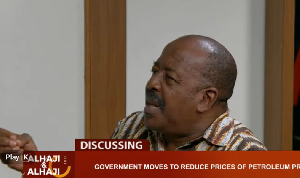
 Philip Longdon is a member of the Movement for Change Communications Team
A member of the Movement for Change Communications Team, Philip Longdon, has called on government to leverage ongoing tensions in the Middle East as an opportunity to strengthen Ghana’s economic resilience.
Speaking on Alhaji and Alhaji on Pan African TV on April 18, 2026, Longdon criticised what he described as a pattern of reactive policymaking by successive governments in response to global shocks.
His comments follow government’s recent decision to reduce fuel prices, cutting diesel by GH¢2 and petrol by 0.36 pesewas in a bid to cushion consumers.
Longdon welcomed the intervention, noting its potential impact on key sectors of the economy.
Iran War: I don’t fear the Trump administration – Pope Leo
“I think it’s a very welcome intervention. They have saved two cedis on a gallon of diesel, and that is instrumental because much of our industrial equipment and public transportation rely on diesel,” he said.
However, he expressed concern over the apparent lack of attention to aviation fuel, warning that rising costs in that sector could have broader implications.
He referenced developments in Nigeria, where aviation fuel prices have surged exponentially, affecting domestic air travel.
“I have not heard anything about aviation fuel,” he noted, adding that domestic airfares in Ghana have already seen increases.
While acknowledging stability in the price of liquefied petroleum gas (LPG), a major household fuel, Longdon stressed that government must move beyond short-term relief measures and adopt more innovative, long-term strategies.
LNG tankers make U-turn as Iran shuts Strait of Hormuz to traffic
“When crisis comes, it gives us the opportunity to think outside the box with urgency. We shouldn’t just use global geopolitics as an excuse,” he stated.
He cautioned that while tax reductions on fuel may provide temporary relief, they could also impact government revenue in the long term, making it even more critical to implement sustainable economic policies.
Longdon further expressed disappointment over what he described as a lack of significant investment in agriculture, particularly in large-scale poultry production.
He cited the government’s “Nkoko Nkete Nkete” initiative as insufficient for transforming the sector.
According to him, a more comprehensive approach is needed, one that includes large-scale poultry farms across districts, improved feed production, and modern processing facilities.
“If the government ensures that every district has a poultry farm with at least 10,000 to 20,000 birds, then we are in business. You create jobs, improve nutrition, and stimulate the entire value chain from production to processing,” he said.
He emphasised that industrialising agriculture, especially poultry farming, could play a key role in enhancing food security, boosting employment, and strengthening Ghana’s economic resilience in the face of global uncertainties.
Longdon insisted that such an approach is necessary for structural reforms aimed at reducing Ghana’s vulnerability to external shocks while promoting sustainable, homegrown economic growth.
Watch video below
VPO
The 4 reasons Justice Dorgu is under fire over judgement in RNAQ divorce case:

