

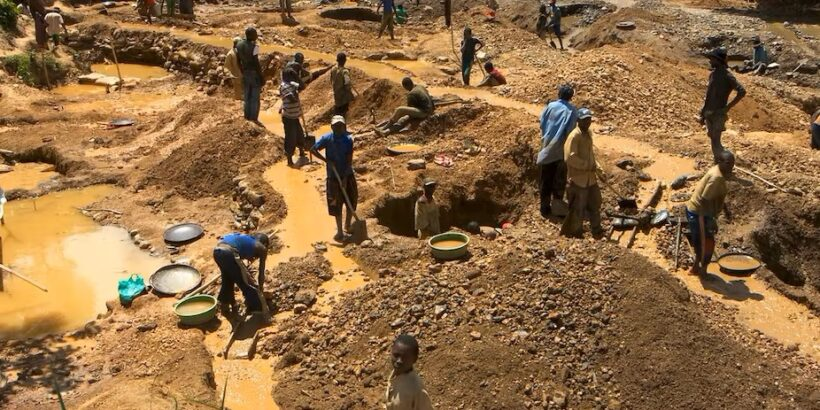
Illegal small-scale gold mining (galamsey) in Ghana, has persisted as a significant issue of concern for many years. Initially, discussions and research around the menace have drawn considerable attention due to its impact on the environment, livelihoods, water bodies, and local communities.
However, as the problem has continued unabated despite government interventions and public outcry many people now feel fatigued by the topic. For example, repeated reports of polluted rivers and major water bodies, and the widespread destruction of farmlands, highlight how the issue remains unresolved.
This ongoing nature means that the public, researchers and other stakeholders alike are now feeling disillusioned, believing that new conversations or studies rarely bring about meaningful change. As a result, the excitement or motivation to engage actively with the subject has waned, replaced by a sense of resignation and frustration.
While trying not to recycle the problem, one factual truth about galamsey is that government officials, high profile political actors and their allies and those who wield power are aware that galamsey activities are sustained by people in their class; political powers and influential actors in the country.
Indeed, it is widely acknowledged that the backing or tacit support from certain politicians and powerful figures allows illegal mining to flourish, often making enforcement efforts ineffective. This reality complicates attempts to address the problem, as vested interests may undermine genuine reform and perpetuate the cycle of environmental degradation and social unrest.
The recent admission by President Mahama signals a notable shift in the usual rhetoric surrounding galamsey. By acknowledging that political actors including those from his own party as complicit, he breaks the tradition of deflecting blame and instead brings the problem’s roots at his doorstep and into public discourse. Such transparency lays the groundwork for more honest conversations about accountability and reform, potentially encouraging other leaders to follow suit.
Furthermore, acknowledging the involvement of influential figures exposes the complexity of tackling galamsey. It suggests that addressing the issue requires more than just regulatory enforcement; it demands confronting entrenched interests and dismantling networks of patronage.
This could pave the way for broader reforms within the political landscape, fostering a climate where meaningful action is not only possible but expected from those in positions of authority.
While President Mahama’s admission signals a step towards transparency, it also raises critical questions regarding the timeliness and effectiveness of his response. Was he truly unaware of the extent of the problem until recently, or has political expediency delayed decisive action? Although some measures are still being implemented, such as NAIMOS and occasional clampdowns, many observers contend that these efforts have lacked consistency, sustainability and long-term impact.
In the midst of these unreliable and unsustainable interventions, one must wonder whether the president and our leaders fully grasp the gravity of galamsey’s consequences-the recent hikes in renal and kidney issues as announced by the health minister, irreversible environmental damage and shattered livelihoods in affected communities are just a few of the many problems.
If the presidency and our leadership do understand the gravity of the problem, then why has it proven so difficult to implement robust solutions? Is it a matter of feeling overwhelmed by the entrenched interests, or a lack of political will? and who ultimately bears the brunt of this neglect? Sadly, it is ordinary citizens, vulnerable Ghanaians who cannot afford importing water, kidney transplant and general treatment, and future generations who stand to lose the most, making this issue not just a political failure, but a profound tragedy for the nation.
In a democratic country like Ghana, laws are meant to provide clear frameworks for addressing social and environmental challenges, yet in the case of galamsey, the effectiveness of laws is severely diminished.
Despite the existence of regulations intended to curb illegal mining,enforcement remains weak and inconsistent, often undermined by the same influence of powerful individuals and political actors. As a result, these laws might as well be absent, given their inability to deter offenders or protect affected communities.
This lack of meaningful legal action creates an environment where impunity thrives, leaving citizens with little recourse and perpetuating the cycle of environmental degradation and social injustice. If institutions and governance structures fail to uphold their mandate, the consequences stretch far beyond the immediate issue of galamsey.
It signals a breakdown in accountability and erodes public trust, fostering an atmosphere where lawlessness and disregard for regulations become the norm. Ultimately, this undermines the very foundations of democracy and development, leaving citizens questioning whether genuine progress is possible when those in power are unable or unwilling to enforce the rules.
In addition, existing laws, although designed to provide structure and protection, are rendered impotent by inconsistent enforcement and the undue influence of powerful individuals. When regulations become meaningless and impunity prevails, the rule of law is replaced by unconventional systems.
Such developments, undeniably, is a classic precursor to an anarchist state, where the boundaries set by legal and institutional frameworks erode, and citizens are left without reliable recourse or protection. The persistent failure to address galamsey in Ghana, despite widespread awareness of its devastating effects reflects a broader collapse of effective governance.
When the president himself appears unable to implement decisive solutions, it signals a vacuum of authority. This vacuum may be further deepened by the reality that the primary victims of such neglect are ordinary citizens and future generations.
Moreover, the breakdown of accountability within institutions and governance structures, as described, creates fertile ground for lawlessness and the normalisation of disregard for rules. As public trust erodes and citizens witness the repeated failure of authorities to uphold their mandates, the legitimacy of the state itself is called into question.
In such a context, it becomes increasingly difficult to distinguish between official governance and the absence thereof effectively laying the groundwork for an anarchist state in which order, justice, and progress are no longer guaranteed by those in power.
Ghana’s democracy has developed immensely over the past three decades. As a result, while the notion of Ghana sliding towards an anarchist state may appear to be a theoretical argument, it is crucial to reflect on the practical implications of our failure to address galamsey for our democracy.
Recent political unrests in West Africa and the Sahel regions such as coups, civil strife, and the erosion of democratic institutions demonstrate how fragile governance structures can become when accountability is weakened and public trust is lost.
These developments serve as stark reminders that the breakdown of law and order is not merely an abstract concern, but a very real threat that can destabilise societies, disrupt economies, and compromise the wellbeing of millions.
For Ghana, the persistent inability to tackle issues like galamsey, combined with the apparent impotence of laws and institutions, risks undermining the foundations of democratic governance. If citizens perceive that those in power are either unwilling or unable to enforce regulations, protect the environment, and uphold justice, the legitimacy of the state is called into question.
This erosion of trust can foster conditions similar to those seen in neighbouring countries, where political instability and unrest have taken root. It is therefore imperative to address these challenges proactively, ensuring that governance remains robust and responsive, and that the rule of law is preserved for the benefit of all.
DISCLAIMER: The Views, Comments, Opinions, Contributions and Statements made by Readers and Contributors on this platform do not necessarily represent the views or policy of Multimedia Group Limited.
DISCLAIMER: The Views, Comments, Opinions, Contributions and Statements made by Readers and Contributors on this platform do not necessarily represent the views or policy of Multimedia Group Limited.