
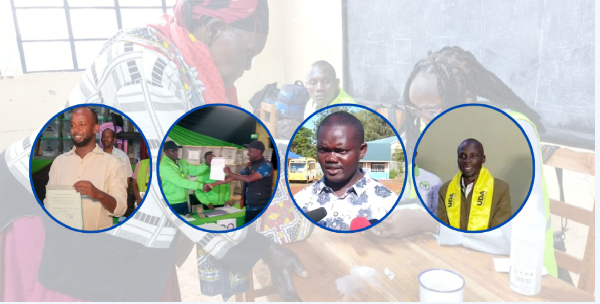
 UDA won four by-elections
President William Ruto’s United Democratic Alliance (UDA) party secured sweeping victories in the Thursday by-elections in Kenya, helped by low-key campaigns by an opposition apparently still low in confidence after its heavy loss in November.
UDA candidates emerged comfortable winners in all four races to fill the vacant Isiolo South parliamentary seat, two county assembly seats in Embu County, and one county assembly seat in Kakamega County.
The latest round of by-elections, occasioned by the death of a Member of Parliament and resignations of three ward representatives, was the second in three months following the November mini polls.
President Ruto’s so-called Broad-Based Government, a loose coalition between UDA and the largest opposition party, the Orange Democratic Movement (ODM), similarly obliterated the opposition in November, winning all seven parliamentary seats.
Like the November by-elections, the Thursday contests had been billed as significant political showdowns, providing a platform for political parties to test their electoral strengths in key regional battlegrounds ahead of the next General Election in August 2027.
Two of the three regions – Western and Mount Kenya East – are shaping up as key battlegrounds in the 2027 elections, going by political activity in recent months.
But the campaigns were notably devoid of the excitement witnessed in the run-up to the November by-elections, with the opposition still frustrated with the electoral commission’s perceived inability to conduct free, fair, and credible elections.
In the wake of their heavy loss in November, opposition parties blamed the Independent Electoral and Boundaries Commission (IEBC) for abetting vote rigging and electoral malpractices such as the use of State resources to campaign for government-backed candidates and widespread violence.
This time, key figures in the United Opposition, the alliance of political party leaders seeking to field a single candidate against President Ruto in the next elections, did not show up to drum up support for their candidates as frequently as they did last time.
The eve of the latest by-elections coincided with a tour, hundreds of kilometres away, of Kisii and Nyamira counties by the United Opposition leaders, whose highlight was the symbolic coronation of former Interior minister Fred Matiang’i as the region’s political supremo.
Dr Matiang’i, a powerful figure in the administration of former president Uhuru Kenyatta and the deputy party leader of the former ruling Jubilee Party, is one of the two frontrunners for the single opposition presidential candidate. He faces competition from former vice-president Kalonzo Musyoka, the leader of Wiper Patriotic Front.
The two are believed to enjoy the backing of Mr Kenyatta, who retains considerable political clout and resource mobilisation capacity.
President Ruto and his predecessor do not see eye to eye politically after the latter overlooked his then deputy in his succession plan, backing then opposition leader Raila Odinga’s presidential candidacy instead.
Tensions between the duo have escalated in recent months, with Dr Ruto’s political allies accusing Mr Kenyatta of orchestrating an internal rebellion in ODM to scupper planned negotiations for a pre-election alliance that would see the opposition party back the president’s re-election campaign.
The old guard in ODM, led by Senator Oburu Oginga, is pushing for pre-election alliance talks with UDA.
But a faction led by the 20-year-old party’s youthful secretary-general, Edwin Sifuna, has lit a fire under the old guard, setting it up for possible implosion in March when a national delegates conference is expected to decide its position on the 2027 elections.
An ODM fallout would complicate President Ruto’s re-election plans, with his key support base in the populous Mount Kenya region already drifting away.
But he will still take a lot of encouragement from his party’s performance in the by-elections and the opposition ceding further ground.
In its by-election victory statement on Friday, UDA sought to frame the results as a vote of public confidence in President Ruto’s administration.

