


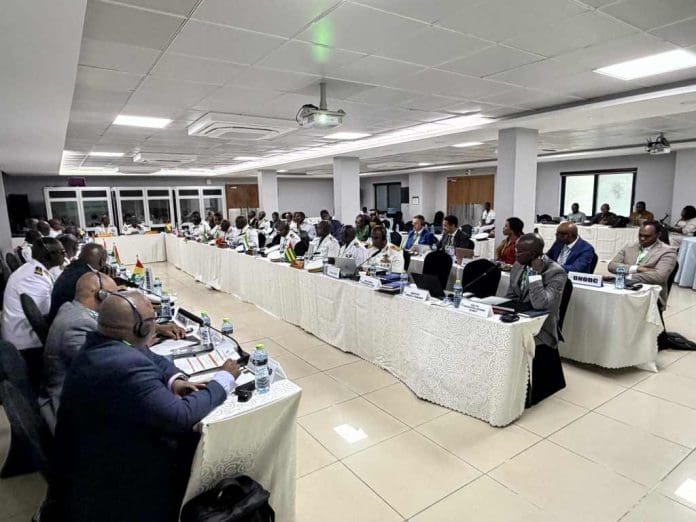

West African naval commanders concluded a three-day summit in Accra, Ghana, on February 20, 2026, with renewed urgency around a legal problem that has hampered the effectiveness of the region’s maritime security architecture for years: the ambiguous legal status of military and security personnel deployed to regional maritime centres across the Gulf of Guinea.
The fifth meeting of the Economic Community of West African States (ECOWAS) Sub-Committee of the Chiefs of Naval Staff, held from February 18 to 20, brought together naval chiefs and coast guard commanders from across the 12-member bloc to act on recommendations left outstanding from the fourth meeting held in Cabo Verde. That earlier gathering had identified critical gaps in air support, medical evacuation capabilities, and data system interoperability. The Accra session went further, confronting the legal architecture underpinning those joint deployments, without which operational commanders argue that cross-border cooperation cannot reach its full potential.
The legal status of deployed personnel matters in practice. Officers stationed at shared maritime centres across the different maritime zones of the Gulf of Guinea currently operate in a grey area, with unclear rules governing jurisdiction, immunity, accountability, and command authority when incidents occur during joint operations. Resolving this ambiguity is widely regarded within the bloc’s security apparatus as a precondition for operationalising an effective combined maritime force.
Commodore Samuel Ayelazono, who chaired the opening proceedings, stressed the importance of the Yaoundé process as the overarching political and legal framework guiding regional maritime governance and called for stronger collective action on resource mobilisation and intelligence sharing among member states.
Ambassador Abdel-Fatau Musah, ECOWAS Commissioner for Political Affairs, Peace and Security, used his address to catalogue progress made under the ECOWAS Integrated Maritime Strategy (EIMS), citing the implementation of Operation SAFE DOMAIN in Zone E, Operation ANOUANZE in Zone F, and ongoing joint patrols in Zone G. He stressed that threats requiring enhanced cooperation include terrorism, drug trafficking, and illegal, unreported, and unregulated (IUU) fishing, which the Gulf of Guinea Fisheries Commission estimates accounts for nearly 40 percent of global IUU fishing incidents.
Ambassador Musah directed Naval Chiefs and Coast Guard Commanders to concentrate their institutional energy on four priorities: advancing the Yaoundé Architecture Regional Information System (YARIS) and its planned transfer to a regional management body, operationalising the Combined Maritime Task Force, resolving the legal status of ECOWAS maritime centre personnel, and finalising a harmonised manual of procedures governing joint naval operations.
The YARIS platform, which is designed to synchronise intelligence across national maritime centres and regional coordination hubs, was identified at the Cabo Verde meeting as underfunded and technically fragmented. Its transfer to a formally constituted regional body, a key agenda item in Accra, would mark a significant step toward giving the platform independent institutional standing and sustainable financing beyond donor cycles.
