


Transparency International Ghana has released its latest assessment on corruption, stating that the country’s progress remains limited despite ongoing efforts by state institutions to combat graft.
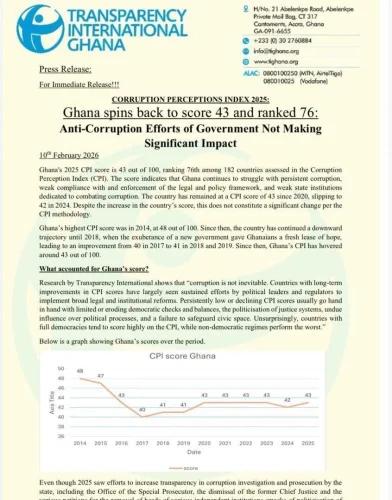
In a press statement dated Monday, February 10, 2026, the organization reported that Ghana’s score in the 2025 Corruption Perceptions Index (CPI) stands at 43 out of 100, placing the country 76th out of 182 nations assessed globally.
The group stressed that the result suggests Ghana is still struggling with persistent corruption and weak enforcement of laws, noting that the country has remained at a CPI score of 43 since 2020. Although there was a slight rise from 42 in 2024, the change does not amount to any significant improvement under the index’s methodology.
Transparency International Ghana pointed out that the country’s best performance in recent years was recorded in 2014 when it scored 48 out of 100. Since then, the trend has generally declined, with only minor improvements that have kept the score hovering around the low 40s.
The organization explained that Ghana’s performance reflects persistent weaknesses in enforcement, political accountability, and institutional effectiveness. The assessment comes amid growing public concern about the withdrawal of corruption cases involving government officials through 60:40 settlement arrangements, which critics argue undermines accountability.
According to the statement, corruption is not inevitable, and countries that improve their rankings usually do so through sustained political commitment and strong institutional reforms. The group emphasized that persistently low or declining CPI scores usually accompany limited or eroding democratic checks and balances, the politicization of the justice system, undue influence over political processes, and a failure to safeguard civic space.
Ghana scored 42 in 2024, meaning the one point increase to 43 in 2025 represents marginal improvement. The country has maintained a score around 43 since 2020, which Transparency International Ghana stated does not constitute change under the index methodology.
The organization linked Ghana’s stagnant performance partly to the controversial 60:40 settlement process that allowed government officials facing corruption charges to avoid prosecution by paying a portion of allegedly misappropriated funds. This policy dampened public expectations following the launch of Operation Recover All Loot (ORAL), an initiative announced by President John Dramani Mahama to recover state assets allegedly misappropriated during the previous administration.
Despite efforts by the Office of the Special Prosecutor (OSP) to increase transparency in corruption investigations and prosecutions, including actions such as the removal of the former Chief Justice, these measures have not led to improved perception ratings in the 2025 assessment.
The Ghana Integrity Initiative (GII), Transparency International’s local chapter, noted that the index score should be treated as an early signal rather than a final judgment. The organization emphasized that defensive responses will not change perceptions, but consistent action will.
Transparency International Ghana called for comprehensive reforms including strengthening the justice system and protecting its independence, fast tracking the establishment of anti corruption courts, passing the Community Tribunal Bill currently awaiting parliamentary attention, and adopting the National Ethics and Anti Corruption Plan.
Other recommendations include promoting ethical conduct in public service, improving the business environment, revising political party financing rules, protecting civic space and media freedom, and raising awareness among designated non financial businesses and professions of their anti money laundering obligations.
The organization welcomed the Chief Justice’s recent decision to fast track the establishment of anti corruption courts, which it stated would speed up the hearing of corruption related cases. However, it stressed that court establishment alone would be insufficient without broader systemic reforms.
Transparency International Ghana emphasized that with sustained political will and measurable reforms, Ghana can rebuild public trust and improve its anti corruption outcomes over time. The statement added that the country’s position points to corruption challenges, weak compliance with legal rules, and institutions under strain.
The 2025 global assessment shows widespread corruption challenges, with the global average score dropping to 42 out of 100, the lowest level in more than a decade. Sub Saharan Africa ranked lowest on the global index, with a regional average score of 32 out of 100.
According to the global report, 122 out of 182 countries scored below 50 in the index, signaling widespread public sector corruption. Only five countries now score above 80, down from 12 a decade ago, and recent slippage in high scoring democracies shows corruption risks can rise even where institutions once looked secure.
François Valérian, Board Chair of Transparency International, emphasized the need for both domestic and international cooperation in tackling corruption. He stated that in an interconnected world, national action and multilateral cooperation are essential to protect the public interest and tackle shared challenges like corruption.
The global organization noted that countries that curb civic space often lose control of corruption, with 36 of the 50 biggest CPI decliners having restricted freedoms of expression, association, and assembly. Over 90 percent of journalists murdered for investigating corruption were in low scoring countries.
For Ghana, the 2025 CPI results reinforce growing public concerns that anti corruption rhetoric has yet to be matched by decisive action capable of restoring confidence in governance and public institutions. The assessment provides a benchmark against which future reforms and their effectiveness can be measured.
