


Recently, I photographed a special dog‑waste bin in a public park. Its purpose is simple: dog owners and walkers are required to collect their animals’ waste and dispose of it properly. Such bins are strategically positioned throughout public spaces, while local and central authorities enforce clear rules to keep public areas clean, safe and attractive. The principle is equally simple: those who pollute public spaces must be held responsible for cleaning them up.
For a start, failure to pick up after your dog could attract an £80 penalty. There is no begging, no favouritism and no selective enforcement. The rule applies equally to everyone.
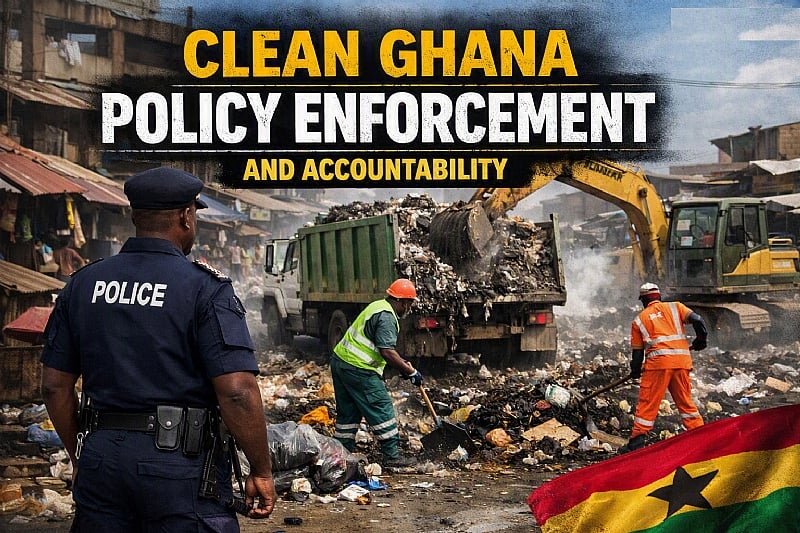
Ghana can and should adopt a similar philosophy in dealing with the persistent problem of urban filth, indiscriminate dumping, plastic waste, open defecation and the degradation of our public spaces and coastline.
I therefore hope that the new Environment Minister, Zanetor Agyeman‑Rawlings, MP, working with the relevant ministries, metropolitan, municipal and district assemblies, environmental agencies and other stakeholders, will develop a comprehensive national urban sanitation and environmental management policy. This should not be another policy document that sits on a shelf. It should contain measurable targets, dedicated funding, clear responsibilities, enforcement mechanisms and consequences for failure.
PUBLIC TOILETS MUST BE PART OF THE SOLUTION
Previous governments, including the administration of Dr Mahamudu Bawumia, spoke extensively about the need for public toilets. The underlying policy objective was sensible, even if the implementation and value for money of some projects deserve serious scrutiny. The lesson should be clear: good policies must be accompanied by good implementation and financial discipline.
The new administration should therefore set an ambitious but measurable target: within two years, no Ghanaian should have to use the Atlantic coastline as a place of convenience because there is no accessible public toilet.
Build sufficient, properly maintained public toilets. Put them where people actually need them. Ensure that they have water, lighting, sanitation facilities and proper maintenance arrangements. There should be no excuse for open defecation along Ghana’s beaches and coastal communities.
PUT RUBBISH BINS EVERYWHERE THEY ARE NEEDED
Public rubbish bins should become a normal feature of Ghanaian cities—not an exception.
There should be clearly designated bins for different types of waste where appropriate, particularly in markets, transport terminals, beaches, parks, commercial areas, schools, public institutions and heavily trafficked streets.
But providing bins alone will not solve the problem. Enforcement must accompany infrastructure.
Anyone who deliberately dumps rubbish in public spaces should face a meaningful penalty. Environmental sanitation laws must be enforced consistently, regardless of a person’s political connections, social standing or financial influence.
And critically, enforcement officers must themselves be subject to strict oversight.
NO BRIBES. NO FAVOURITISM. NO POLITICAL INTERFERENCE.
A sanitation enforcement system that can be neutralised with a small payment to an enforcement officer is worse than having no system at all.
Government must therefore establish strong internal controls, transparent penalty systems and mechanisms for reporting corruption. Where fines are imposed, payments should preferably be made through traceable official channels—not directly into the hands of enforcement officers.
Officials who solicit or accept bribes should face disciplinary and, where appropriate, criminal consequences. Clean cities require clean administration.
PUBLIC MONEY MUST NOT BECOME PRIVATE WEALTH
There is another matter that cannot be ignored. Whenever government announces a major sanitation, waste‑management or environmental programme involving substantial public expenditure, citizens must be able to follow the money.
If billions of cedis are raised, borrowed or allocated for environmental purposes, the public should know:
- How much was allocated;
- Which projects were approved;
- Who received the contracts;
- How much each project cost;
- What was actually delivered;
- Whether the work was independently inspected; and
- Whether the intended environmental outcomes were achieved.
Ghana has seen too many instances in which laudable public policies have been undermined by poor procurement, inflated contracts, abandoned projects, weak supervision and allegations of diversion of public resources. This time must be different. Environmental money must remain environmental money.
SET TARGETS AND MEASURE RESULTS
The Environment Ministry should publish a clear two‑year national sanitation and environmental action plan, with measurable targets for metropolitan, municipal and district authorities. For example:
Year One:
- Expand public toilets in identified high‑need communities.
- Install sufficient public waste bins.
- Establish stronger anti‑litter enforcement.
- Identify and clear major illegal dumping sites.
- Begin systematic monitoring of coastal sanitation.
Year Two:
- Eliminate open defecation from identified coastal hotspots.
- Sustain clean public spaces through regular enforcement.
- Introduce stronger waste separation and recycling programmes.
- Publish performance reports for local authorities.
- Penalise authorities that consistently fail to meet agreed sanitation standards.
The public should be able to see whether these targets are being achieved.
GHANA DESERVES CLEANER CITIES
This is not simply about aesthetics. A dirty city affects public health, tourism, business, property values, the dignity of citizens and the reputation of the country.
Ghana cannot aspire to become a modern, competitive economy while allowing rubbish to accumulate on streets, drains to become dumping grounds and sections of our coastline to become open toilets.
We need a change in both government policy and public behaviour. Government must provide the infrastructure and enforce the law. Citizens must use the facilities provided and obey the rules. And officials must administer the system honestly and transparently. That is what good governance should look like.
If the Ministry of Environment and the relevant local authorities want assistance in developing a practical, comprehensive and measurable sanitation policy framework, I, Mansa Musa, would be willing to contribute my ideas and experience at no cost to the Ghana I love.
Clean Ghana is achievable. But it requires political will, proper planning, disciplined expenditure, firm enforcement and accountability. Let us stop talking about filth and start measuring its elimination.
— Mansa Musa
