


Quick overview
- South Africa’s fuel price outlook for September has worsened, with early data indicating increases for both petrol and diesel.
- Projected increases include R0.40 for petrol 93, R0.51 for petrol 95, and R3.11 to R3.22 for diesel.
- Brent crude prices are around $81.75 per barrel, with geopolitical tensions in the Middle East contributing to market volatility.
- The rand’s stability at R16.35 per dollar is providing some relief against rising international oil prices.
South Africa’s September fuel price outlook has deteriorated sharply, with early CEF data pointing to higher petrol prices and potentially much larger increases for diesel.
September Fuel Price Outlook Turns Negative
South Africa’s fuel price outlook for September has started on a concerning note, with early Central Energy Fund (CEF) data pointing to increases across both petrol and diesel.
The projections are still subject to change, but the latest figures highlight growing pressure from higher international oil prices and continued Middle East uncertainty.
Diesel Faces the Biggest Increase
According to CEF data from the end of the first week of August:
- Petrol 93: projected increase of R0.40 per litre
- Petrol 95: projected increase of R0.51 per litre
- Diesel 0.05%: projected increase of R3.11 per litre
- Diesel 0.005%: projected increase of R3.22 per litre
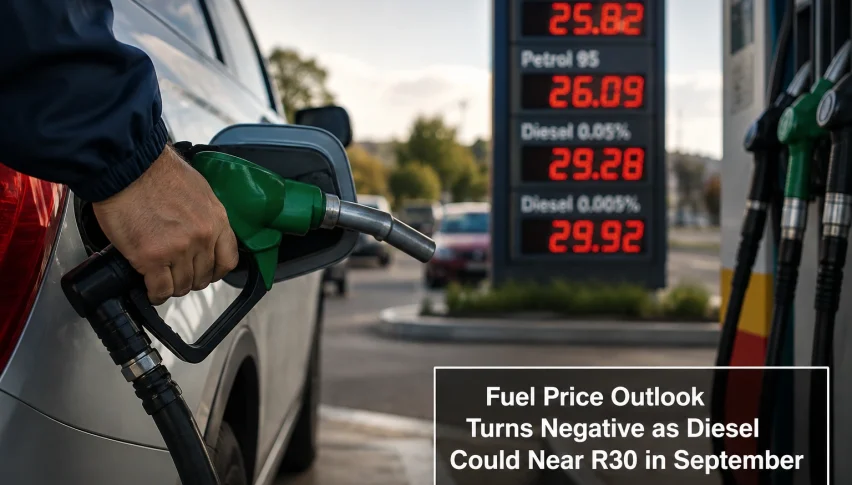
If these projections were to hold, petrol 93 could rise to approximately R25.82 per litre, while petrol 95 could reach R26.09.
Diesel would face significantly greater pressure, with wholesale prices potentially reaching R29.28 and R29.92 per litre.
Middle East Remains a Key Risk
Brent crude is trading around $81.75 per barrel, with further gains possible if tensions surrounding Iran and the Strait of Hormuz intensify.
Although direct military action between the United States and Iran has paused, negotiations over reopening the critical shipping route remain uncertain. Restrictions on vessels could keep oil markets volatile.
Rand Provides Some Relief
The rand’s relative resilience is providing an important buffer. The currency has remained around R16.35 per dollar, helping limit the impact of higher international oil prices on South African import costs.
Investec Chief Economist Annabel Bishop has suggested that global currencies could strengthen toward the end of 2026, although renewed Middle East conflict could undermine that outlook.
Early Warning, Not a Final Forecast
The CEF figures are only early-month projections and can change significantly before the official September adjustment.
Still, the current direction is unfavorable, particularly for diesel users. If oil prices continue rising while geopolitical risks remain elevated, South African motorists and businesses could face renewed fuel-cost pressure in September.

Skerdian Meta
Lead Analyst
Skerdian Meta Lead Analyst.
Skerdian is a professional Forex trader and a market analyst. He has been actively engaged in market analysis for the past 11 years. Before becoming our head analyst, Skerdian served as a trader and market analyst in Saxo Bank’s local branch, Aksioner. Skerdian specialized in experimenting with developing models and hands-on trading. Skerdian has a masters degree in finance and investment.
