


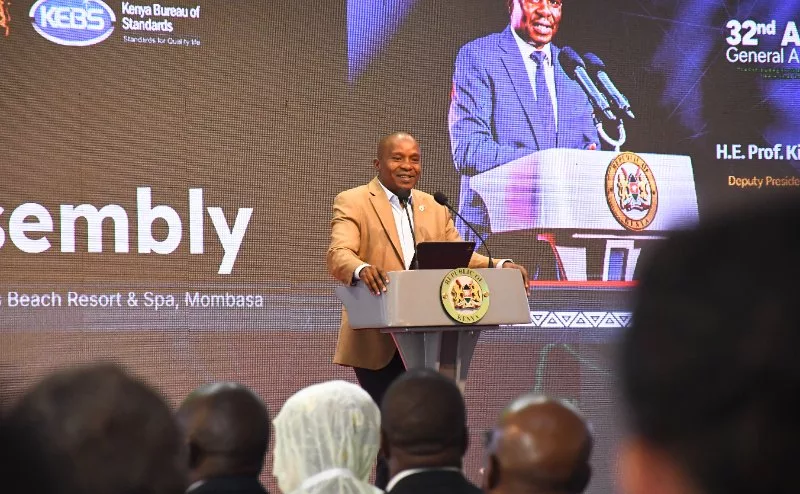
 Deputy President Kithure Kindiki during the opening of the 32nd ARSO General Assembly in Mombasa.
Kenya will host the permanent headquarters of the African
Organisation for Standardisation (ARSO) after the government pledged to provide
land in Nairobi for the construction of a purpose-built continental
headquarters.
The move is expected to strengthen Kenya’s position as
Africa’s standards and quality infrastructure hub, according to the government.
On Wednesday, Deputy President Kithure Kindiki announced the
decision while officially opening the 32nd ARSO General Assembly in
Mombasa.
Delegates from more than 40 African countries gathered to
discuss harmonising standards to accelerate trade under the African Continental
Free Trade Area (AfCFTA).
Kindiki said Kenya’s commitment goes beyond hosting
meetings, describing the decision to allocate land as an investment in Africa’s
institutional future and economic integration.
“The government intends to scale up this partnership by
making available adequate and appropriate land for the construction of a
permanent, fit-for-purpose ARSO headquarters,” Kindiki said.
“We are offering ARSO a permanent home from which its vision
can flourish, its operations can expand, and its influence can radiate across
Africa and the globe.”
He revealed that discussions with Trade Cabinet Secretary
Lee Kinyanjui had already identified a possible location in Nairobi, with the
process of formally handing over the property set to begin immediately after
the General Assembly.
The announcement comes as Kenya also prepares to host the
2028 International Organization for Standardization (ISO) Annual Meeting in
Nairobi, a development Kindiki said demonstrates Africa’s growing influence in
shaping global quality and standards infrastructure.
He said Kenya wants to position itself as a leader in
building institutions that support industrialisation, competitiveness and
innovation across the continent.
“Standards are not simply a measure of quality; they are
instruments of transformation,” Kindiki said.
Addressing delegates, the Deputy President described
standards as the “invisible infrastructure” that underpins trade. He argued
that roads, ports and railways alone cannot unlock Africa’s economic potential
without harmonised product standards.
He said the AfCFTA has created a market of 1.4 billion
people with a combined GDP of about USD3.4 trillion. However, he warned that
fragmented regulatory systems across 54 countries continue to hinder the free
movement of goods.
Kindiki criticised the repeated testing and certification of
products as they move from one African country to another. He said the
duplication increases costs, delays trade and disproportionately affects micro,
small and medium enterprises (MSMEs).
He urged African countries to embrace ARSO’s vision of “One
Standard, One Test, One Certificate, Accepted Everywhere”, saying a product
certified in one African country should be recognised across the continent
without undergoing additional inspections.
Kindiki pointed to the East African Community as proof that
harmonised standards and mutual recognition agreements can reduce trade
barriers and build trust between neighbouring countries.
Kinyanjui said hosting the General Assembly in Mombasa was
symbolic because the city has historically served as East Africa’s gateway to
regional and international trade.
Kinyanjui noted that intra-African trade remains at about 17
per cent, significantly lower than in other regions. He said harmonised
standards are critical to increasing trade among African countries.
He said many African products still leave the continent for
processing or certification before returning to African markets, a practice he
described as costly and unnecessary.
The Cabinet Secretary also called for greater support for
MSMEs, saying affordable certification would enable small businesses to expand
beyond national borders and compete across Africa.
