


Friday 28th August, 2026 07:34 AM|

If you have spotted a vehicle bearing a KEA number plate on Kenyan roads, you are looking at the latest chapter in a registration system that has changed dramatically over the decades.
The arrival of the KEA series marks the next step after the KDA series, which began in 2020 and has now reached the end of its available combinations. Recent reports indicate that newly registered vehicles are now being assigned KEA plates.
But Kenya’s number-plate story goes much further back.

Long before KDA, KCA, KBA and KAA, the letters on a vehicle could actually tell you where that vehicle had been registered.
When a number plate could reveal a vehicle’s town
Kenya’s earliest vehicle registration system was largely organised around registration districts.
Historical records indicate that individual letters were assigned to different areas. A was associated with Mombasa, C with Nakuru, D with Kericho, F with Eldoret, G with Nyeri and L with Kisii, among other locations.
The system meant that the registration mark was not simply a random identification number. The letters could give an indication of the vehicle’s registration area.
The older plates also looked very different from what motorists see today, with early plates using white or silver characters on black backgrounds.
The K-era begins
As the number of vehicles increased, the old system became inadequate.
In 1950, Kenya introduced a K-prefix system using three-letter combinations. The first two letters were initially linked to registration areas.
For instance, KA was associated with Mombasa, KB with Nairobi, KC with Nakuru and KD with Kisumu. Other combinations were subsequently allocated as vehicle registrations increased. This is an important part of the story behind today’s plates.
Although motorists now see KAA, KBA, KCA, KDA and KEA as part of a national sequence, some of the earliest K combinations had a geographical meaning.
The big shift: Kenya goes national
The system eventually changed. From 1980, vehicle registration was centralised and numbers began being issued in a national sequence rather than being assigned according to individual regions.
This meant the letters on a new registration no longer necessarily told you whether a vehicle came from Nairobi, Mombasa, Kisumu or another town.
That change laid the foundation for the numbering system familiar to today’s motorists.
From KZZ to KAA
By the late 1980s, the available combinations in the previous system were being exhausted. In 1989, Kenya introduced the next major format, beginning with KAA 001A and eventually running through the KAZ series.
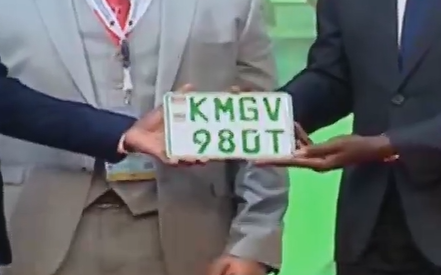
The format provided substantially more combinations, allowing the registration system to accommodate the growing number of vehicles on Kenyan roads.
This is the same basic format that has continued through subsequent generations. After the KAA-KAZ sequence was exhausted, Kenya moved to the next generation.
The KBA series began in 2007 and ran through the KB series before being replaced by another generation. It was followed by KCA in 2014. Then came KDA in 2020. And now, in 2026, motorists are beginning to see KEA.
So, what does KEA actually mean?
The easiest way to understand KEA is this:
It is not a new county code. It is not a special designation for a particular class of motorists. And it does not mean the vehicle was bought in a particular part of Kenya.
It is the latest registration sequence. The KD series has reached its available combinations, prompting the move into KE. A standard sequence such as KEA 001A is therefore simply a registration mark assigned to a vehicle through the national registration system.
Kenyans may also have noticed that the sequence does not simply run through every possible alphabet combination. Some letters are deliberately avoided.
For example, I and O can be excluded because of the potential confusion between letters and numbers, particularly I and 1 or O and 0.
Certain combinations have also been skipped or reserved for other purposes.
This explains why the progression of Kenyan number plates is not always as straightforward as moving from one letter to the next.
Number plates have also become more secure
The evolution has not only been about numbers.
Kenya has also upgraded the physical design and security features of its plates.
In 2022, the government launched a new generation of number plates incorporating additional security features, including a hologram, watermark and other elements intended to make counterfeiting more difficult.
The introduction of KEA should therefore be understood separately from the introduction of the newer physical plate design.
KEA is primarily a change in the registration sequence, not necessarily a new plate technology.
