


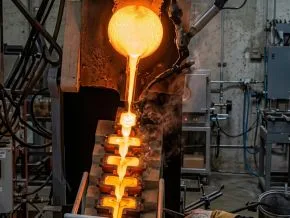
- Ghana will require GoldBod partners to refine artisanal and small-scale mining gold locally from Sept. 1.
- The country has four licensed gold refineries, but GoldBod has so far announced supply contracts with only two of them.
- No Ghanaian refinery has yet secured accreditation on the London Bullion Market Association’s Good Delivery List, limiting international market access.
Ghana is now creating additional demand for its domestic refineries through a new GoldBod directive. From Sept. 1, the agency responsible for overseeing gold exports from artisanal and small-scale mining will require its partners to refine gold doré destined for foreign markets in Ghana.
Gold doré represents a semi-finished product that miners typically cast into bars after extraction. The alloy mainly contains gold and silver, but refineries must further purify it to produce fine gold.
The Aug. 26 directive applies to Self-Financing Aggregators (SFAs), which finance artisanal gold purchases with their own funds or through approved foreign buyers. These intermediaries must now use a refinery approved or designated by GoldBod, which oversees their exports. The SFA or its buyer will pay the refining fees, depending on their commercial agreement.
Private Plants Need More Volumes
GoldBod’s licensing register lists four authorized refineries: Gold Coast Refinery, Sahara Royal Gold Refinery, IPM KAL Ghana and Royal Ghana Gold.
However, the four plants operate at different levels of activity. Regular doré supplies can help refineries spread the fixed costs of laboratories, furnaces, security and staff and improve their prospects for profitability.
GoldBod has so far announced supply agreements with only Gold Coast Refinery and Royal Ghana Gold.
GoldBod signed its first contract with Gold Coast in January for five years. The initial agreement required the delivery of one tonne of doré per week, while the refinery, which opened in 2016, can process as much as two tonnes per week.
However, supply has increased more slowly than initially expected. A March amendment replaced the weekly delivery commitment with a one-tonne ceiling.
The second agreement covers Royal Ghana Gold. The refinery opened in August 2024 and can theoretically process 400 kilograms of gold per day. However, GoldBod said in April that the plant still needed additional equipment before it could operate at full capacity.
Costs and International Standards
By requiring local refining for artisanal and small-scale gold, the government aims to retain refining fees, jobs and associated metals such as silver within Ghana.
Gold Coast’s contract sets its refining fee at 0.3% of the value of fine gold. Based on GoldBod’s reference price of $4,594.95 an ounce on Aug. 27, that fee amounts to about $13.8 an ounce before taxes.
Major Swiss refineries and South Africa’s Rand Refinery rarely disclose their fees publicly, which prevents a direct comparison with Gold Coast.
Several project estimates nevertheless provide benchmarks. For Guinea’s Bankan gold project, owner Predictive Discovery uses a refining cost of $2.50 an ounce. In Zimbabwe, the Bilboes project assumes a $0.65-an-ounce refining charge plus a treatment commission equivalent to 1.24% of gold value.
Refining costs alone therefore do not provide enough information to compare Ghanaian refineries or assess their competitiveness.
Beyond pricing, major refineries retain an important advantage through their access to international markets. No Ghanaian refinery currently appears on the London Bullion Market Association’s Good Delivery List.
Without that accreditation, some banks may require gold refined in Ghana to undergo additional testing or remelting at an approved facility before accepting it.
Gold Coast is working with South Africa’s Rand Refinery to obtain the necessary recognition.
For now, GoldBod’s new requirement applies only to SFAs. Industrial mines can continue to ship doré to their existing refining partners.
Guinea has adopted a broader approach. A decree issued on July 8, which will apply after a transition period ending in October, bans the export of gold with a purity below 95.5%, regardless of whether miners produce it through artisanal, semi-industrial or industrial operations.
The decree requires local refineries to process the metal, while mining companies will remain responsible for selling and exporting their production.
The implementation of Guinea’s policy will show whether a broader local-refining requirement can operate without creating shipment bottlenecks or increasing costs. Ghana will need to assess both risks before potentially extending its own requirements to industrial mines.
Emiliano Tossou
