


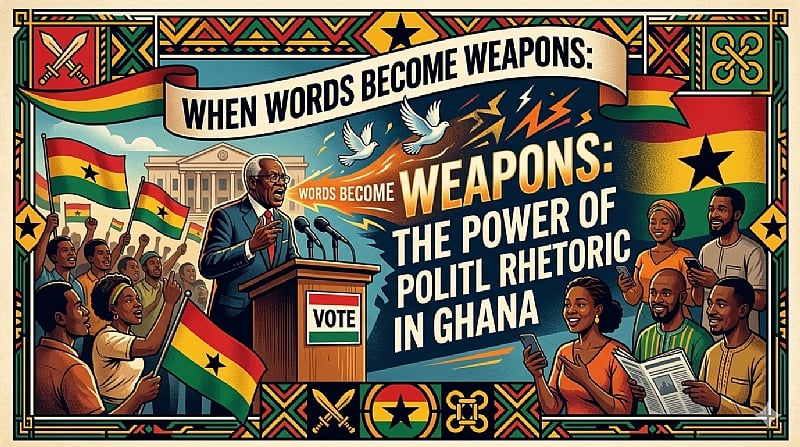
How bold declarations shape perception, morale, and destiny in our democracy
“When the drumbeat changes, the dancer must also change his steps.” — African proverb
In Ghana’s political theatre, words are not idle chatter; they are instruments of power, carefully chosen to stir emotions, shape perceptions, and mobilize supporters. Recently, Hon. Alexander Afenyo-Markin declared that the ruling NDC would be “shocked” if elections were held today. Such a statement is not about numbers or polls — it is about narrative control, about projecting strength from the opposition bench.
As I have sharply observed, “If elections were held today, the NPP would commit mass suicide upon seeing the results.” This satirical exaggeration underscores the intensity of Ghana’s political banter, where rhetoric is sharpened into both sword and shield, and where words are deployed to dramatize the stakes of power.
The Opposition’s Voice
Opposition parties thrive on bold declarations. They must convince the electorate that change is not only possible but inevitable. Afenyo-Markin’s words are designed to energize supporters, unsettle incumbents, and plant seeds of doubt in undecided voters.
ABA Fuseini, known for his colorful turns of phrase, often reminds us: “Politics is not a child’s play; it is a serious business of destiny.” In this spirit, opposition rhetoric becomes a performance of confidence, a declaration that the tide is turning.
The Media’s Echo Chamber
Ghana’s media thrives on quotable soundbites. A single phrase — “they will be shocked” — can dominate headlines, radio discussions, and social media debates.
Internationally, Winston Churchill once observed: “A good speech should be like a woman’s skirt; long enough to cover the subject and short enough to create interest.” Ghanaian politicians understand this well. Their words are crafted to be sharp, memorable, and provocative, ensuring they echo far beyond the chamber of Parliament.
The Psychology of Voters
Political rhetoric is not just about entertaining the masses; it is about shaping psychology. For supporters, bold claims boost morale and create a sense of inevitability. For undecided voters, they plant seeds of doubt about the ruling party’s strength. For incumbents, they force a counter-narrative — equally bold, equally confident.
“Death and life are in the power of the tongue” (Proverbs 18:21). In politics, the tongue of the strategist brings momentum, while the tongue of the wise brings healing.
“When the lion roars, the forest trembles.” — African proverb
Political rhetoric in Ghana is not idle talk. It is a deliberate strategy to shape perception, mobilize supporters, and influence the undecided. Whether in government or opposition, parties wield words as instruments of power.
As Ghanaians, we must listen beyond the noise. We must ask: what do these declarations mean for our democracy, our civic responsibility, and our collective future?
“The ballot is stronger than the bullet.” — Abraham Lincoln
In the end, it is not rhetoric that decides, but the people. And the people’s voice, expressed through the ballot, remains the ultimate arbiter of destiny.
✍️ Retired Senior Citizen
For and on behalf of all Senior Citizens of the Republic of Ghana 🇬🇭
Teshie‑Nungua
[email protected]
