

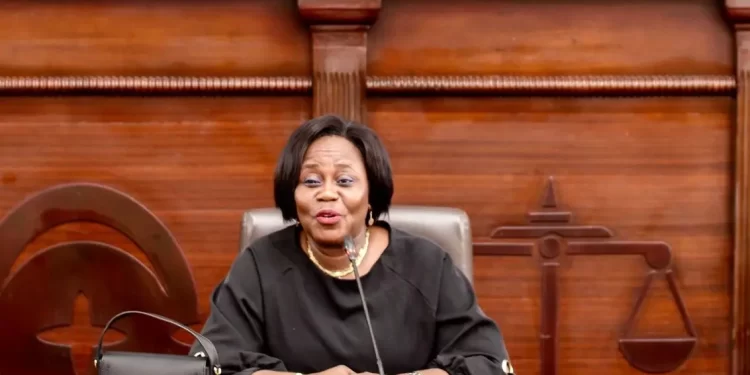
The ECOWAS Court of Justice on Thursday, January 30, 2026, granted an application by Justice Gertrude Torkornoo to amend her case against the Republic of Ghana, allowing her to formally challenge her removal as Chief Justice and as a Justice of the Supreme Court.
The amendment comes after the completion of the work of the Pwamang Committee, the submission of its recommendations, and President John Dramani Mahama’s decision to act on those recommendations by removing Justice Torkornoo from office. These developments occurred after her original case had already been filed before the ECOWAS Court.
Justice Torkornoo, represented by Femi Falana, Senior Advocate of Nigeria (SAN), asked the court for permission to introduce twelve new claims to reflect what has now happened. Her legal team argued that it would be unfair and impractical to force her to start an entirely new case when the new issues arise from the same dispute already before the court.
Falana urged the court to accept the amended application, which had already been filed at the court’s registry, and treat it as properly filed in the interest of justice. He explained that the amendment directly challenges the legality of Justice Torkornoo’s suspension and removal, which are central to the matter.
The application was opposed by Deputy Attorney General of Ghana, Dr. Justice Srem-Sai. He argued that the amendment went beyond the original claims and sought to introduce new reliefs based on later events. According to him, allowing the amendment would amount to an abuse of the court’s process, and he asked the court to dismiss the application.
In a brief ruling, the ECOWAS Court unanimously rejected Ghana’s objection and granted Justice Torkornoo’s application. The court held that refusing the amendment would likely lead to multiple lawsuits arising from the same issue, which the law seeks to avoid.
The court also directed the Republic of Ghana to amend its defense within 30 days from January 30, 2026 to respond to the new claims. Ghana will be required to file an amended defense addressing the expanded allegations regarding removal and dismissal.
Following the amendment, Justice Torkornoo is asking the ECOWAS Court to declare that her suspension and removal as Chief Justice violated her right to a fair hearing under the African Charter on Human and Peoples’ Rights. She argues that the panel set up to investigate allegations against her was not properly constituted to guarantee independence and impartiality.
The former chief justice claims the process violated her right to work, dignity, and fair conditions of service. She alleges that the process exposed her to public ridicule locally and internationally, damaging her reputation and professional standing.
Justice Torkornoo is also challenging the refusal to give her the reports relied on by the president and the investigative committee, arguing this violated her right to information. Her amended claims assert that by subjecting her to an illegal and unfair investigation, Ghana has inflicted injuries on her professional standing and image.
She is asking the court to order Ghana to immediately lift her removal and restore her as Chief Justice and restore her as a Justice of the Supreme Court. She also seeks an order compelling Ghana to release all reports connected to the proceedings against her.
In addition, she is seeking an award of 10 million United States dollars as compensation for moral and reputational damage suffered as a result of the suspension and removal process.
Justice Torkornoo filed the suit at the ECOWAS Court of Justice on July 4, 2025, alleging human rights violations arising from her suspension on April 22, 2025. President Mahama suspended her following three separate petitions calling for her removal from office.
Earlier, the court dismissed her application for interim measures seeking to restrain the government of Ghana from proceeding with the removal process, thereby allowing the process to continue. In that November 19, 2025 ruling, the court directed the Attorney General to file a response to the substantive application within 30 days.
The court held that although the former chief justice had established a prima facie case alleging human rights violations, she failed to demonstrate the urgency required for the court to issue temporary orders stopping the committee’s proceedings. The court noted she waited approximately three months after her suspension to file her emergency request.
The ECOWAS Court also rejected a preliminary objection from the Government of Ghana, which argued that the regional court lacked jurisdiction because related issues were before a Ghanaian court. The court described the objection as misplaced, stating it has jurisdiction to determine alleged human rights violations.
The court’s decision does not determine whether Justice Torkornoo’s removal was lawful. Instead, it clears the way for the court to fully examine the suspension, removal, and the process leading to those decisions under regional human rights law.
As Ghana prepares its amended defense, the case now moves closer to a full hearing on the merits, where the ECOWAS Court will be asked to decide whether Justice Torkornoo’s rights were violated and whether she should be restored to office.
The case has sharply divided legal opinion in Ghana, with some experts contending the move is misguided while others firmly assert the regional court’s right to hear the case even amid ongoing domestic legal battles.

