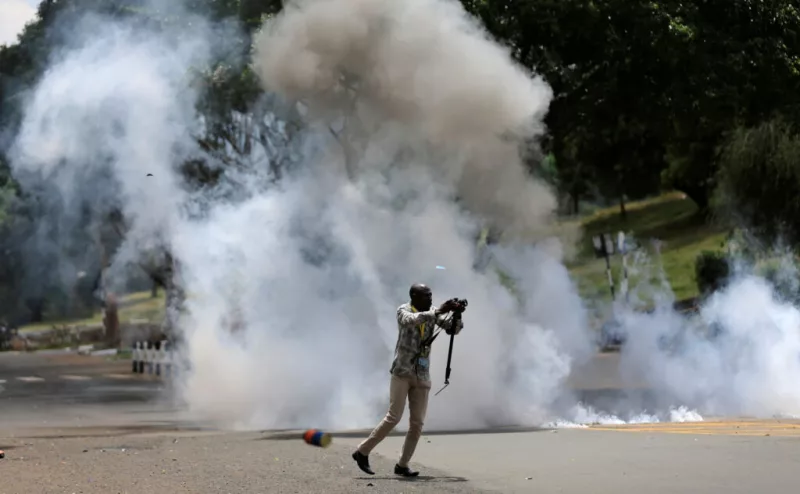
 A journalist covers a past demonstration.
Kenyans are likely to experience a repeat of the
Internet and media restrictions witnessed during the 2024 and 2025 protests as
the country heads towards the 2027 General Election, the Thomson Reuters
Foundation has warned.
TRF’s Weaponising the Law: Threats to
Media Freedom in Kenya report says Internet and media shutdowns could
become more common during the election period, threatening journalists’ ability
to report events in real time and leaving the public vulnerable to
misinformation.
The warning comes against the backdrop of a
significant shift in the government’s approach to information access and media
freedom. Until 2024, the country had largely avoided using legal or
administrative measures to interfere with Internet access, including during the
2022 polls. But that changed during the Gen-Z-led #RejectFinanceBill2024
protests, when the government either ordered or tacitly allowed disruptions
that limited the flow of information.
As a result, the government faced widespread
condemnation and legal challenges after global watchdogs and civil society
reports confirmed nationwide Internet disruptions.
The report says such disruptions not only
inconvenience users but also prevent journalists from transmitting live
updates, accessing sources and verifying information, undermining real-time
reporting and the public’s access to accurate information.
Internet disruption can take different forms,
including a complete shutdown, blocking particular websites or applications or
throttling bandwidth to slow connections.
The report also highlights the danger of creating
an information vacuum during politically volatile periods.
Forty per cent of survey respondents identified
misinformation and disinformation as one of their primary concerns facing
journalism. During the 2024 shutdown, one focus group participant said
misinformation became so widespread that some members of the public believed
security forces had carried out a massacre in Githurai. A media house that
reported there was no evidence of such a massacre was subsequently accused of
covering up the incident.
The report says repeated shutdowns could also
discourage news organisations from investing in live coverage of politically
sensitive events because journalists may expect their work to be obstructed.
Internet restrictions can also compromise journalists’ safety by cutting them
off from colleagues and other sources of assistance.
In June 2025, ahead of protests marking the
first anniversary of the Finance Bill demonstrations, civil society groups
obtained a High Court injunction barring the government from restricting access
to the Internet, digital platforms and social media. Despite the order, the
Communications Authority of Kenya instructed media houses to stop live coverage
of the protests.
The directive was eventually suspended and later
quashed by the High Court, which affirmed the right to broadcast the
demonstrations.
In July this year, the High Court struck down a
controversial provision that allowed the government to order Internet providers
to block websites and online applications without first obtaining a judge’s
approval.
The Computer Misuse and Cybercrimes (Amendment)
Act, 2025 had authorised the National Computer and Cybercrimes Coordination
Committee to direct service providers to make websites or applications
inaccessible, if it concluded they promoted unlawful activities, religious
extremism or cultism.
Justice Patricia Nyaundi ruled such a system gave
the state broad censorship powers without adequate safeguards.
According to TRF’s report, with restrictions on
the flow of information having already been attempted during periods of
political unrest, the 2027 election could provide another test of whether those
tactics return.
The report further notes that Kenya experienced
censorship guidelines, media surveillance and harassment, as well as Internet
blackouts, during the 2024 anti-Finance Bill protests and the 2025
commemoration protests.
With the 2027 elections fast approaching, it
says the ability of journalists to freely and accurately report is a major
concern. More than half of those surveyed expressed a lack of confidence in the
legal system’s ability to protect journalists covering sensitive or
controversial subjects.
The report recommends that media-freedom and
civil-society groups urgently engage state agencies ahead of the 2027 election
to address the threat of Internet shutdowns.
It also calls for scrutiny of the role
telecommunications companies could play in facilitating unlawful throttling or
full shutdowns, while urging media organisations to secure commitments from
telecom operators to respect human rights and freedom of expression during
elections.