


Saturday 05th September, 2026 11:02 PM|

Kenya’s police are signalling a tougher approach to political rallies as the country moves towards the 2027 election, putting their claim of political neutrality to a crucial test: whether public-order laws will be enforced equally while peaceful political activity is protected.
The National Police Service (NPS) has warned political leaders and their supporters against violence, incitement, thuggery and disruption of lawful gatherings. It has also reminded organisers of existing requirements under the Public Order Act, including notifying police between three and 14 days before a planned public meeting or procession.
“political intolerance, violence and thuggery in various parts of the country,” police said, warning that such conduct undermines public order, national cohesion and constitutional rights.
The provisions being emphasised are not new. Section 5 of the Public Order Act requires organisers to notify the regulating officer at least three days and no more than 14 days before an event. The notice must include the organiser’s details, proposed venue or procession route, date and time. The law provides for meetings and processions between 6 a.m. and 6 p.m.
What gives the police warning greater political significance is the environment in which those existing rules are being reasserted.

Kenya has a long history of political competition spilling into street confrontations, with rival groups sometimes disrupting meetings and demonstrations. During protests in 2025, Reuters reported groups of men armed with sticks and other weapons confronting demonstrators, while some people described the groups as protecting property and critics accused them of acting as political goons.
The security challenge facing police is therefore real. But so is the democratic risk if public-order powers are applied selectively.
Kenya’s Constitution protects the right of every person, peaceably and unarmed, to assemble, demonstrate, picket and petition public authorities.
“Every person has the right, peaceably and unarmed, to assemble, to demonstrate, to picket, and to present petitions to public authorities.”
That creates a dual responsibility for the National Police Service. Officers must prevent violence while also protecting people who are exercising their political rights peacefully.
Section 5 of the Public Order Act gives police powers to intervene where there is a:
“clear, present or imminent danger of a breach of the peace or public order”
The public order
But that power is not an unrestricted licence to prevent political gatherings because disorder is merely possible.
Kenyan courts have repeatedly considered the balance between public order and the constitutional right to assembly. In a 2025 judgment, the High Court described peaceful assembly as:“an essential feature of any democratic society”
The court also said the state has a positive obligation to facilitate and protect the peaceful exercise of that right.
That distinction is central to the NPS’s latest position.
A violent group attacking a political rally is a public-order problem. A politician expressing an unpopular or controversial political opinion is not, by itself, equivalent to incitement or disorder.
The police must therefore distinguish between political disagreement and unlawful conduct.
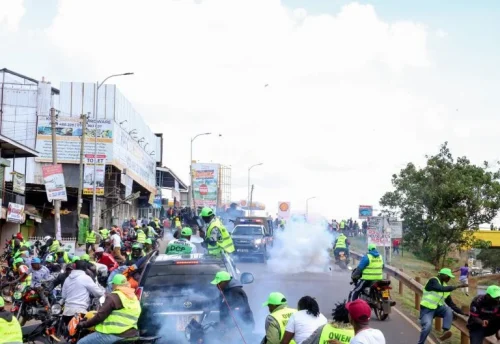
“engaging in violence, sponsoring criminal gangs, inciting supporters or disrupting lawful gatherings”
That is a legitimate policing objective when those descriptions correspond to identifiable criminal conduct.
The difficulty will arise when police have to decide whether a gathering represents a genuine and immediate security threat or whether the possibility of disruption is being used to restrict a peaceful political event.
That is where neutrality will be tested.
If supporters attempt to storm an opposition rally, police should protect the rally and act against those disrupting it. If opposition supporters attempt to disrupt a government gathering, the response should be equivalent.
The test is not whether police are tough. It is whether they are tough in every direction.
The NPS has insisted that it remains “apolitical and impartial” and is committed to serving and protecting the public while upholding human rights, dignity and accountability.
That claim will ultimately be judged by conduct rather than statements.
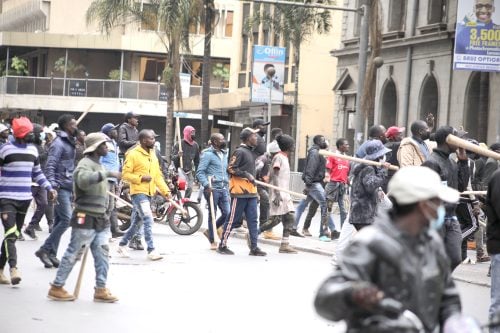
PHOTO/Bernard Malonza
Abductions and goonism
The issue has added sensitivity because public confidence in Kenya’s security institutions has also been affected by continuing concerns over abductions and claimed buses.
On September 2, People Daily reported that Standard Group associate editor Alex Kiprotich was abducted by armed men near Nakuru and later found safe near Masinga Dam. His employer said the abductors demanded that he reveal the newspaper’s sources. Police opened an investigation, while the Committee to Protect Journalists called for a thorough inquiry.
The case is not evidence that the NPS’s rally-enforcement warning is connected to the abduction, nor does it establish police involvement.
But it illustrates the wider environment in which Kenyans are assessing the exercise of security powers.
Standard Group chief executive Chaacha Mwita said Kiprotich had previously escaped an attempted abduction and linked the incidents to the journalist’s work. That is a claim by his employer and not an established finding of the police investigation.

Human rights groups have also raised concerns over reported abductions and disappearances of government critics and activists since the 2024 anti-government protests. The government has denied allegations of security-agency involvement.
Against that background, the NPS faces three tests.
First is equal enforcement. Government and opposition politicians should face the same requirements and consequences.
Second is evidence. Terms such as “incitement”, “thuggery” and “disruption” should be tied to identifiable conduct rather than political affiliation or criticism of those in power.
Third is proportionality. A violent individual should not automatically make an otherwise peaceful gathering unlawful, just as a lawful rally should not shield someone who commits violence.
These principles are particularly important because Kenya’s political rallies are not simply public events. They are part of the mechanism through which political parties and candidates mobilise supporters, communicate policy and challenge those in power.
Opposition being attacked
If police protect an opposition rally from organised disruption, they are not suppressing dissent. They are protecting it.
If police prevent an opposition rally from taking place merely because they anticipate that rival supporters could cause trouble, the same public-order power could have the opposite effect.

That is why the NPS’s latest warning should not automatically be interpreted as an attempt to restrict dissent. Nor should its assertion of impartiality be accepted without scrutiny.
The real evidence will come from how officers behave when the political identities of the people involved are reversed.
Kenya needs stronger action against political goonism. It also needs police officers capable of preventing violence without making peaceful political participation more difficult.
As the country approaches the 2027 election, the standard should therefore be straightforward: protect the gathering, stop the violence and apply the law regardless of which political side is involved.
If the same rules protect government and opposition rallies, the NPS will have demonstrated neutrality.
If enforcement is selective, the rules themselves may become part of the political contest they were intended to regulate.
That is the real test facing Kenya’s police as political tensions rise.
