


It took only seconds for two jets to fly over DHL Stadium in Cape Town. It has taken considerably longer for them to fly out of the headlines.
Minutes before kick-off in the second test of the Rugby’s Greatest Rivalry series between the All Blacks and South Africa, two Airlink Embraer jets flew over the Stadium in formation, passing hair-raisingly close to the roof as fireworks erupted below.
Footage of the flyover quickly spread around the world, with flight-tracking data indicating one of the aircraft came within 12-14 metres of the stadium roof.
For those inside the stadium, it was a spectacular sight. For others, it was a moment of alarm.
All Blacks assistant coach Jason Ryan was among those caught off guard.
“I thought it was coming through the box,” he said after the All Blacks’ 33-26 loss to South Africa. “That was low. I don’t know if it’s a competition, but that’s probably enough.”
The spectacle has since prompted a different kind of scrutiny. South Africa’s Civil Aviation Authority (SACAA) started compliance checks and is examining flight data and other information relating to the flyover.
Airlink, meanwhile, has defended the operation. In a statement, the airline said flight data recorded by both planes confirms they were within the SACAA’s approved and rehearsed safety altitude and speed limits for the flypast.
However, a planned flyover for Sunday morning’s (NZT) third test of the Rugby’s Greatest Rivalry tour at Johannesburg’s FNB Stadium has since been scrapped, with Airlink citing unfavourable weather conditions.
So why does South African rugby have such an enduring fascination with stadium flyovers in the first place?
The answer lies in one of the most famous moments in the history of the Springboks – and in a country that was trying to redefine itself.
A tradition takes flight
On 24 June 1995, South Africa hosted New Zealand in the Rugby World Cup final at Ellis Park in Johannesburg.
It was far more than a rugby match.
South Africa had only recently emerged from apartheid and returned to international sporting competition after years of isolation. Nelson Mandela, elected president the previous year, had embraced the Springboks – once deeply associated with white Afrikaner nationalism – as a vehicle for reconciliation.
Mandela arrived at packed-out Ellis Park wearing a Springbok jersey. The nation was watching. Then came the roar.
South African Airways captain Laurie Kay piloted a Boeing 747-200 over the stadium, with the words “GOOD LUCK BOKKE” emblazoned across the underside of the wings. The aircraft made two passes, with the second lower and more dramatic than the first.
The image became inseparable from the mythology of that day: Mandela, Francois Pienaar, Joel Stransky securing the 15-12 victory with a drop goal – and, above them all, a jumbo jet announcing the occasion to the entire stadium.
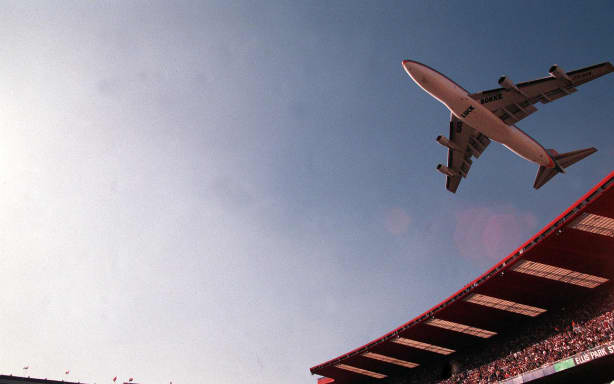
The 1995 Rugby World Cup flyover at Ellis Park.
©INPHO/Billy Stickland
The 2009 film Invictus, which dramatised the events surrounding the 1995 World Cup, recognised the cinematic power of the moment and recreated the flyover for the big screen.
Since then, aircraft have become a familiar part of major Springbok matchdays. It has also become an opportunity for spectacle.
Masters of the mind games, the Boks used the tradition to machiavellian effect in 2024, timing the flyover just as the All Blacks’ haka was reaching its crescendo.
The arrival of the Emirates Airlines A380 jumbo jet coincided with an explosion of fireworks and music, drowning out Kapa O Pango.
All Black Damian McKenzie voiced his displeasure about the tactic following New Zealand’s 31-27 loss.
“I don’t know when the plane was supposed to fly over. But it’s an opportunity for us to connect with back home, we knew the noise was going to be there, but it’s out of my control.”
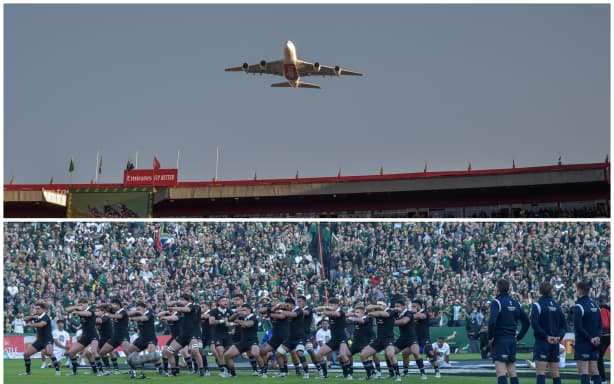
In 2024, an Emirates A380 jumbo jet did a flyover of Ellis Park while the All Blacks were performing the haka.
Catherine Kotze / www.photosport.nz
How low can they go?
Last weekend’s flyover in Cape Town proved the most daring flyover to date.
The stunning images were quickly shared on social media, with awe soon turning unease.
From some angles, the jets appeared to skim the stadium roof, while one aircraft flew right through the pyrotechnics. The footage prompted international concern about the margin for error when aircraft are operating so close to a large structure and a crowd of more than 50,000 people.
The airline behind the Airlink released a statement saying that the flight demanded careful planning and rehearsal, as it required navigating at low altitude – around 150 knots.
“The South African Civil Aviation Authority and Air Traffic Navigation Services provided valuable guidance, approval and support to ensure a safe flyby.
“The two aircraft were flown by highly-experienced crew, with each comprised of three senior captains operating in the roles of commander, co-pilot and safety/technical officer.”
Airlink also added that the flight data recorded by both aircraft confirms that the flights were performed within the SACAA’s approved and rehearsed safety altitude and speed limits for the flypast.
The SACAA said it had “initiated compliance verifications” with Airlink and will examine the available data before reaching its conclusions.
Regardless of the findings, the episode has raised the question far should a tradition rooted in one of rugby’s most significant moments be pushed in the pursuit of making the next flyover more dramatic than the last.
