


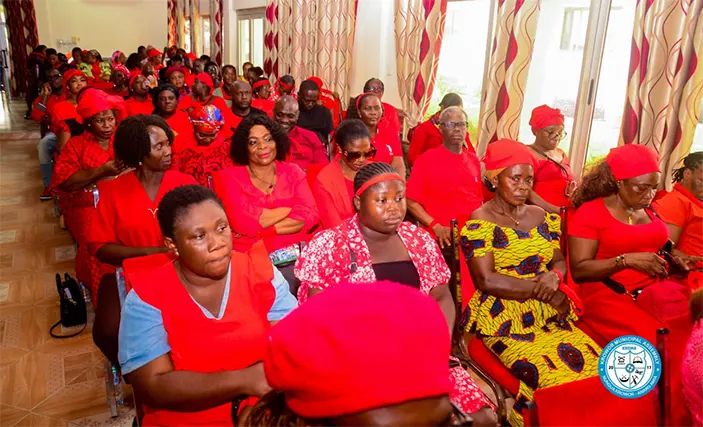
Some shop owners at the engagement
The Nungua Market Shop Owners Association has unanimously rejected the proposed demolition of their privately acquired and funded shops for the construction of a new 24-hour economy market, demanding an immediate cancellation of the demolition plans.
Speaking following recent stakeholder engagements with the Krowor Municipal Chief Executive, the Nungua Market Shop Owners Association and the shop owners at the premises of the Nungua GNAT Hall, the Secretary of the Shop Owners Association, Mr. William Kassah, cited the severe threat to their private investments, the disruption of local livelihoods, and a complete lack of a secured relocation plan as primary grounds for their opposition, calling instead for a full renovation of the existing facility.
Detailing the group’s concerns, Kassah explained that demolishing the market would severely impact livelihoods, particularly for the majority female traders who have taken bank loans to finance their businesses.
Speaking with the media during an interview after the meeting, the Municipal Chief Executive (MCE), Paul Afotey Kwei, explained that the transformation of the Nungua Central Market into a modern 24-hour economy market and commercial centre is set to revolutionise local trade and community infrastructure.
Highlighting the objectives of the 24-hour economy market, he said the project aims to deliver safe, modern trading spaces, boost public health, upgrade sanitation, lower the number of exits from 14 to a manageable count, and introduce digitalised market management tools alongside improved security.
According to the MCE, a structural integrity report deemed the current 20-year-old market structurally uninhabitable, making a full rebuild necessary within an 18-month execution timeline following sod-cutting.
He assured traders that funding is fully secured in the assembly’s bank account via the District Assemblies Common Fund, with 25% to 30% ring-fenced for the project, and pledged a written undertaking guaranteeing that existing shop owners would receive priority allocation upon completion.
”The concept of the 24-hour economy market, is a tool to stimulate economic activity through improved infrastructure, such as proper lighting, paving, and security, rather than requiring vendors to operate in rotating eight-hour shifts. This enhanced trading environment will allow businesses to operate longer, withstand poor weather conditions, and create additional employment,” he explained.
However, the Shop Owners Association and the traders opposed the proposed 24-hour economy modern market. Mr. Kassah, on behalf of the Association and the shop owners, noted that being displaced for two years or more would make it difficult for traders to meet their financial commitments to banks, while seeking temporary alternative stores would create an additional financial burden.
He emphasised that “the current shops represent private investments, as traders used their own money to acquire them and, in some cases, advanced funds for their construction to suit specific business needs.”
”Demolishing these structures without a clear relocation plan or formal arrangement,” he argued, “constitutes an injustice to shop owners.”
He stated that the financial strain on traders would be compounded by active financial obligations and temporary relocation expenses. “Closing shops for an extended duration would severely hinder members’ ability to service existing bank loans and other business-related debts, at the same time, forcing traders to find and fund alternative shops and storage facilities at exorbitant market rates would impose an additional financial burden during a period when their primary income is already halted.”
On behalf of the Shop Owners Association, he also highlighted significant flaws in the assembly’s approach regarding planning and the condition of the physical site. He pointed out a total lack of a clear relocation plan for shop owners, noting that the assembly’s proposed arrangements appear tailored toward tabletop traders while leaving established businesses without a secure alternative.
Additionally, he said the existing market is approximately 20 years old and is not structurally dilapidated to the extent that complete demolitions are the only reasonable option.
The traders also raised concerns over historical maintenance and the core purpose of public development, saying, “Since the Nungua traditional authorities assumed the management of the market in 2021 to date, shop owners continued to pay annual ground rent, yet little or no significant maintenance has been undertaken. Shop owners should not now bear the consequences of years of inadequate maintenance.”
For her part, Madam Nina, one of the shop owners, stated that the market does not belong to the government, nor was it built using public funds. Instead, the market consists entirely of private individual properties. Every shop owner personally funded and constructed their own space, including shops and warehouses, or acquired and rented them directly from individual owners.
Consequently, demolishing the market for the proposed 24-hour economy project, she said, would destroy millions in private capital and completely ruin the livelihoods of everyday traders.
”Rather than demolishing all the existing shops, the local authorities should renovate the current market structure instead,” she said.
Alternatively, she added that if a new modern project is required, the government should secure a different suitable location to construct it from scratch, ensuring that existing business owners are not stripped of their hard-earned investments and daily income.
By Janet Odei Amponsah
