


Wednesday 02nd September, 2026 04:41 PM|

Kenya’s police have promised to remain neutral and protect all participants in the 2027 General Election, as concerns over political violence and the reported use of organised groups raise fresh questions about whether voters can trust security agencies to act impartially.
Speaking on Wednesday, September 2, 2026, during a high-level National Election Security Roundtable Consultative Forum convened by the Independent Electoral and Boundaries Commission (IEBC) in Nairobi, Inspector General of Police Douglas Kanja said the National Police Service (NPS) would work with the electoral body and other stakeholders to secure a peaceful and credible election.
“The National Police Service reaffirms its commitment to neutrality, professionalism and readiness to secure a peaceful 2027 General Election,” Kanja said.
The pledge comes amid growing political debate over security, policing and the alleged use of groups commonly referred to as “goons” to disrupt political activities.
The Kenya National Commission on Human Rights (KNCHR) said in August that it had documented incidents involving political intolerance, violence, intimidation and the alleged use of organised groups to disrupt the rights and freedoms of Kenyans. The commission called for action against those responsible and urged authorities to protect constitutional rights.
The claims have increased pressure on security agencies to demonstrate that their response to political violence will be based on the law rather than political affiliation.
For the NPS, that makes neutrality one of the most important tests of its preparations for the August 2027 polls.

Goonism raises stakes
The issue carries particular weight in Kenya because organised political violence has previously accompanied disputed elections.
The violence that followed the 2007 presidential election left more than 1,200 people dead and more than 300,000 displaced, according to the United Nations human rights office, as scale of that crisis remains part of the country’s political memory and has made election security a major concern whenever political tensions rise.
The current allegations are not evidence that Kenya is heading towards a repeat of 2007-08. But they explain why the emergence of organised groups around political activity is attracting scrutiny well before the 2027 vote.
Kanja has himself warned against hired groups and criminal gangs. The Inspector General has said police would not tolerate such groups as the country approaches the election.
The NPS framework now explicitly says officers should not engage in politics or give preferential treatment to any political party or candidate.
“Every participant throughout the electoral process must receive equal protection,” the framework states.
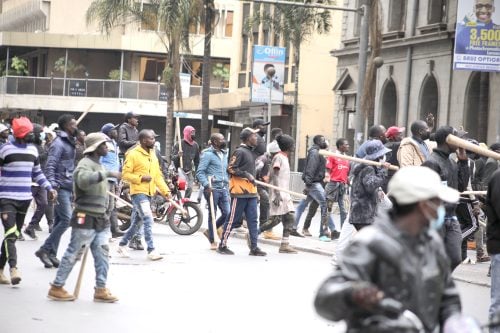
PHOTO/Bernard Malonza
That commitment provides a straightforward measure against which the conduct of the police can be judged during the campaign and voting period.
If rival political groups hold events in the same area, for example, the credibility of the neutrality pledge will depend on whether security is provided without favour. The same principle will apply to demonstrations, political rallies, polling stations and tallying centres.
The KNCHR has also documented recent incidents that it says illustrate the risks. These include the disruption of a public participation forum at All Saints Cathedral in Nairobi in June, where the commission said armed men stormed the premises, assaulted participants and damaged property, and a fatal attack during a political rally in Kisii County in July.
The commission’s findings do not establish who organised or financed the alleged groups. Those questions require investigation and evidence.
That distinction will be important as the election approaches, particularly as political accusations become more frequent.
Police build command
Alongside its neutrality pledge, the NPS is preparing a four-level security command system covering national, regional, county and sub-county operations.
At the national level, an IC3 Command and Communication Centre at NPS headquarters will provide strategic oversight and coordination.

Regional commanders will operate through Regional Security Committees and Regional Joint Operations Centres, while county commanders will coordinate security operations through County Security Committees and County Operations Rooms.
At sub-county level, police stations, county committees and designated national government administration officers will form part of the local coordination structure.
The NPS says the system will improve intelligence sharing, coordinate deployment and enable faster responses to threats affecting electoral operations.
Its five priorities are cooperation with the IEBC, inter-agency collaboration, command coordination, public order and human rights, and strategic communication.
The service also says officers will be responsible for protecting life and property, preventing and investigating electoral offences, securing polling and tallying centres and protecting IEBC personnel.
But the success of the structure will ultimately depend on how it operates on the ground.

A sophisticated command system cannot by itself guarantee political neutrality. That will depend on decisions made by individual officers and commanders when rallies become tense, protests break out, or rival political groups accuse each other of intimidation.
The NPS says those decisions must be guided by neutrality, equal treatment, accountability and the rule of law.
Kanja said the police would remain committed to ensuring that Kenyans could exercise their democratic rights in a safe and peaceful environment.
“Our commitment is to ensure a secure, peaceful, credible and lawful electoral process before, during and after the 2027 General Election,” he said.
For Kenyan voters, the most important question ahead of 2027 may therefore be less about how many officers are deployed than whether every participant receives the protection promised by the police.
As concerns over political violence and alleged goonism continue to draw attention, the NPS will face a test of both security and public confidence: proving that its promise of neutrality applies equally to those on every side of Kenya’s political divide.
