



The antiretroviral medicine lenacapavir, delivered via injection every six months, is almost completely effective in preventing HIV. But it is expensive at present, and millions will need to be initiated on it every year to make a dent on HIV transmission in South Africa.
CAPE TOWN – South Africa has the biggest population of people living with HIV in the world – over eight million people, around 18% of those aged 15 to 49. So its Health Ministry and researchers are laser-focused on HIV prevention tools, particularly how to optimise pre-exposure prophylaxis (PrEP), which involves using antiretroviral medication to prevent HIV.
The newest PrEP offering is lenacapavir, Gilead’s “miracle” twice-yearly injection that has prevented almost 100% of HIV transmission in clinical trials, some of which took place in South Africa.
The country started to roll out lenacapavir in June, and it is now available at 360 health facilities to anyone who feels at risk of HIV.
South Africa’s President Cyril Ramaphosa described the introduction of lenacapavir as “a major turning point in South Africa’s national story. It is the triumph of science over despair and the power of innovation to save lives”.
But fewer than 47,000 people have been initiated so far – mainly because the health department cannot afford a huge rollout.
Yet actuaries advising the government have worked out that the country needs to get at least 1.7 million people on lenacapavir every year for the next five years if it wants to break the transmission of HIV.
Drug price and procurement
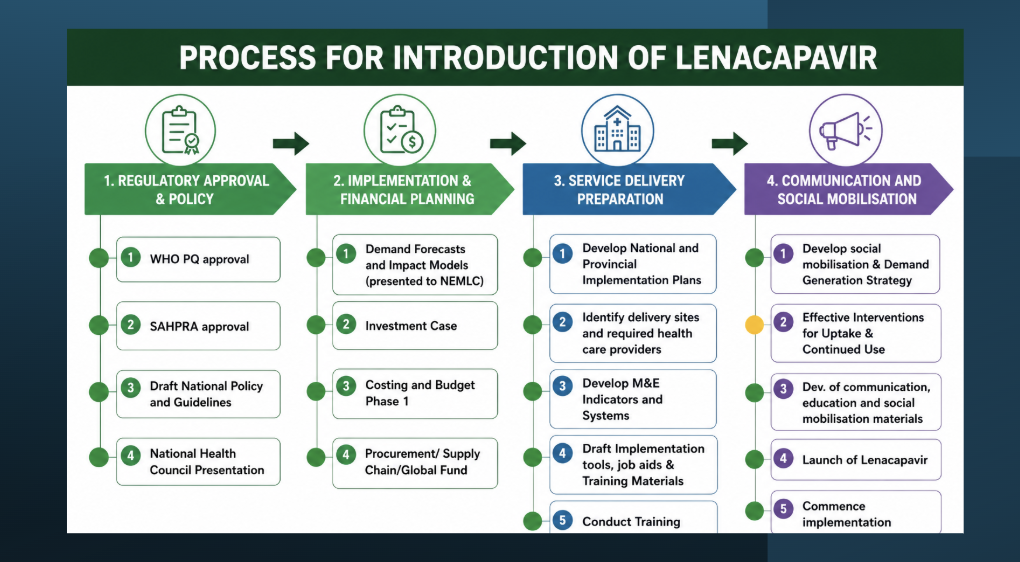
The Global Fund, which has an agreement with Gilead, is procuring the drug for South Africa, and has asked the health department to ring-fence $29.2 million of its three-year Global Fund grant for lenacapavir.
“The Global Fund asked us to budget for $60 per person per annum, and it is topping this up, but the price they are paying [to Gilead] is confidential,” says Hasina Subedar, senior technical advisor at the South African Department of Health.
This budget translates into doses for around 420,000 people. While the United States government is assisting other countries to buy lenacapavir, it decided not to support South Africa over political disagreements. However, the Children’s Investment Fund Foundation (CIFF) has stepped in to assist the country.
“We will really only be able to have roll-out at scale when we have the generics,” says Subedar, noting that lenacapavir has been included on the country’s essential medicines list, subject to the availability of generics at $40 per annual dose.
In October 2024, Gilead announced that it has signed non-exclusive, royalty-free voluntary licensing agreements with six pharmaceutical manufacturers to make and sell generic lenacapavir for 120 “high-incidence, resource-limited countries”. It has prioritised 18 of these countries, including South Africa.
The six are Dr Reddy’s Laboratories, Emcure, Eva Pharma, Ferozsons Laboratories Limited, Hetero and Mylan – none South African.
So far, only Hetero has submitted its dossier for regulatory approval to the South African Health Products Regulatory Authority (SAHPRA). Generics are expected by mid-2027, but it is unclear yet when they will reach South Africa.
Lumps and bumps: administering lenacapavir
 South African health facilities have offered oral PrEP since 2016, although the small supplies initially available were first directed to groups most at risk: sex workers, then men who have sex with men and then teenage girls and young women.
Since its introduction, some 2.3 million people have started oral PrEP, but have stopped taking the pills. Supply has been affected by the 2025 US budget cuts. But some people also get tired of daily pill-taking.
Others, particularly vulnerable young women, are reluctant for their partners to know that they are taking precautions against potential HIV infection.
This makes the six-monthly injectable option so attractive. But it’s not a simple process, as Subedar explains.
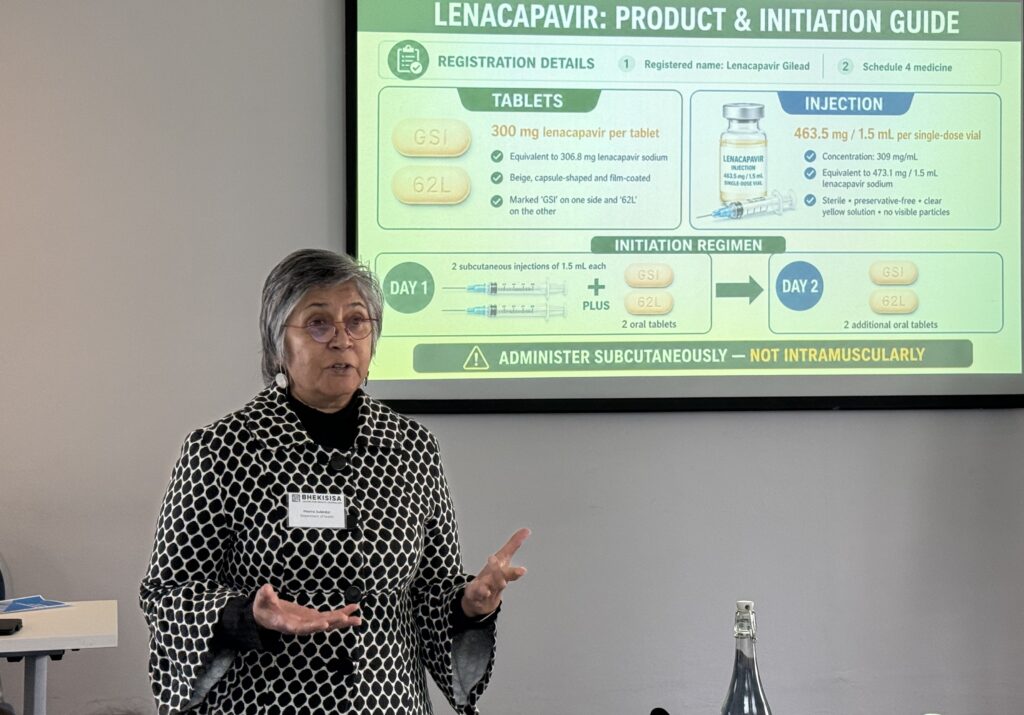
Lenacapavir initiation happens over two days. On day one, people get two 1.5ml injections in separate areas, administered subcutaneously (in the fatty layer of skin). This is usually in the person’s abdomen or buttocks. At the same time, they get two 300mg pills.
People are sent home with two 300 mg pills, which they need to take the following day. By day three, they are protected against HIV for the next 26 weeks until their next injections. They have a two-week grace period either side of their 26-week date to get their next injections. No pills are needed on subsequent visits unless they miss the two-week window.
Patients’ experiences: ‘Next time, the buttocks’

Dimpho Tsotetsi, who has used oral PrEP since 2017, switched to lenacapavir in a Soweto clinic on 4 July.
“I used to work in a [USAID] donor-funded clinic, so I knew it was coming,” said Tsotetsi, an extroverted 32-year-old trans woman who describes herself as a health advocate for her community.
“I had nausea every day with oral PrEP,” she added, and despite about two weeks of discomfort after her injections, Tsotetsi describes the experience as “pleasant”.
“I got two shots on my stomach, one on the left, one on the right. Until today I still have the bumps. I can feel them,” said Tsotetsi, who adds that this has made wearing clothes with tight waistbands harder as they rub against the injection bumps.
“Hence I’m wearing something flowy”, she laughs.
Precious Mafanga, a sex worker and sex worker advocate, describes lenacapavir as “very helpful and easy to take” – unlike oral PrEP “which makes you hungry”.
She and many others working in organisations serving “key populations” – those most at risk of HIV – have had a rough time since the US stopped funding these groups after Donald Trump came to power in January 2025.
Mafanga describes chaos in the sex worker sector, with job losses for peer educators, sex workers defaulting on antiretroviral medication and a lack of support for people who inject drugs as specialised clinics and mobile outreach came to a screeching halt.
In the past few months, a new organisation, Tholwana e Molemo, has stepped up to assist sex workers. While resources are much more limited, the organisation’s nurses have been able to work with government clinics to enable sex workers to get fast access to lenacapavir.

Meanwhile, Siviwe Gaika, a 24-year-old law student and church-goer who uses PrEP to protect herself, said she tried to get lenacapavir three times before her local clinic, a designated site, was ready to administer it.
She also describes bumps on her abdomen at the injection sites: “I think next time I will get it on the buttocks.”
It was the buttocks for Lindiwe Mqatazana, who had a positive pregnancy test and lenacapavir all in the same day.
“It was a bit scary, but the nurses explained that this is the best way to protect my baby and that it won’t hurt the baby,” said Mqatazana.
Million-person rollout
Dr Lise Jamieson from the Health Economics and Epidemiology Research Office (HE2RO) at Wits University is one of the health economists advising the health department.
Using Thembisa, a mathematical model of the South African HIV epidemic, researchers have made various forecasts, said Jamieson. Their key message is that lenacapavir will be far more effective than oral PrEP – if it is rolled out at scale.
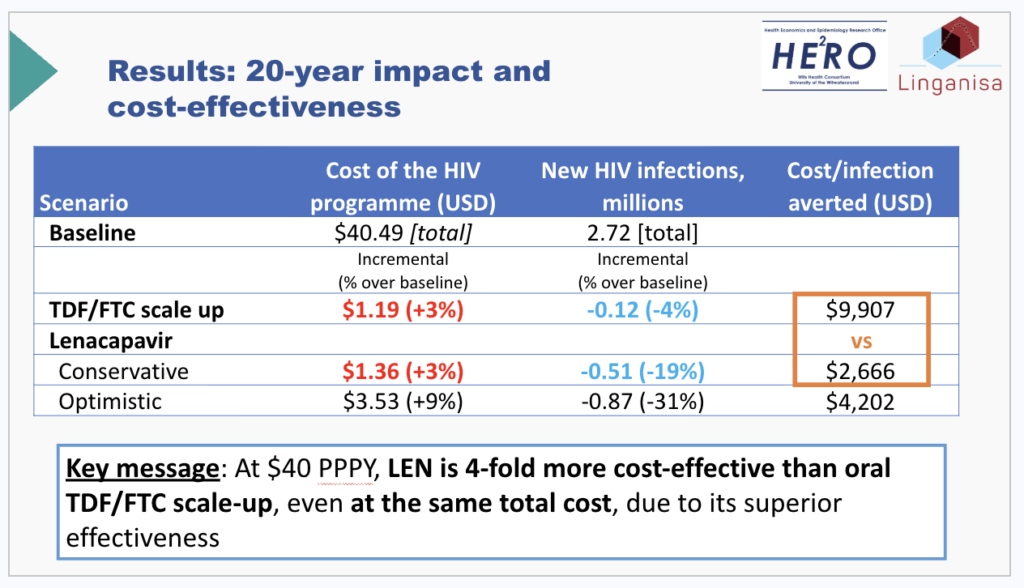
After modelling various scenarios, they calculate that lenacapvir can reduce HIV by 19-31% over 20 years in comparison to 4% by oral PrEP. It will also end AIDS seven to 10 years earlier than oral PrEP.
But this impact requires serious volumes: between 1.7 million and 2.3 million people need to start lenacapavir every year for at least the next five years.
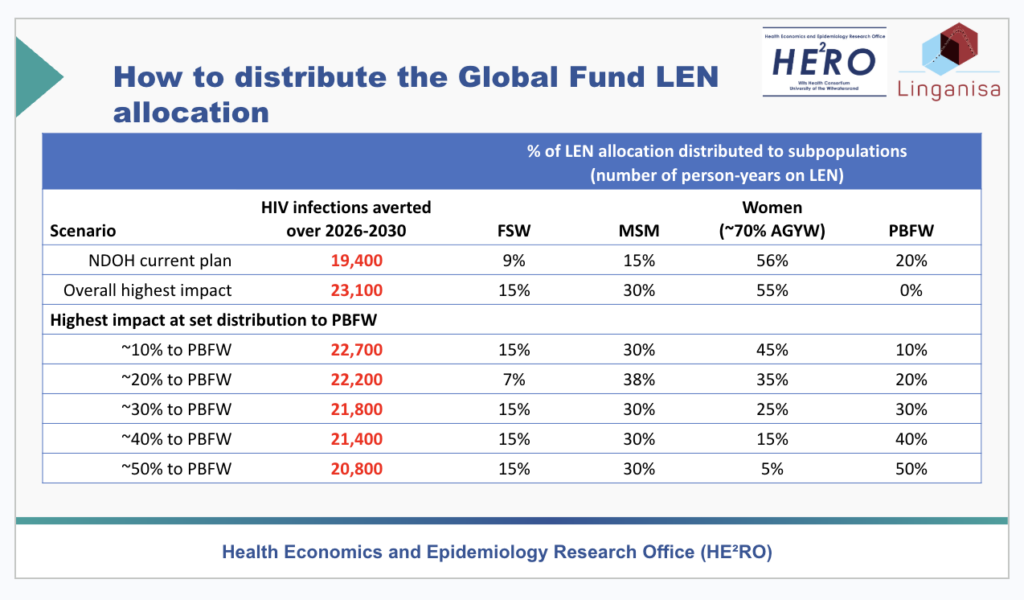
The rollout needs to be more targeted at those who need it most, with the most optimal breakdown to be 45% for adolescent girls and young women (AGYW); 30% for men who have sex with men (MSM); 15% for female sex workers; and 10% for pregnant and breastfeeding women.
This is slightly different from the health department’s targets, which are weighted more heavily to teenage girls, young women, and pregnant and breastfeeding women. Currently, it is hard to tell which groups most of the 47,000+ people who have opted for lenacapavir come from, as over 70% describe themselves as the “general population”.
Meanwhile, the financial investment is substantial, with up to $106 million needed for five years – but, says Jamieson, this is still four times more cost-effective than oral PrEP.
More choices
“The excitement about lenacapavir is huge, but what is the follow-up going to be like?” asks Dr Pippa McDonald, from the Desmond Tutu Health Foundation. The foundation was one of the partners that ran the clinical trial of lenacapavir, and is currently monitoring people’s responses and uptake to the medication.
So far, over 80% of people surveyed want the six-monthly injections rather than oral PrEP, said MacDonald.
“Choice is really important,” says MacDonald, who believes that offering different PrEP options and points of delivery are important ingredients for success.
A monthly PrEP pill, alimatravir, is currently undergoing clinical trials – and may prove even more popular than the six-monthly injections.
At the International AIDS Society (IAS) conference in Brazil in July, the company developing the pill, Merck/ MSD, announced that it has already granted voluntary licenses to seven generic companies – three in sub-Saharan Africa and four in India – to produce the medicine for 129 low- and middle-income countries. This is even before the medicine has been proven effective.
There are many possibilities in the mix, including the government distributing PrEP in partnership with private pharmacies and people self-injecting follow-up lenacapavir doses.
But there are still many unknowns, principally how fast generic lenacapavir can be produced, whether there will be enough money for the scale needed, and how many people will come back after six months.
Interviews for this article are from a media workshop on South Africa’s lenacapavir rollout organised by Bhekisisa.
Combat the infodemic in health information and support health policy reporting from the global South. Our growing network of journalists in Africa, Asia, Geneva and New York connect the dots between regional realities and the big global debates, with evidence-based, open access news and analysis. To make a personal or organisational contribution click here.
