


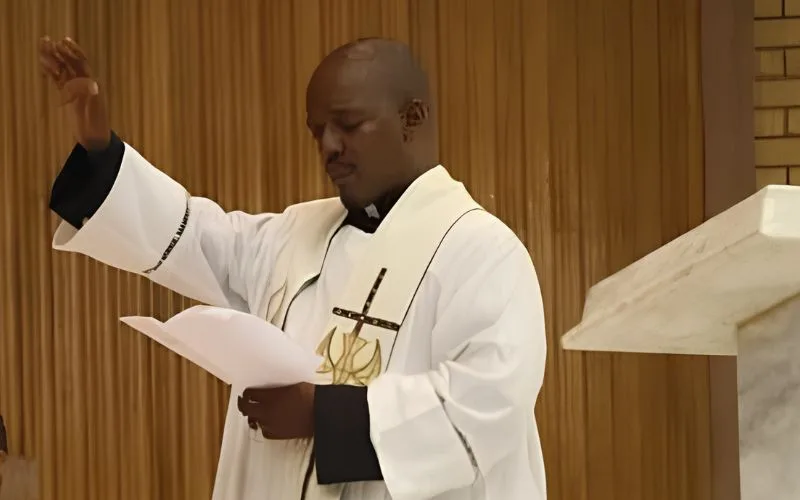
In a letter to the Clergy, Members of the Institutes of Consecrated Life and the Societies of Apostolic Life (ICLSAL), and the faithful of the Diocese, the Ghanaian Catholic Bishop attributed the suspension to what he described as “serious acts” on the part of the Priest.
Bishop Opoku-Agyemang highlighted the seriousness of the actions, including “a unilateral decision” by the suspended Priest “to take a leave of absence from the diocese” and to abandon “his pastoral ministry at the St. Anthony of Padua Rectorate, Nkwantakese, without legitimate permission (in contravention of Can. 533 §1).”
The decision of the Diocese to impose an indefinite canonical suspension a divinis on Fr. Adapore, according to the August 27 statement by the Diocesan Chancellor, has sparked criticism on social media platforms, with some questioning whether “sufficient efforts were made to locate him before imposing the suspension”
“These concerns deserve to be taken seriously,” Fr. Kyere states in the statement, alluding to sentiments by those suggesting that the Diocese “is more concerned with discipline than care,” or “raising doubts about the canonical basis and procedure in relation to Canons 533 and 1717, including whether Fr. Adapore’s right to defence was respected.”
While acknowledging that the Ghanaian Episcopal See doesn’t object to questions about the welfare, whereabouts, and safety of the suspended Catholic Priest, Fr. Kyere emphasizes, “It would be a misunderstanding to conclude from a public disciplinary statement that the Diocese cares only about punishment and not about finding, assisting, and caring for him.”
“A statement announcing canonical discipline is not, and cannot be expected to be, a full account of every pastoral, administrative, canonical, and personal steps taken,” the Chancellor of the Konongo-Mampong Diocese said.
He added, “The Church can ask whether a priest is safe while also determining whether he has abandoned his assignment without authorisation, and can seek his whereabouts while regulating his ministry.”
“If a pastor leaves his parish, removes his belongings, stops communicating, and does not return, the Bishop cannot simply set the matter aside indefinitely because his location is uncertain,” Fr. Kyere said.
He further explained that a Local Ordinary “has duties not only to the priest but to the parish, the faithful, and the wider diocesan community, who have a right to the sacraments and to responsible governance. The Bishop must therefore ensure ministry continues even when a priest becomes unavailable.”
“The proper conclusion is therefore not ‘find the priest instead of disciplining him,’ but rather: find him, care for him, establish the facts, respect his canonical rights, and at the same time fulfil the Bishop’s duty to maintain the order and pastoral life of the Diocese,” he said, adding, “That is not a failure of pastoral charity — it is pastoral charity exercised together with ecclesiastical responsibility.”
