


Monday 17th August, 2026 08:49 AM|
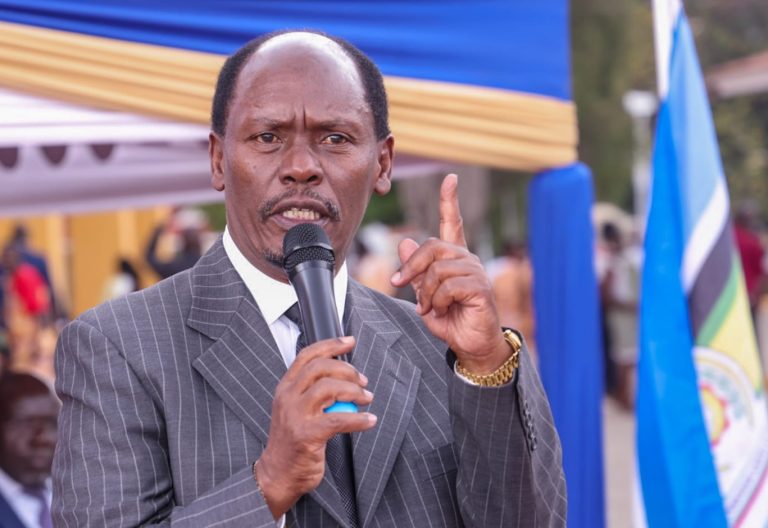
Cabinet Secretary for Information, Communications and the Digital Economy William Kabogo has dismissed suggestions that the Democracy for the Citizens Party (DCP) victory in the Ol Kalou parliamentary by-election was a decisive indicator of how Kenya will vote in the 2027 general election.
Speaking in an interview with Kameme FM on Monday, August 17, 2026, Kabogo said the outcome should instead be viewed within the wider pattern of by-elections held since the 2022 General Election, arguing that the government-backed candidates have maintained a significant advantage overall.
“The defeat of the government candidate in Ol Kalou is neither here nor there. We have had 10 by-elections, and the government has won nine and the opposition has won one,” Kabogo said.

His remarks come weeks after the July 16, 2026, Ol Kalou by-election, in which DCP candidate Sammy Douglas Kamau Waweru secured a landslide victory to take the parliamentary seat previously held by the late David Njuguna Kiaraho.
DCP’s Ol Kalou breakthrough
Waweru was declared the winner by the Independent Electoral and Boundaries Commission after garnering 35,440 votes. His closest challenger, United Democratic Alliance candidate Samuel Muchina Nyagah, polled 5,450 votes.
The result represented a major upset for UDA and gave DCP its first National Assembly seat. The margin of victory also made the contest one of the most closely watched by-elections in Kenya in 2026.
The outcome was particularly significant because Ol Kalou is located in Nyandarua County, part of the wider Mount Kenya region, where President William Ruto enjoyed strong support in the 2022 presidential election.
The contest was therefore quickly interpreted by political opponents of the Kenya Kwanza administration as evidence of shifting political loyalties in the region and a possible warning ahead of 2027.
Kabogo, however, has rejected that interpretation.
‘Mount Kenya results are 50-50’
According to Kabogo, the broader picture in Mount Kenya does not support the argument that the Ol Kalou result represents a political realignment across the region.
“In Mount Kenya region, we have had two by-elections, and the government has won one and the opposition has won one. It is a 50-50 win,” he said.
His assessment places the Ol Kalou result alongside other electoral contests in the region rather than treating it as an isolated political referendum on the national government.
“If anyone thinks that Ol Kalou was a lesson to Kenya, they are mistaken,” he said.
Different picture from national by-elections
The Ol Kalou result broke a string of victories by UDA and other Kenya Kwanza-aligned candidates in parliamentary and senatorial by-elections.
Among the contests won by government-backed candidates were Malava, Banissa, Mbeere North, Isiolo South, Emurua Dikirr and the Baringo Senate seat.
Against that background, the Ol Kalou victory offered DCP and former Deputy President Rigathi Gachagua a significant political boost.
The result was especially important for Gachagua because DCP had positioned the by-election as an opportunity to demonstrate its ability to challenge UDA in the Mount Kenya region.
Waweru’s victory also provided the party with its first elected MP, giving DCP a foothold in Parliament and a platform from which to build its political organisation ahead of 2027.
Why Ol Kalou attracted national attention
The by-election became more than a contest for a parliamentary seat because of the personalities and political interests surrounding it.
UDA was seeking to retain a constituency in a region that has increasingly become central to the political calculations of the Kenya Kwanza administration and its opponents. DCP, meanwhile, saw the contest as an opportunity to demonstrate Gachagua’s influence after his fallout with President Ruto.
The campaign consequently attracted considerable attention from national political leaders, with the result eventually being framed as a contest between the administration and the emerging opposition forces.
The size of Waweru’s victory further intensified the debate. He secured more than six times the votes of his closest rival, turning what had been expected to be a closely watched contest into a decisive DCP win.
Different political contest
The 2027 general election will involve millions of voters across all 47 counties and will be shaped by issues extending far beyond the circumstances surrounding an individual parliamentary by-election.
Presidential candidates and political coalitions will have to compete across regions, assemble national alliances and address issues such as the economy, cost of living, employment, development, taxation and governance.
A parliamentary by-election, by contrast, is heavily influenced by local personalities, constituency issues, party structures and the circumstances surrounding the vacant seat.
For Kabogo, these differences make it premature to use Ol Kalou as a definitive measure of what will happen in 2027.
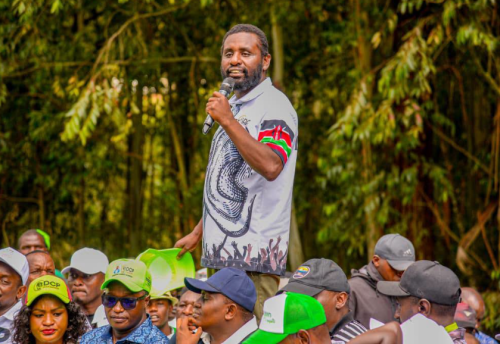
The Ol Kalou defeat nevertheless gives the opposition an important political talking point. It demonstrates that UDA is not guaranteed victory in every contest in Mount Kenya and that DCP can convert political mobilisation into an electoral victory.
At the same time, the government’s record in other by-elections gives Kenya Kwanza reason to argue that Ol Kalou was an exception rather than evidence of a nationwide collapse in support.
Warning or isolated defeat?
The political significance of Ol Kalou is therefore likely to remain contested.
For Gachagua and DCP, the result offers evidence that their campaign to establish a political base in Mount Kenya can produce electoral gains.
For the government, Kabogo’s interpretation presents the result as one defeat within a much larger record of electoral victories.
What happens between now and the 2027 General Election will ultimately determine whether Ol Kalou becomes the beginning of a broader political shift or remains a major but isolated by-election upset.
For now, Kabogo’s message is that Kenyans should not conflate a single-constituency contest with a national electoral verdict.
The Ol Kalou by-election may have changed the political conversation in Mount Kenya, but according to Kabogo, it has not written the script for Kenya’s 2027 election.
