


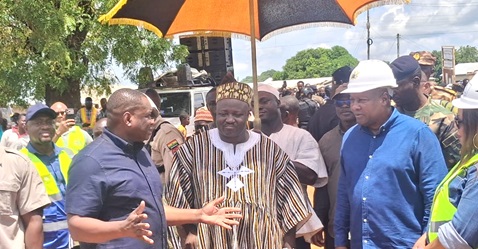
President John Dramani Mahama says the time has come for the Upper East Region to have its own airport to facilitate travel, stimulate economic activity and attract investment to the region.
He said the proposed airport would end the need to travel about 160 kilometres to Tamale to access domestic flights to Accra, while also providing a major boost to businesses and the mining industry.
The President made the remarks yesterday when he inspected the proposed airport site in Bolgatanga as part of his Resetting Ghana tour of the Upper East Region.
Economy
President Mahama said the project would not only comprise an airport, but would also support the development of a city around the facility to maximise its economic value.
He said the airport was part of efforts to open up the country to air travel and make it easier for people to travel quickly between the region and Accra.
“We want to open up the country to air travel because there are some people who want to go very quickly to Accra, transact their business and come back quickly,” he said.
The President said spending long hours travelling by road to Accra or driving to Tamale to catch a flight was a constraint to business and investment.
“Nobody wants to drive 11 hours to come to his factory in Upper East and drive 11 hours back to Accra,” he said.
President Mahama said the airport would also support gold mining companies in the region by providing an easier and more secure means of transporting gold bullion to Accra.
President Mahama described the facility as a potential “game changer” and urged residents to patronise it when completed so that passenger numbers would increase rapidly.
President Mahama said the sod-cutting would be done before the end of the year, with the project expected to take 24 months to complete, although contractors had indicated that they could finish earlier.
Airport passengers
The Board Chairman of the Ghana Airports Company Limited, James Agalga, said the airport would have a 2.2-kilometre runway capable of receiving both jet and propeller-engine aircraft currently operating on domestic routes.
He said the facility would have an apron capable of accommodating two aircrafts at a time, a link taxiway and airfield lighting to facilitate night operations.
The terminal building would be integrated with an air traffic control tower, while a Rescue and Fire Fighting Services facility would also be constructed.
Mr Agalga said an approximately five-kilometre asphalted access road formed part of the contract.
He said the airport would initially handle about 100,000 passengers annually, with the terminal designed to allow for future expansion.
The project, he said, was currently at the public procurement stage, with the necessary approvals expected by October to allow for the sod-cutting ceremony.
Chuchuliga-Sandema road
President Mahama subsequently inspected work on the Chuchuliga-Sandema road, which forms part of the broader Chuchuliga-Tumu-Wa corridor linking the Upper East and West regions.
The project has an original contract sum of GH¢469,711,150.35 and covers 24.23 kilometres plus an additional 10.18 kilometres.
It is being executed by Myturn Limited, with work having commenced on January 7, 2026 and scheduled for completion on January 6, 2028.
As of now, physical progress stood at 28 per cent, marginally below the planned progress of 29 per cent.
President Mahama said the road was important because it provided a major link between the Upper East and West regions and formed part of the government’s Big Push programme, under which priority roads receive annual budgetary allocations.
He recalled that the sod was cut for the project in 2016, but work stalled after his administration left office.
Arrears cleared
The Minister of Roads and Highways, Kwame Governs Agbodza, said payment challenges had previously slowed work on the road.
He said the government had, as of the previous month, paid a total of GH¢23.1 billion, including payments to Big Push contractors and the settlement of arrears.
Mr Agbodza said the bulk of the amount represented arrears owed to contractors.
He said the payment of outstanding debts had begun to reflect in the level of activity on project sites across the country.
