


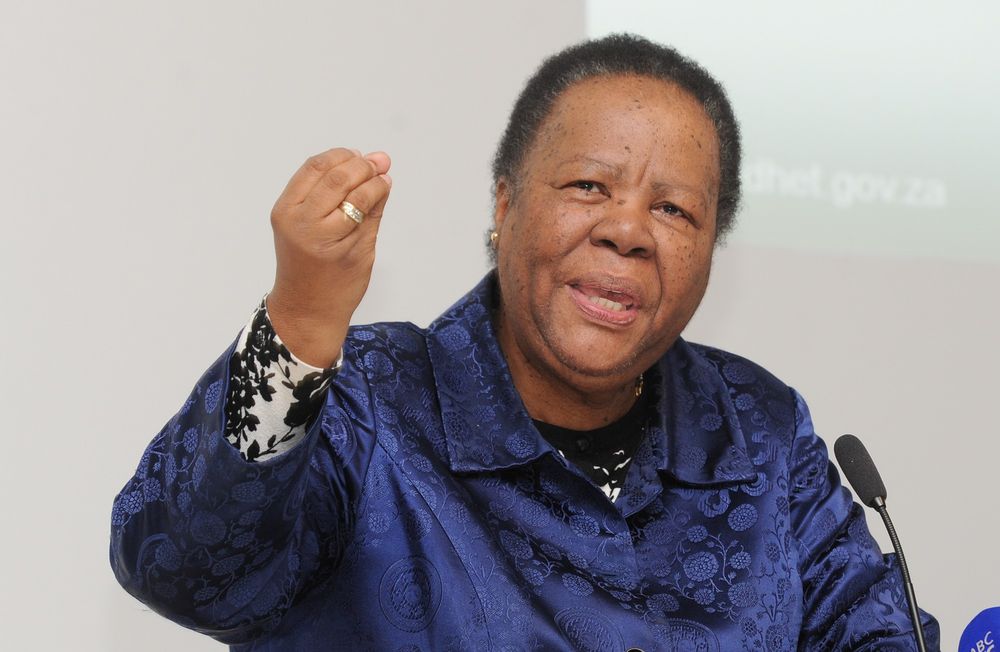
Former Cabinet minister Dr Naledi Pandor has expressed “disappointment” with the Ghanaian and Nigerian governments for blaming South Africa over anti-migrant violence, saying African leaders must confront the economic and political failures driving citizens to seek opportunities elsewhere.
Pandor, the former international relations minister, made the remarks in an interview with former EFF heavyweight Dr Mbuyiseni Ndlozi on the African Renaissance Podcast.
Her comments come amid growing debate over immigration across Africa and in South Africa, where anti-migrant groups continue to call for undocumented foreign nationals to leave the country despite repeated government appeals for calm.
Many migrants who came to South Africa in search of better opportunities say they are now living in fear as hostility towards foreign nationals intensifies.
Protesters, including controversial anti-migrant group March and March, argue that undocumented immigrants are taking jobs from South Africans, placing pressure on healthcare services and schools, and failing to contribute to the economy through taxes.
Nigeria and Ghana have strongly condemned anti-immigrant violence in South Africa, urging authorities to stop xenophobic attacks and protect foreign nationals who are lawfully resident in the country.
The violence and attacks on African migrants have prompted Nigeria, Ghana and Malawi to repatriate some of their citizens and summon South African diplomats.
Two Ghanaian nationals have also reportedly asked the International Criminal Court to examine years of xenophobic violence in South Africa, arguing that repeated attacks on foreign nationals could amount to crimes against humanity.
The petition, submitted to the ICC prosecutor by former Ghanaian government spokesperson Palgrave Boakye-Danquah and security analyst Emmanuel Kotin, seeks accountability for recurring attacks on migrants.
However, South Africa has repeatedly rejected claims that the country is xenophobic.
Commenting on Ghana and Nigeria’s stance, Pandor said she was disappointed by the reaction from the two countries.
“Well, you know, I was, as their co-minister, I attended AU meetings, so I was quite familiar with seeing leaders avoid difficult questions. And what our leaders are not doing is asking themselves why so many of their nationality or citizens wish to be in South Africa, which is a fairly small economy. It’s large in African terms, but it’s small in world terms.”
Pandor said migrants primarily came to South Africa as economic migrants or political asylum seekers.
“And it means, therefore, that a number of countries on the African continent are not doing what they should in order to provide for their people,” she said.
She argued that poor economic conditions, a lack of opportunities and shortcomings in human rights were among the factors driving migration to South Africa.
“You’re not getting the economies right and you don’t have freedom of association, freedom of expression and human rights. The people are running to South Africa because those things exist here.”
“I think that the leaders know that the government of South Africa is not behind what was happening here,” she said.
“They know that there are organisations like March and March, which are leading this anti-migrant attitude. And that the government has tried to act, to assert human rights, to assert nonviolence and has not been listened to.”
She said it was problematic to blame South Africa as a whole for the actions of specific groups.
“But I think that often, on our continent, our leaders avoid complexity. When the subject is too difficult, they divert to something else.”
Pandor said African leaders needed to confront the underlying causes of migration, including economic development, infrastructure, rural development and opportunities for young people.
“All those problems of development are very closely linked to the issue of migration. And if our leaders don’t want to look at that, they’re always going to say, it’s South Africa, take it there, take it up.”
She said South Africa was right to call for a broader discussion on migration rather than allowing the issue to become a dispute centred solely on the country.
Meanwhile, last week IOL reported that International Relations and Cooperation Minister Ronald Lamola has similarly rejected calls to place allegations of xenophobia in South Africa at the centre of the next African Union summit, saying migration should be addressed as a continental issue.
Speaking at a media briefing in Pretoria, Lamola said South Africa supported the AU’s longstanding call for a continent-wide migration conference.
He said the conference should examine migration alongside economic development, regional integration, peace and stability, democratic governance and the root causes of anti-migrant sentiment.
“Migration is a continental phenomenon whose consequences extend beyond the jurisdiction of any single state,” Lamola said.
He said most African migration was intracontinental, with South Africa, Egypt and Ivory Coast among the continent’s major destination countries.
Lamola said South Africa did not support isolating the country over allegations of xenophobia, arguing that such an approach would amount to “naming and shaming” rather than producing solutions.
“We raised our view that any discussion on this matter must be comprehensive, dealing with the push and pull factors, the root causes of illegal migration – climate change, the economy, peace and stability, democracy – in a comprehensive manner,” he said.
Lamola said the AU had already agreed in 2015 to convene a migration conference and that the resolution should now be implemented.
“If the matter reaches the summit, it should do so as a well-considered report, not simply as an opportunity to name and shame countries,” he said.
He added that South Africa would cooperate with the African Commission on Human and Peoples’ Rights, which is expected to visit the country.
“It’s not that we are afraid of defending ourselves. We can do so if necessary, but we do not believe that would solve the problem.”
Lamola said the focus should instead be on addressing the root causes of migration, including unemployment, economic inequality, climate change, and instability.
“You cannot treat the symptom of the problem. You must treat the root cause to come up with a solution.”
[email protected]
IOL Politics
