


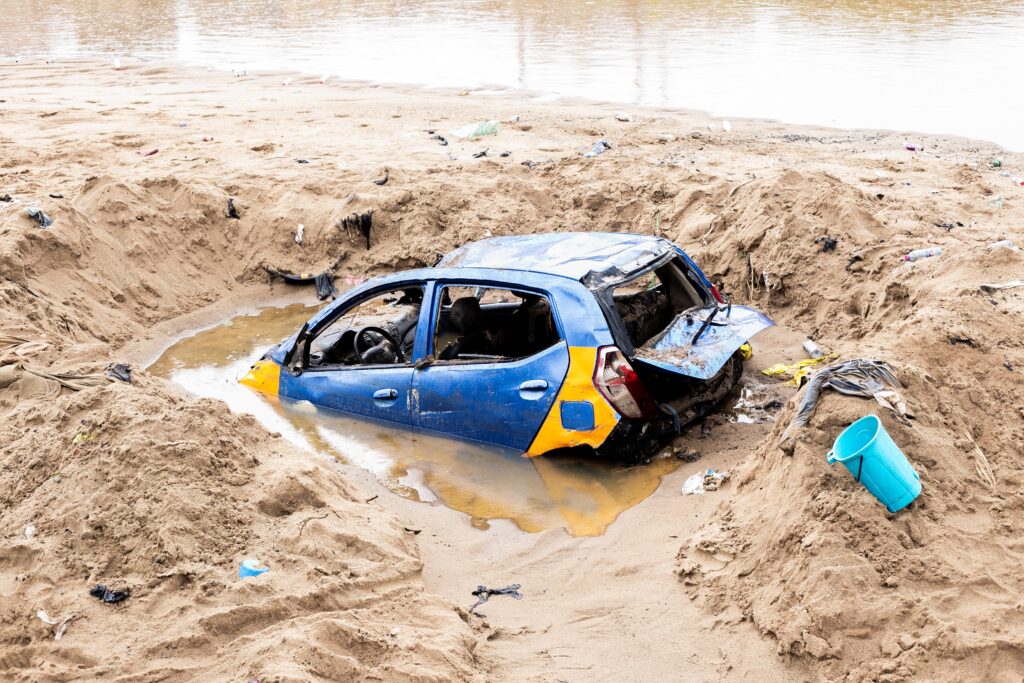
The pains that follow floods as a natural disaster, means that they are not to be used as political party symbols. In the same way, they are not meant to be used for political campaign messages to score political points.
Floods are tragedies that lead to loss of lives, destroy homes and interrupt livelihoods. Unfortunately, in Ghana, these disasters have become tools that politicians use to score points, trade blames and show selective concerns. That is not right. When water rises to destroy, the nation should rise together and not search for villains.
In 2018, when floods struck parts of Northern Ghana, and 34 people lost their lives. Survivors grieved, families buried loved ones, and communities struggled with recovery. Yet the then President of the Republic of Ghana, Nana Addo Dankwah Akufo-Addo and his Vice who hails from that enclave of the country, Dr. Mahamudu Bawumia, showed no urgency to offer relief to the victims. The following year, there was another devastating flood disaster in Accra, with five lives lost. Again, no one showed any concern.
The pattern did not end there. During the Akufo-Addo administration, there were unfortunate national incidents with the affected victims reportedly receiving little or no direct comfort through official presence or consolatory engagement. Instead, attention seemed to lean toward calamities outside Ghana, with instances where empathy and international solidarity were expressed, while those within the country struggled in silence. This approach does not strengthen national unity; it deepens distrust and widens the gap between leaders and ordinary citizens.
Volta flood warning: Leadership without logic is still neglect
When the Akosombo dam spillage occurred, and people in the Volta Region were displaced, leadership visited the affected areas. However, the response and official utterances raised concerns as instead of providing assistance, the voting pattern of the people were questioned. Then President Akufo-Addo visited the area and stated that if he were to go by the voting pattern of those people, he would not have done anything for them.
Let us be clear, people do not drown because of whom they voted for. They do not lose property because of political differences. When leaders treat disasters as political mathematics, the nation suffers twice—first through the flood, and then through humiliation from those who are meant to protect and serve everyone.
Now the floods return: Politics has again found a way
Recently, floods struck again, and public discourse quickly became partisan. Some opposition voices blamed President John Dramani Mahama for the situation. Others went further by attacking him publicly for his participation in a National Prayer and Thanksgiving Service, including the claim that the President “danced.” Others criticized that he used a helicopter to view flood damage. Let us state plainly: disaster does not require political theatre, and leadership presence does not become less valid because of the tone of a service or the method of observation.
If the President saw the destruction from the air, it was not to entertain himself; it was to understand the situation rapidly, assess where help was most urgently needed, and give informed direction. Aerial observation can provide a wider view of affected communities, road disruptions, the scale of damage, and the immediate interventions required. Leadership must work with clarity, especially under time pressure, because response delay costs lives.
There are also leaders and public representatives whose actions speak louder than their accusations. For example, when the Weija Dam spillage occurred, citizens expected those responsible for advocacy in the area to show presence with empathy, and not optics. While flood victims struggled, attention was reportedly drawn to the Member of Parliament of the Weija-Gbawe Constituency, Jerry Ahmed Shaibu, in a Black Stars jersey in the USA/Canada to watch matches. In moments like these, the public expects solidarity in the flesh, not solidarity in speeches. Yet, the same Ahmed Shaibu reportedly attacked President Mahama for his movements in a service setting. That double standard is what Ghanaians must reject. People cannot demand “compassion” from others while withholding compassion when it counts most. If leadership is real, it is consistent. If solidarity is genuine, it is not selective.
The Bible reminder: When Noah sent birds for the mission
The story of Noah in the Bible is not for decoration, but it teaches a spiritual principle: when the task requires a certain kind of visibility, Noah used what was best for the mission. That is, after the waters destroyed the earth, Noah sent out a raven, and later a dove, on repeated occasions to confirm whether the flooding had receded even though there were several big animals that could have been sent for that mission. The key point is that birds were chosen because they could observe from the air. In the same way, when leaders assess flood damage from above, they are not trying to “perform.” They are searching for accurate information to guide action.
If someone argues that the President could not have understood the situation because he used air observation, then that person is questioning the logic of visibility itself, an attitude that cannot help disaster response.
The most important truth: Floods do not belong to any party
The floods do not discriminate. They travel across borders and impact multiple countries. This is not a “Ghana issue only.” Nigeria, Togo, and Côte d’Ivoire were also affected during the same period. If Ghana has recorded fatalities, including 34 lives lost so far, we must also recognize that the region suffers together. Côte d’Ivoire’s reported fatalities include the loss of 59 lives so far.
So, the real question is not “Who caused it?” because nature does not sign manifestos. The real question is: What systems are we putting in place to end preventable loss? How quickly can we respond? How transparently are funds released? How effectively are shelters and relief distributed? How do we reduce risk before disasters strike again?
Cheap politics must stop—And accountability must begin
It is easy to blame an opposition leader. It is easy to attack a President for a dance or a prayer moment. It is easy to question a helicopter view. But when the roof collapses, when crops rot, when bodies are recovered, when families cry for help, the nation needs more than accusations.
Ghana needs immediate, transparent relief delivered to affected communities without delays or political bargaining; better early warning systems and emergency preparedness; improved drainage and flood-control infrastructure, especially in high-risk areas; serious enforcement of building and land-use regulations near water bodies; accountability mechanisms so that funds meant for disaster response do not disappear into administrative fog; and national unity in recovery, regardless of party affiliation, ethnicity, region, or voting history.
Conclusion
Ghana cannot afford to treat floods as political currency. Leaders who want credibility must practice compassion consistently and not only when it is advantageous. Citizens deserve more than symbolic visits, selective messages, or partisan commentary.
When disaster strikes, we should respond like one nation: with urgency, with empathy, with discipline, and with solutions that prevent the next tragedy. The water will keep rising if we keep drowning in blame. Let us stop cheap politics and join forces to rescue lives, protect communities, and build resilience, because calamity can happen to any regime, any region, and any family, at any time.
By Innocent Samuel Appiah
