


The National Security Council Secretariat (NSCS) has cautioned Ghanaians against taking the country’s peace and security for granted.
It said the changing security situation in the West African sub-region posed emerging threats that required sustained vigilance, stronger collaboration and early preventive action.
The Director of the National Counter Terrorism Fusion Centre, Major General Timothy Ba-Taa-Banah, said Ghana’s position as a beacon of peace in West Africa had not been achieved by accident and required the collective efforts of all sections of society to preserve it.
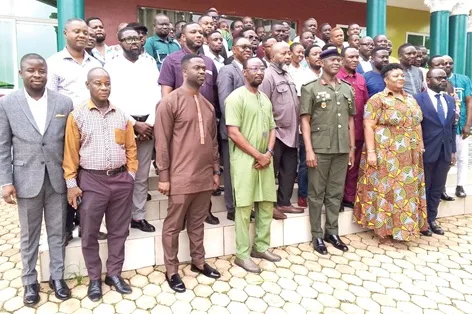
He was speaking at a strategic engagement between state security institutions and selected media practitioners from the Bono, Bono East and Ahafo regions in Sunyani last Friday.
The one-day engagement, organised by the NSCS, sought to promote responsible, accurate and peace-sensitive reporting on conflicts and other security-related issues, while building a voluntary partnership between the media and national security institutions.
Participants were taken through topics including responsible reporting in conflict zones, conflict-sensitive reporting and national security, and the role of the media in peace-building.
Media collaboration
Maj. Gen. Ba-Taa-Banah said Ghana was not immune to the security threats and hardships confronting other countries in the sub-region.
He underscored the need for continuous collaboration between the security agencies and the media to identify and address potential threats before they escalated.
He said journalists, being in close contact with communities, had access to information about the fears, concerns and grievances of people at the grassroots, which could serve as an important early warning mechanism.
“You communicate their fears and apprehensions to leadership for decisions to be taken, and then this serves as a sort of early warning for us to be able to act pre-emptively to secure our country,” he said.
Maj. Gen. Ba-Taa-Banah urged journalists to report anomalies or developments capable of disturbing the peace and serenity of their communities to responsible persons or security agencies.
The National Counter Terrorism Fusion Centre director also stated that the partnership with the media was particularly important because the country’s security environment had changed considerably over the past decade.
While giving an assurance that the state would continue to protect the country, Maj. Gen. Ba-Taa-Banah urged the media to complement those efforts by providing timely information to facilitate appropriate action.
The Second-in-Command, Strategic Communication at the NSCS, Bernice Hiadzi-Hetor, said the media possessed immense influence over how society understood events, responded to tensions and built confidence in public institutions.
She said the media also played a critical role in promoting social cohesion and strengthening confidence in national institutions and thus urged journalists to “inform without inflaming” and “investigate without inciting”, while reporting conflicts with accuracy, context and sensitivity.
A lecturer at the University for Development Studies (UDS), Dr James Natia, said fairness and balance in media reportage were essential to creating a peaceful society.
He said legitimate business interests should not be allowed to undermine fairness or the public interest, emphasising that balanced reporting could give individuals and stakeholders an equal opportunity to be heard and have their grievances addressed, while skewed reportage could create tension, misunderstanding and conflict.
Writer’s email:
