


“The axe forgets, but the tree remembers.” This African proverb aptly captures the historical relationship between the continent and global economic partnerships. As the dust settles on the recent Africa Forward Summit, African policymakers—particularly in Ghana—are left to ponder whether the latest wave of international agreements will plant the seeds of genuine industrial transformation or merely chop away at the continent’s economic sovereignty under the guise of green energy.
1. Background to the Summit: From Aspiration to Execution
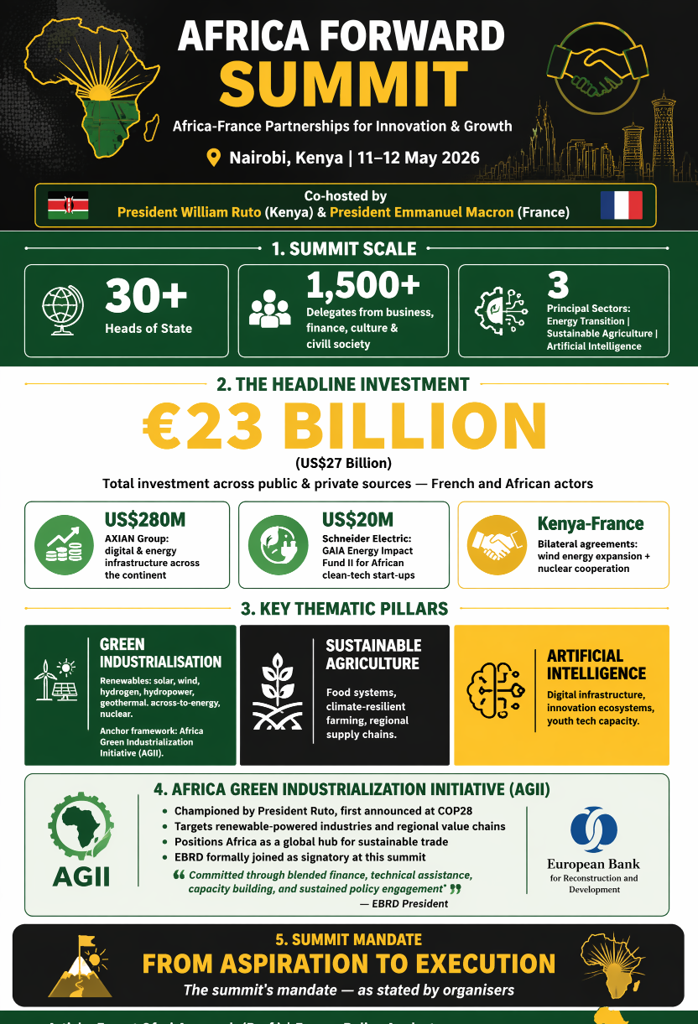
Held on May 11–12, 2026, in Nairobi, Kenya, the Africa Forward Summit (officially the Africa-France Partnerships for Innovation and Growth Summit) was designed with a singular mandate: to move Africa from aspiration to execution. Co-hosted by Kenyan President William Ruto and French President Emmanuel Macron, the gathering was a diplomatic and economic heavyweight event.
It brought together over 30 heads of state, including Ghana’s President John Mahama, alongside thousands of business leaders, youth representatives, and civil society delegates. With over 1,500 official delegates in attendance, the summit was meticulously structured to produce bankable, scalable, and implementable outcomes, moving away from the rhetorical promises that have historically characterized such bilateral summits.
2. Key Themes and Decisions Taken
The most ambitious and consequential thematic pillar of the summit was green industrialisation and energy transition. The outcome document issued a clarion call for accelerated commitments to promote green industrialisation through investments in renewable energy and low-carbon systems, spanning hydrogen, hydropower, geothermal, waste-to-energy, and nuclear power.
A landmark decision at the summit was the advancement of the Africa Green Industrialisation Initiative (AGII). Initially announced at COP28 and championed by President Ruto, the AGII is a pan-African framework aimed at accelerating the growth of renewable-powered industries, expanding regional value chains, and establishing Africa as a global hub for sustainable trade. Crucially, the European Bank for Reconstruction and Development (EBRD) formally joined African development finance institutions as a signatory to the AGII Framework for Cooperation. EBRD President Odile Renaud-Basso committed the institution’s support through blended finance, technical assistance, capacity building, and sustained policy engagement.
3. Major Investment Commitments
The Summit delivered substantive financial pledges, generating an overall investment of €23 billion ($27 billion) across public and private sources from both French and African actors. These funds are earmarked for three principal sectors: energy transition, sustainable agriculture, and artificial intelligence. Notable specific commitments included:
- Bilateral Energy Agreements: Kenya and France signed comprehensive agreements covering wind energy expansion and nuclear cooperation.
- Digital and Energy Infrastructure: The AXIAN Group and its partners committed $280 million to co-develop critical infrastructure across the continent.
- Clean-Technology Start-ups: Schneider Electric pledged $20 million to its GAIA Energy Impact Fund II, specifically targeting African clean-tech innovators.
4. Major Policy Directions: The Fault Line of Finance
Despite the impressive financial figures, the summit highlighted a critical policy fault line for African nations: the distinction between Transition Finance and Transformation Finance. This is not merely an academic debate; it is the difference between Africa becoming a passive site for green energy deployment versus an active centre of green industrial production.
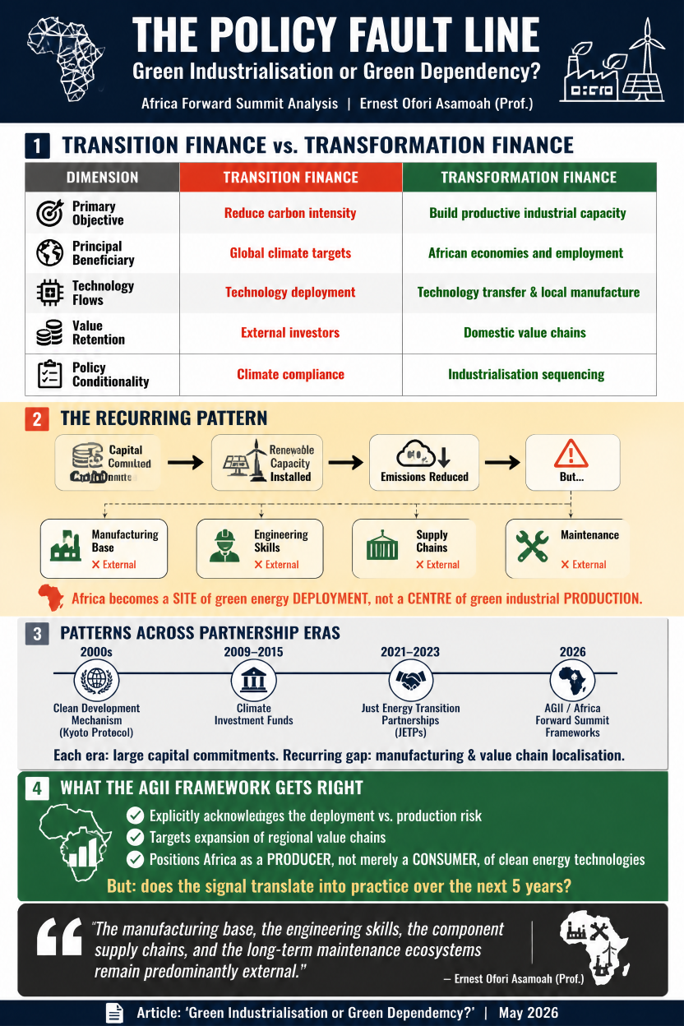
Historically, large-scale capital committed to Africa has led to increased installed renewable capacity and reduced emissions, but the manufacturing base, engineering skills, and long-term maintenance ecosystems have remained external. The AGII framework attempts to address this by explicitly targeting the expansion of regional value chains, positioning Africa as a producer of clean energy technologies.
5. What Ghana Can Do: Key Takeaways and Imperatives
For Ghana, the Summit presents both a profound opportunity and a structural risk. Ghana’s energy sector is currently at a critical juncture, burdened by non-cost-reflective tariffs, excess installed capacity relative to peak demand, legacy take-or-pay obligations, distribution losses, and persistent arrears. The Energy Sector Recovery Programme (ESRP) launched in 2019, has struggled to resolve the fundamental imbalance between installed capacity costs and recoverable revenue.
Access to blended finance and technology partnerships under AGII could help rationalise Ghana’s energy mix and attract private capital at lower costs. However, installing new renewable capacity without fixing the underlying distribution and revenue architecture will simply add a “green layer” to an unreformed, debt-ridden system. To ensure meaningful participation, Ghana must adopt three strict policy imperatives:
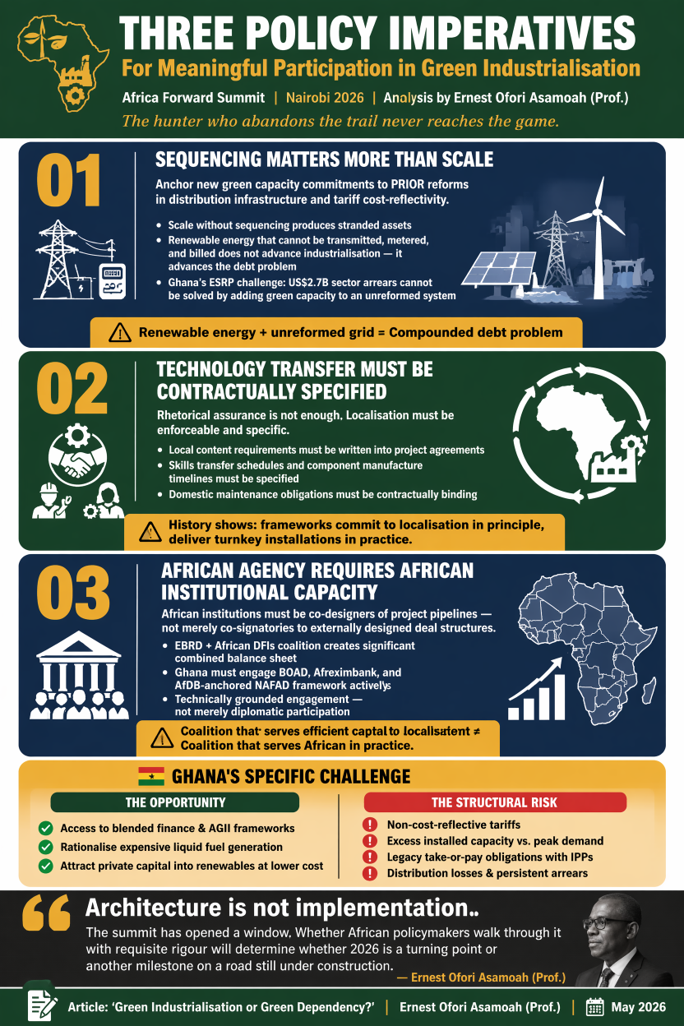
· Seqencing Matters More Than ScaleThe instinct in international partnerships is to maximize investment commitments for political optics. However, scale without proper sequencing produces stranded assets. Ghana’s priority must be to anchor any new green capacity commitments to prior reforms in distribution infrastructure and tariff cost-reflectivity. Renewable energy that cannot be efficiently transmitted, metered, and billed does not advance industrialization—it only advances the national debt problem. · Contractually Specify Technology TransferRhetorical assurances of technology transfer are insufficient. The AGII framework’s commitment to regional value chains is only meaningful if operationalized through specific project agreements. Ghana’s energy sector policymakers must insist on enforceable specificity: strict local-content requirements, mandatory skills-transfer schedules, component-manufacture timelines, and domestic maintenance obligations. The era of accepting turnkey installations must end. Leverage African Institutional CapacityAfrican agency requires robust institutional backing. The EBRD’s accession to the AGII framework alongside African development finance institutions creates a powerful multilateral coalition. Ghana must actively engage with institutions like BOAD, Afreximbank, and the AfDB-anchored NAFAD framework. Ghanaian institutions must act as co-designers of project pipelines, not merely diplomatic co-signatories to deal structures designed in Paris,London or New York. |
The Long View
The Africa Forward Summit represents a genuine step forward in the architecture of Africa-Europe partnerships on the energy transition. However, as the proverb reminds us, the hunter who abandons the trail never reaches the game.
Architecture is not implementation. The summit has opened a window of opportunity. Whether Ghanaian policymakers, energy sector institutions, and regulatory bodies walk through it with the requisite rigour and institutional discipline will determine whether 2026 is remembered as a turning point toward true green industrialisation or just another milestone on the road of green dependency.
By Prof Ernest Ofori Asamoah
Email: [email protected]
