


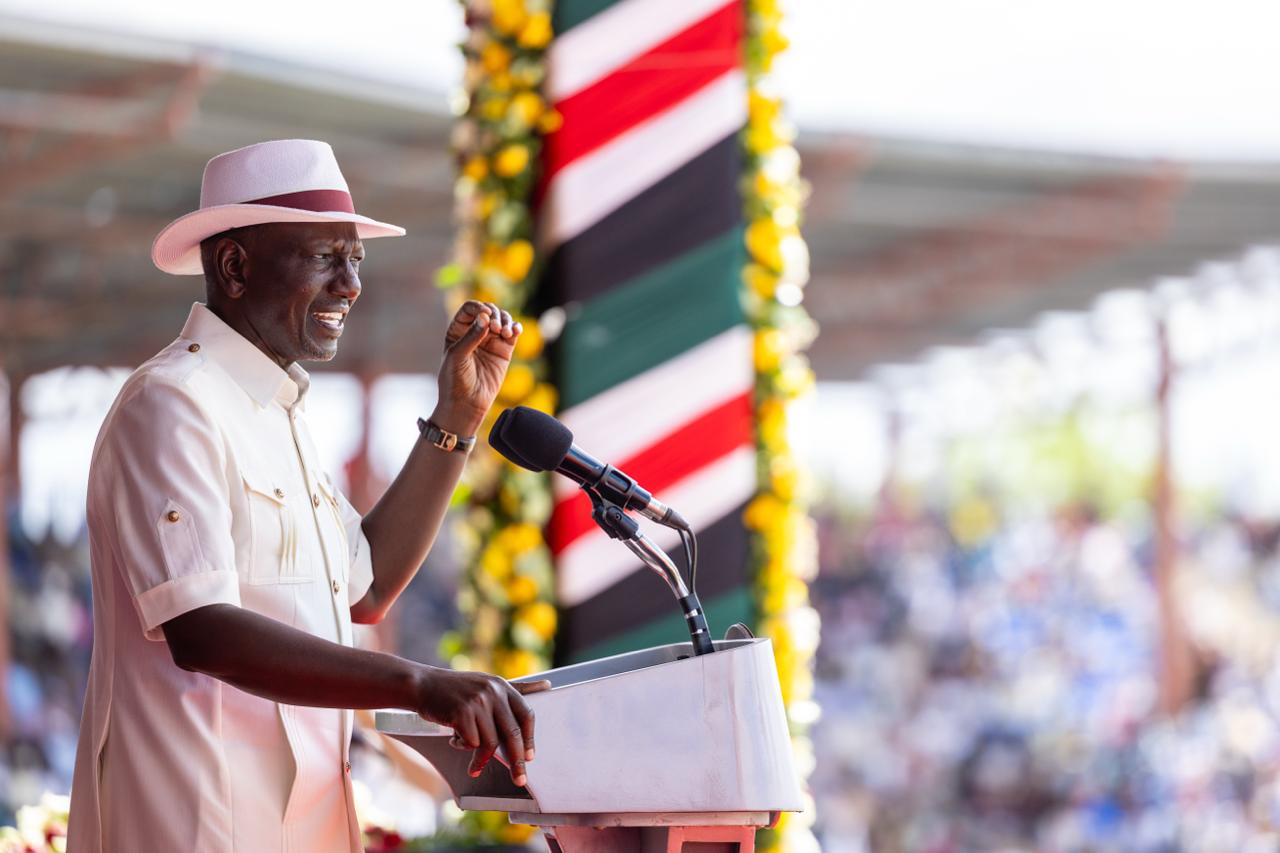
 President William Ruto giving his speech during Madaraka Day celebrations in Wajir County/PCS
Residents of Northern Kenya have seen expanded healthcare access under the Social Health Authority (SHA) programme, with President William Ruto saying more than 800,000 people across Wajir, Garissa and Mandera are now registered under the national health coverage system.
President William Ruto said the expansion marks one of the most significant gains in healthcare inclusion since independence, positioning the reforms as a central pillar of efforts to reduce long-standing inequalities in marginalised regions.
“Today, of the 31.5 million Kenyans registered with the Social Health Authority about 800,000 are residents of Wajir, Garissa and Mandera counties representing one of the most significant expansions of healthcare inclusion since independence,” Ruto said.
He made the remarks on Monday during his Madaraka Day address in Wajir where he linked health reforms to the broader national agenda of inclusion and equal access to essential services.
The President said the reforms are already translating into measurable financial support for health facilities in the region, noting that claims worth Sh8.1 billion have been paid out for services delivered in the three counties.
“To date, SHA has paid Sh8.1 billion in claims for services provided in these three counties, demonstrating the transformative impact of this reform on access to quality healthcare,” he said.
The payments form part of the government’s shift towards a health financing model that is designed to strengthen reimbursement to hospitals and expand access to treatment, particularly in remote and underserved areas.
The SHA framework replaces earlier insurance arrangements and is intended to improve risk pooling and streamline claims management.
President Ruto framed the health reforms as part of the Bottom-Up Economic Transformation Agenda, saying equitable access to healthcare must be treated as a core development priority alongside education, infrastructure and livelihoods.
“Inclusion does not end with recognition. It must be reflected in people’s daily lives; in the education their children receive, the healthcare they can access, the opportunities available to their young people and the roads they travel on,” he said.
He added that improved healthcare access is expected to strengthen productivity and household resilience in arid and semi-arid regions where communities have historically faced persistent gaps in service delivery.
The President said increased registration under SHA has already led to higher utilisation of health facilities in Northern Kenya, with hospitals receiving improved financial flows that support service delivery.
He said this shift is helping to address long-standing barriers that previously limited access to affordable care.
Ruto also tied the health reforms to national cohesion, saying equitable access to medical services is part of restoring dignity to communities that were historically excluded from development planning.
“Every Kenyan, regardless of ethnicity, religion or geography, deserves equal protection, equal dignity and equal treatment under the law,” he said.
He noted that ongoing government investments in Northern Kenya, including infrastructure and social services, are intended to complement the health reforms by strengthening the overall delivery of essential services in the region.
The SHA rollout continues as part of wider structural changes in the health sector aimed at expanding coverage and improving efficiency in public health financing across the country.
