


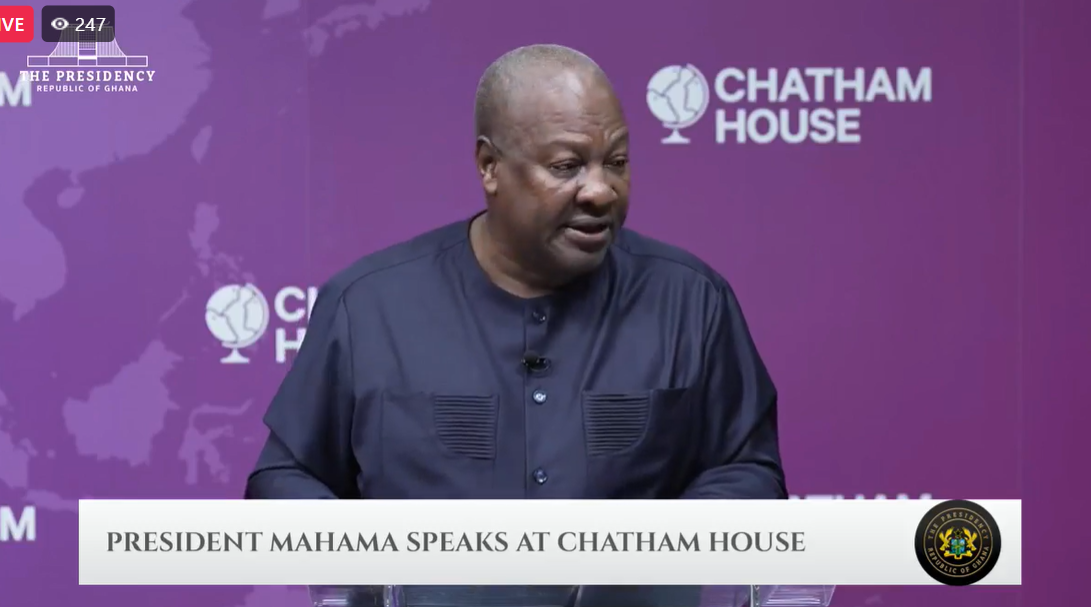
President John Mahama has outlined what he describes as a pragmatic and interest-driven foreign policy approach for Ghana.
He stressed that the country will prioritise strategic partnerships and economic opportunities over ideological alignments in an increasingly fragmented global order.
Speaking at Chatham House in London, President Mahama said Ghana’s foreign policy would continue to be guided by national interests, economic transformation and strategic cooperation rather than rigid geopolitical loyalties.
According to him, the rapidly evolving global environment requires countries like Ghana to adopt flexible and balanced diplomatic strategies capable of navigating growing geopolitical and economic uncertainties.
“Ghana believes that partnerships remain indispensable, but they must be increasingly balanced, pragmatic, and mutually beneficial,” President Mahama said on Monday, June 1.
He noted that while Ghana remains committed to its long-standing relationships with traditional partners, the country is also actively expanding cooperation with emerging economies and new centres of global influence.
“We continue to value our long-standing relationship with our traditional partners while expanding cooperation with emerging economies and new centers of global influence,” he stated.
The President stressed that Ghana’s foreign policy direction is not rooted in ideological considerations or dependency on any particular bloc.
“Our foreign policy approach is guided neither by ideological rigidity nor by dependence, but by strategic pragmatism rooted in Ghana’s national interest,” he said.
His remarks come at a time when many countries are reassessing diplomatic and economic relationships amid growing competition between major global powers, shifting trade alliances and increasing geopolitical tensions.
President Mahama argued that countries capable of maintaining constructive relationships across geopolitical divides would become more relevant and influential in the emerging global order.
“In a fragmented world, countries that can build bridges across geopolitical divides will be more strategically relevant,” he said.
He explained that Ghana’s pursuit of partnerships is ultimately tied to economic transformation and national development objectives.
“Ghana therefore seeks partnerships that expand markets, that facilitate technology transfer, creates opportunities for our young people, support industrialization, and strengthen economic transformation,” he stated.
The President added that Ghana remains committed to international cooperation and multilateral engagement despite growing global divisions.
“At the same time, we remain committed to international cooperation, peaceful coexistence, and multilateral engagement,” he said.
Beyond foreign policy, President Mahama linked Ghana’s international standing to the strength of its domestic institutions and economic resilience.
According to him, countries can only maintain credibility and influence on the global stage if they possess strong democratic systems, effective governance structures and productive economies.
“Our ability to navigate a changing global order is inextricably linked to the strength of our democratic institutions, economic governance, productive capacity, and human capital,” he said.
President Mahama also highlighted Ghana’s democratic record as one of its most important strategic assets.
“At a time when democratic systems are under pressure across regions, Ghana continues to demonstrate that constitutional governance, political pluralism, the rule of law, and peaceful transfer of power remain essential foundations for long-term stability and sustainable development,” he stated.
He further argued that democracy should not be viewed solely as a political principle but also as an economic advantage that strengthens investor confidence and supports long-term development.
“Democracy is not merely a political ideal. For us, it is also an economic asset,” he said.
“It strengthens investor confidence, enhances institutional credibility, supports social cohesion, and creates the predictability necessary for long-term investment and development.”
President Mahama used the address to reaffirm Ghana’s commitment to economic transformation through industrialisation, value addition, export diversification and regional economic integration.
“Ghana therefore remains committed to industrial transformation, value addition, export diversification, and regional economic integration,” he stated.
He also pointed to ongoing reforms under his administration’s “national reset” agenda, which he said are aimed at restoring macroeconomic stability, rebuilding investor confidence and strengthening public financial management.
“As part of our national reset agenda, we’re pursuing reforms to restore macroeconomic stability, strengthen domestic resource mobilization, improve public financial management, and rebuild investor confidence in our economy,” he said.
The President added that the government’s flagship 24-hour economy initiative and accelerated export development programme would play a central role in achieving long-term economic transformation.
DISCLAIMER: The Views, Comments, Opinions, Contributions and Statements made by Readers and Contributors on this platform do not necessarily represent the views or policy of Multimedia Group Limited.
DISCLAIMER: The Views, Comments, Opinions, Contributions and Statements made by Readers and Contributors on this platform do not necessarily represent the views or policy of Multimedia Group Limited.
