


In every democratic society governed by the rule of law, the principle is simple yet profound: an accused person is innocent until proven guilty. This constitutional guarantee is not merely a legal technicality; it is the cornerstone of justice and individual liberty. In Ghana, however, a troubling trend has emerged in recent years one that threatens to erode this fundamental principle through the imposition of excessive and often unattainable bail conditions.
Across the country, suspects and accused persons are increasingly being subjected to astronomical bail sums, burdensome surety requirements, excessive property justifications, and restrictive reporting conditions that effectively amount to punishment before trial. While bail is intended to safeguard liberty pending the determination of guilt or innocence, it is increasingly becoming an instrument of pre-trial detention.
Constitutional Protection of Liberty
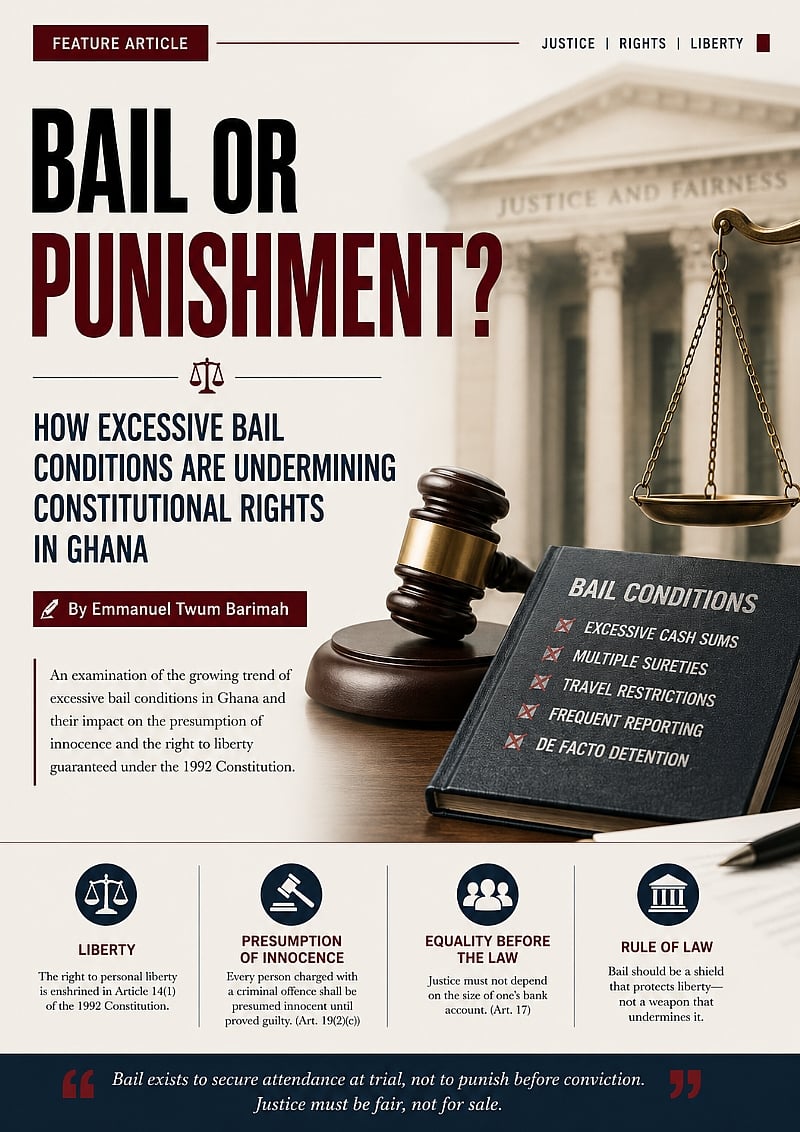
The 1992 Constitution of Ghana firmly protects the right to personal liberty. Article 14 guarantees that no person shall be deprived of liberty except in circumstances permitted by law. Equally significant is Article 19(2)(c), which enshrines the presumption of innocence by declaring that every person charged with a criminal offence shall be presumed innocent until proven guilty or until a plea of guilt is entered.
These constitutional protections are not mere aspirations; they are enforceable rights intended to shield citizens from arbitrary state action. Bail serves as one of the principal mechanisms through which these rights are protected within the criminal justice system.
The Evolution of Bail Law in Ghana
Historically, Section 96(7) of the Criminal Procedure Act, 1960 (Act 30) classified certain offences such as murder, treason, robbery, and rape as non-bailable. However, this legal position changed significantly following the landmark Supreme Court decision in Martin Kpebu v Attorney-General (2015-2016).
The Court declared the provision unconstitutional, restoring judicial discretion in bail matters and affirming that no offence should automatically exclude an accused person from consideration for bail. The decision represented a significant victory for constitutionalism and human rights, reinforcing the principle that liberty should not be denied solely because of the nature of an allegation.
Today, every application for bail must be considered on its individual merits, guided by constitutional principles and statutory safeguards.
Judicial Discretion Must Be Exercised Reasonably
The power to grant bail remains discretionary, but that discretion is not unlimited. In Gorman v Republic [2003-2004] 2 SCGLR 784, the Supreme Court emphasized that judicial discretion must be exercised judiciously and not arbitrarily.
Section 96(5) of Act 30 outlines the relevant factors that courts must consider, including:
- Whether the accused is likely to appear for trial;
- Whether the accused may interfere with investigations or witnesses;
- Whether the accused may commit further offences if released; and
- Whether the accused has a history of criminal conduct.
Notably absent from these considerations is the accused person’s wealth or financial status. Bail was never intended to be a reward for the wealthy or a punishment for the poor.
The Growing Problem of Excessive Bail Conditions
Despite clear constitutional and statutory guidance, excessive bail conditions have become increasingly common. In many cases, courts and investigative agencies impose bail sums running into millions of Ghana cedis, coupled with stringent surety requirements that ordinary citizens have little hope of satisfying.
Such conditions often render bail meaningless. An accused person may technically be granted bail, yet remain incarcerated because compliance is practically impossible.
This raises a critical question: if a person cannot realistically meet the conditions attached to bail, has liberty truly been granted?
The answer, in many instances, is no.
A Threat to Equality Before the Law
One of the most disturbing consequences of excessive bail is its discriminatory effect. Wealthy individuals may be able to satisfy demanding financial conditions, while those of modest means remain in custody regardless of their actual risk profile.
This creates a two-tiered system of justice one where freedom is determined not by constitutional principles but by economic status.
Such outcomes undermine Article 17 of the Constitution, which guarantees equality before the law and prohibits discrimination. Justice should never depend upon the size of one’s bank account.
Bail Is Not Punishment
The purpose of bail is straightforward: to secure the attendance of an accused person at trial while preserving liberty in the meantime.
Unfortunately, excessive bail conditions increasingly resemble punitive measures. Conditions involving multiple property-owning sureties, frequent reporting obligations, travel restrictions, and disproportionate financial requirements often go far beyond what is necessary to ensure attendance in court.
When bail conditions become punitive, they violate the very constitutional values they are meant to protect.
The danger is particularly pronounced where investigative agencies and prosecutorial authorities seek to use bail as a tool of deterrence or public appeasement. Such practices effectively circumvent the constitutional safeguards that exist to protect individuals who have not yet been convicted of any offence.
Preserving Public Confidence in the Justice System
Public confidence in the administration of justice depends upon fairness, impartiality, and consistency. When citizens perceive that liberty can be purchased by the wealthy while denied to the poor, trust in the legal system diminishes.
A justice system that relies on excessive bail conditions risks appearing more concerned with punishment than due process. This perception damages the credibility of courts and weakens public faith in the rule of law.
The Way Forward
Ghana’s judiciary has long been regarded as a guardian of constitutional rights. In the area of bail, that role has never been more important.
Judges and magistrates must ensure that bail conditions are reasonable, proportionate, and tailored to the legitimate objective of securing attendance at trial. Defence lawyers and human rights advocates must continue to challenge excessive bail orders through review and variation applications where necessary.
Additionally, policymakers should consider developing comprehensive bail guidelines to promote consistency and prevent excessive conditions. Such reforms could include limits on cash bail requirements, greater reliance on non-monetary conditions, and periodic review mechanisms for prolonged cases.
Conclusion
The right to liberty is among the most precious rights guaranteed under Ghana’s Constitution. Bail exists to protect that liberty while balancing the interests of justice. It was never intended to serve as a hidden form of punishment before conviction.
As Ghana continues to strengthen its democratic institutions and commitment to the rule of law, it must resist the growing tendency toward punitive bail practices. The constitutional promise of innocence until proven guilty can only be meaningful when bail remains a genuine avenue to freedom rather than an insurmountable financial obstacle.
In a constitutional democracy, bail should be a shield that protects liberty not a weapon that undermines it.
By Emmanuel Twum Barimah
Senior Administrative Manager (Ghana Health Service)
BA, MBA in Health Services Management
Student,Faculty of Law, Pentecost University
[email protected]
References
- Constitution of the Republic of Ghana, 1992.
- Article 14(1) – Right to Personal Liberty.
- Article 17 – Equality Before the Law.
- Article 19(2)(c) – Presumption of Innocence.
- Article 296 – Exercise of Discretionary Power.
- Criminal Procedure Act, 1960 (Act 30).
- Section 96(5) – Factors Governing the Grant of Bail.
- Former Section 96(7) – Declared Unconstitutional.
- Martin Kpebu v Attorney-General.
- Landmark decision declaring Section 96(7) of Act 30 unconstitutional and affirming judicial discretion in bail matters.
- Gorman v Republic.
- Supreme Court decision emphasizing that judicial discretion in bail matters must be exercised judiciously and reasonably.
- United Nations. (1948).
Universal Declaration of Human Rights (UDHR).
- Article 9: Protection against arbitrary arrest, detention, or exile.
- Article 11(1): Presumption of innocence.
- International Covenant on Civil and Political Rights (ICCPR). (1966).
- Article 9(3): Pre-trial detention shall not be the general rule.
- Article 14(2): Presumption of innocence.
- African Commission on Human and Peoples’ Rights. (1981).
African Charter on Human and Peoples’ Rights (Banjul Charter).
- Article 6: Right to liberty and security of person.
- Article 7: Right to a fair trial.
- Criminal Procedure in Ghana.
- Discusses the principles governing criminal procedure and bail within Ghana’s legal system.
- Justice S. K. Date-Bah. (2008).
The Legal System of Ghana: History, Development and Prospects.
- Analysis of constitutional rights, judicial discretion, and rule of law principles.
- Ghana Center for Democratic Development (CDD-Ghana).
- Publications on rule of law, constitutional governance, and criminal justice reforms in Ghana.
