




For decades, the average Ghanaian farmer has relied heavily on experience, instinct, and traditional weather patterns to make critical farming decisions. In many farming communities, older and experienced farmers could almost predict the rains with remarkable confidence.
Planting seasons followed familiar rhythms, and generations of farming knowledge were transferred through observation and practice.
But increasingly, that certainty is disappearing.
Across several farming communities in Ghana, rainfall timing has become more unpredictable.
Farmers who plant based on expected rainfall windows sometimes experience long dry spells
immediately after planting. In other instances, excessive rainfall or floods destroy entire acres of maize fields. Fertilizer prices continue to rise, yet yields do not always increase proportionately. Food prices fluctuate sharply, while post-harvest losses remain persistently high.
What used to be mostly agricultural problems are gradually becoming predictive and information problems. In the future, the most successful maize farmer in Ghana may not necessarily be the one with the biggest farm, but the one with the best forecasts.
A Practical Farming Perspective
Having previously worked with and supervised both smallholder and commercial maize and soya bean farmers, I have seen firsthand how farming outcomes often depend on timely and accurate information. In several instances, farmers planted based on expected rainfall windows only for
the rains to delay for weeks. In other cases, fertilizer was applied heavily to lands that later suffered poor yields due to moisture stress or poor soil conditions.
Sometimes, the problem was not the farmer’s effort or even the lack of fertilizer. The problem was the absence of predictive insight. This is why I strongly believe Ghanaian farmers may soon need data scientists almost as much as they need fertilizer.
Exploratory Agricultural Data Analysis
To better understand the changing dynamics of Ghanaian agriculture, a simple exploratory analysis was conducted using annual maize production, yield, area harvested, and rainfall data covering the period 2005–2024. Maize production, yield, and area harvested data were sourced from FAOSTAT, while rainfall data were obtained from the World Bank Climate Change Knowledge Portal (CCKP).
The datasets were cleaned, reshaped, merged, and analyzed using Python. Trend visualizations and exploratory analysis were then conducted to examine how maize production and yield behaved relative to rainfall patterns over time.
Key Analytical Findings
The analysis revealed several important patterns.
First, maize yields in Ghana improved substantially over the study period. Yield levels increased from roughly 1,500 kg/ha in the mid-2000s to nearly 2,800 kg/ha by 2024. This suggests that Ghanaian agriculture is not stagnant. Productivity improvements are clearly occurring.
Second, rainfall patterns remained highly unstable. The rainfall trend chart displayed irregular spikes, sharp declines, and inconsistent annual patterns rather than a smooth long-term upward trend.
Third, the relationship between rainfall and maize production appeared weaker and more complex than many people assume. Some years with only moderate rainfall still achieved relatively strong production outcomes, while certain years with elevated rainfall did not generate proportionately higher maize output. This may suggest that modern agricultural performance increasingly depends on factors beyond rainfall alone, including planting timing, adaptive decision-making, seed quality, fertilizer optimization, extension services, and information access.
In other words, agriculture may increasingly be becoming a decision-and-information problem rather than merely an input problem.
Chart Discussions
Chart 1: Ghana Maize Yield Trend (2005–2024)
Chart 1 reveals a strong long-term improvement in maize productivity in Ghana. Yield levels increased from roughly 1,500 kg/ha in the mid-2000s to nearly 2,800 kg/ha by 2024, indicating that Ghanaian maize production has become significantly more productive over time. However, the growth pattern was not smooth. There were periods of volatility and stagnation, particularly between 2010 and 2016, before a sharp acceleration after 2017. Interestingly, this period
coincides with the introduction and expansion of major agricultural interventions such as the Planting for Food and Jobs (PFJ) programme. While this analysis does not establish direct
causation, the timing suggests that policy support, improved seed access, fertilizer distribution, and extension services may have contributed to the productivity surge.
The broader implication is that modern agricultural performance increasingly depends not only on inputs, but also on the quality of agricultural planning, coordination, and decision-making
systems.
Chart 2: Annual Maize Production vs Rainfall
One of the most interesting findings from the analysis is that maize production in Ghana continued to rise over the years despite highly unstable rainfall patterns.
While annual rainfall fluctuated sharply between 2005 and 2024, maize production maintained a generally strong upward trend, especially after 2017. Interestingly, this period coincides with major agricultural interventions such as the Planting for Food and Jobs (PFJ) programme,
expanded fertilizer distribution, and broader government support for agriculture. While this
analysis does not establish direct causation, the timing suggests that improved farming practices, policy interventions, and farmer adaptation may have contributed to stronger production
outcomes.
Perhaps more importantly, the chart challenges the traditional assumption that rainfall alone determines agricultural success. The findings suggest that modern farming performance increasingly depends on decision quality, timing, adaptation, and access to useful information.
In practical terms, agriculture is gradually becoming an information-sensitive enterprise. Farmers increasingly need more than fertilizer and rainfall alone; they also need forecasts, predictive intelligence, and data-driven decision support systems capable of helping them navigate growing climate uncertainty.
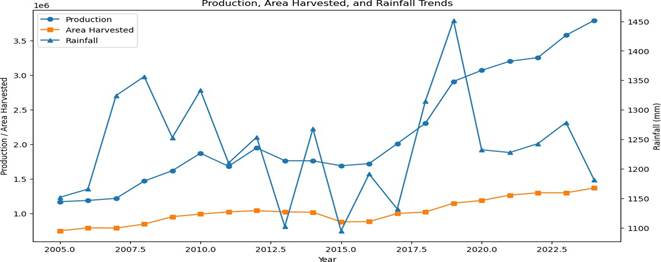
Chart 3: Production, Area Harvested, and Rainfall Trends
Chart 3 perhaps provides the strongest overall insight from the analysis. While area harvested increased gradually over the study period, maize production increased much more aggressively, particularly after 2017.
This suggests that Ghana is not merely producing more maize because more land is being cultivated. Instead, productivity improvements appear to be driving a significant share of the production growth.
At the same time, rainfall patterns remained unstable and inconsistent. Yet production still trended upward. This may indicate that parts of Ghana’s agricultural system are gradually developing adaptive resilience through improved practices, better input utilization, policy interventions, and farmer learning.
The deeper implication is clear: future agricultural competitiveness may depend less on land expansion alone and more on intelligent decision-making, predictive analytics, resource optimization, and climate adaptation.
The Rise of Intelligent Agriculture
Globally, agriculture is rapidly becoming a data-driven enterprise. Modern farming systems increasingly rely on satellite imagery, predictive weather systems, machine learning models, soil analytics, AI-powered advisory systems, and precision agriculture technologies. In countries investing aggressively in precision agriculture, drones are being used to monitor crop health, sensors are tracking soil moisture in real time, and predictive systems are helping farmers estimate optimal planting windows and forecast market demand.
Suppose data collected from maize-producing districts in northern Ghana showed that a significant portion of yield variability was linked not merely to fertilizer quantity, but to rainfall timing inconsistencies. Such a finding would immediately suggest that increasing fertilizer subsidies or introducing superior crop varieties alone may not fully solve productivity challenges without improved weather intelligence and forecasting systems.
Mobile Connectivity and the Future Farmer
One of Ghana’s biggest opportunities may already exist in plain sight: mobile phone connectivity. With mobile phone subscriptions in Ghana now exceeding the country’s population size (approx. 119% penetration rate), digital agricultural transformation becomes much more realistic. Through mobile platforms, farmers could increasingly receive weather alerts, fertilizer application guidance, pest outbreak warnings, market price updates, and localized farming advisories.
The future Ghanaian farmer may not necessarily sit behind a laptop analyzing spreadsheets. But increasingly, he or she may rely on systems powered by data scientists sitting hundreds of miles away.
Development Finance and Agricultural Risk
There is also a major development finance dimension to this conversation.
For years, financial institutions have considered many farmers too risky because agricultural production remains highly uncertain. Yields fluctuate, records are inconsistent, and weather variability creates repayment uncertainty.
But what if agricultural uncertainty could increasingly be reduced through predictive analytics?
Imagine a future where banks use AI-driven agricultural risk models built from historical rainfall patterns, satellite imagery, crop performance analytics, and historical yield data to assess farmer creditworthiness. Instead of relying entirely on traditional collateral systems, lenders may increasingly rely on predictive agricultural intelligence.
In such a future, data itself could become a form of collateral.
The Next Agricultural Revolution
For decades, Ghanaian agriculture has largely reacted to problems after they occur. The next agricultural revolution may depend on predicting problems before they happen.
This does not mean technology will replace farmers. Human judgment, local experience, and practical farming knowledge will always remain essential. However, the farmers who combine traditional wisdom with modern data-driven tools may increasingly outperform those relying entirely on intuition. Of course, data alone cannot solve every agricultural challenge. Poor roads, weak storage infrastructure, high transportation costs, and market access limitations remain serious constraints. However, better information and predictive systems may help farmers navigate these risks more effectively.
Conclusion
The reality is simple: climate patterns are changing, agricultural risks are becoming more complex, and farming blindly may become increasingly expensive. The future Ghanaian farmer will still need fertilizer, improved seeds, rainfall, hard work, and access to land. But increasingly, that farmer may also need predictive intelligence, climate analytics, digital advisory systems, and data-driven decision support.
Because in the coming decades, Ghana’s most productive farms may not necessarily be those with the largest lands or even the highest fertilizer use — but those powered by the smartest decisions, the best forecasts, and the strongest agricultural intelligence.
 Chart 1: Ghana Maize Yield Trend (2005–2024)
 Chart 1: Ghana Maize Yield Trend (2005–2024)
Chart 2: Annual Maize Production vs Rainfall
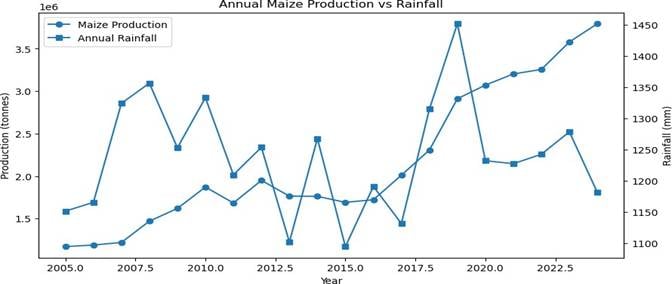 |
Chart 3: Production, Area Harvested, and Rainfall Trends
 |
Data Sources
• FAOSTAT — maize production, yield, and area harvested data (2005–2024)
• World Bank Climate Change Knowledge Portal (CCKP) — annual rainfall
• DataReportal (Digital 2026 Ghana) — mobile penetration data
• Data analyzed using Python
