


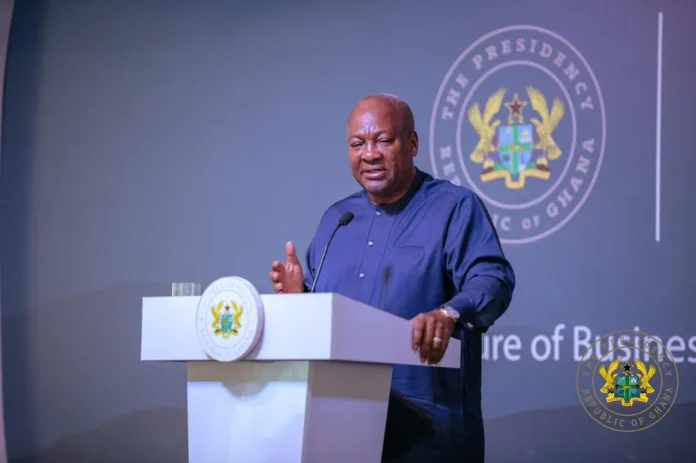
Critical infrastructure deficits across Ghana’s Northern Region took centre stage on Sunday, April 20, as government officials gave a detailed account of development progress and shortfalls at a town hall forum held at the University for Development Studies (UDS) in Tamale.
The event, themed “Accounting to the People,” formed the culmination of President John Dramani Mahama’s two-day Resetting Ghana tour of the region and provided a platform for officials to respond directly to citizens and traditional leaders on policy delivery.
President Mahama reiterated that the national economy remains resilient despite global headwinds, pointing to a decline in inflation from above 24 percent to below 4 percent as evidence of fiscal discipline. He said the government had continued to fund critical projects from domestic revenue even after Ghana’s debt default severed access to international capital markets.
“Even after the debt default cut off access to international markets, we sustained key interventions through domestic mobilisation, demonstrating the effectiveness of deploying our own resources,” he said.
He also disclosed that the government is constructing approximately 2,000 kilometres of roads simultaneously, financed entirely from domestic resources, describing the current works as the first phase of the broader “Big Push” infrastructure programme. “Between last year and this year, we are spending almost 50 billion Ghana cedis of our own money to reconstruct our roads,” he stated, adding that the Northern Region will receive its share of the initiative.
Northern Regional Minister Ali Adolf John provided a detailed breakdown of the region’s development challenges. He disclosed that approximately 32.1 percent of residents still lack access to potable water, while only 10 percent have access to improved sanitation facilities. To address water shortages, 76 boreholes and 125 mechanised systems have been constructed over the past year, with Ghana Water Company Limited (GWCL) increasing daily production capacity from 28,000 to 40,000 cubic metres. He nonetheless called for faster progress on the Yapei–Tamale water project.
On roads, the minister noted that only 19 percent of the region’s estimated 7,000-kilometre network is in good condition, with more than 900 kilometres currently under construction under initiatives including the District Roads Improvement Programme (DRIP). In healthcare, 34 Community-based Health Planning and Services (CHPS) compounds have been built and equipped, while 121 contracts have been awarded for education infrastructure improvements. To tackle youth unemployment, 3,331 apprentices have been trained under the National Apprenticeship Programme, alongside 1,005 beneficiaries supported through the Adwumawura Programme.
President Mahama, who described himself as a son of the North, gave a personal commitment to resolving the Tamale water crisis before leaving office. “If I do not resolve it, who will? You can be assured it will be done under my leadership,” he said.
Traditional authorities, represented by Zangbalun Lana Naa Dr. Jacob Mahama on behalf of Overlord Yaa-Naa Abukari Mahama II, commended the government’s interventions but pressed for urgent action on water supply in Tamale and Yendi, describing clean water access as essential to public health and economic activity across the region.
