
There has been no good news coming out of Telkom Kenya, the state-owned telecommunications provider, for a while, and the dismal streak persists.
Kenya’s oldest telco has recorded its worst-ever Quality of Service (QoS) performance in four fiscal years, achieving just 52.76% in the Communications Authority of Kenya‘s (CA) latest comprehensive assessment for FY24/25.
This poor performance puts it well below the regulatory threshold of 80% (by 27.24%) and trailing significantly behind its privately-owned rivals.
Telkom’s 52.76% overall performance represents less than half the industry standard and pales in comparison to market leader Safaricom’s 89.72% and Airtel’s 81.14%, both of which met or exceeded the regulatory benchmark.
Telkom Kenya’s Performance Across Key Metrics
CA, as per its mandate, assessed telecommunication companies across three critical components. These are End-to-End Drive Tests (60% weighting), Network Performance Systems (25%), and Quality of Experience surveys (15%).

.
In the heavily weighted End-to-End Drive Test category, Telkom managed just 47.94%, dramatically underperforming against Safaricom’s 90.36% and Airtel‘s 76.47%.
The tests, conducted across all 47 counties in Kenya, measure real-world network performance, including call success rates, data speeds, and service reliability.
Perhaps most telling was Telkom’s regional performance as the operator failed to meet the 80% threshold in any of Kenya’s five geographic regions.
By contrast, Safaricom, which has over 63% market share, achieved targets in all five regions, while Airtel met standards in two of five.
| Operator | Overall Score | Status |
| Safaricom | 89.72% | Met Target |
| Airtel | 81.14% | Met Target |
| Telkom Kenya | 52.76% | Failed Target |
Downward Trajectory Raises Concerns
Data across 4 years shows the operator’s performance has deteriorated from 69.85% in the 2020-2021 fiscal year to its current nadir of 52.76%, a drop of more than 17 percentage points.
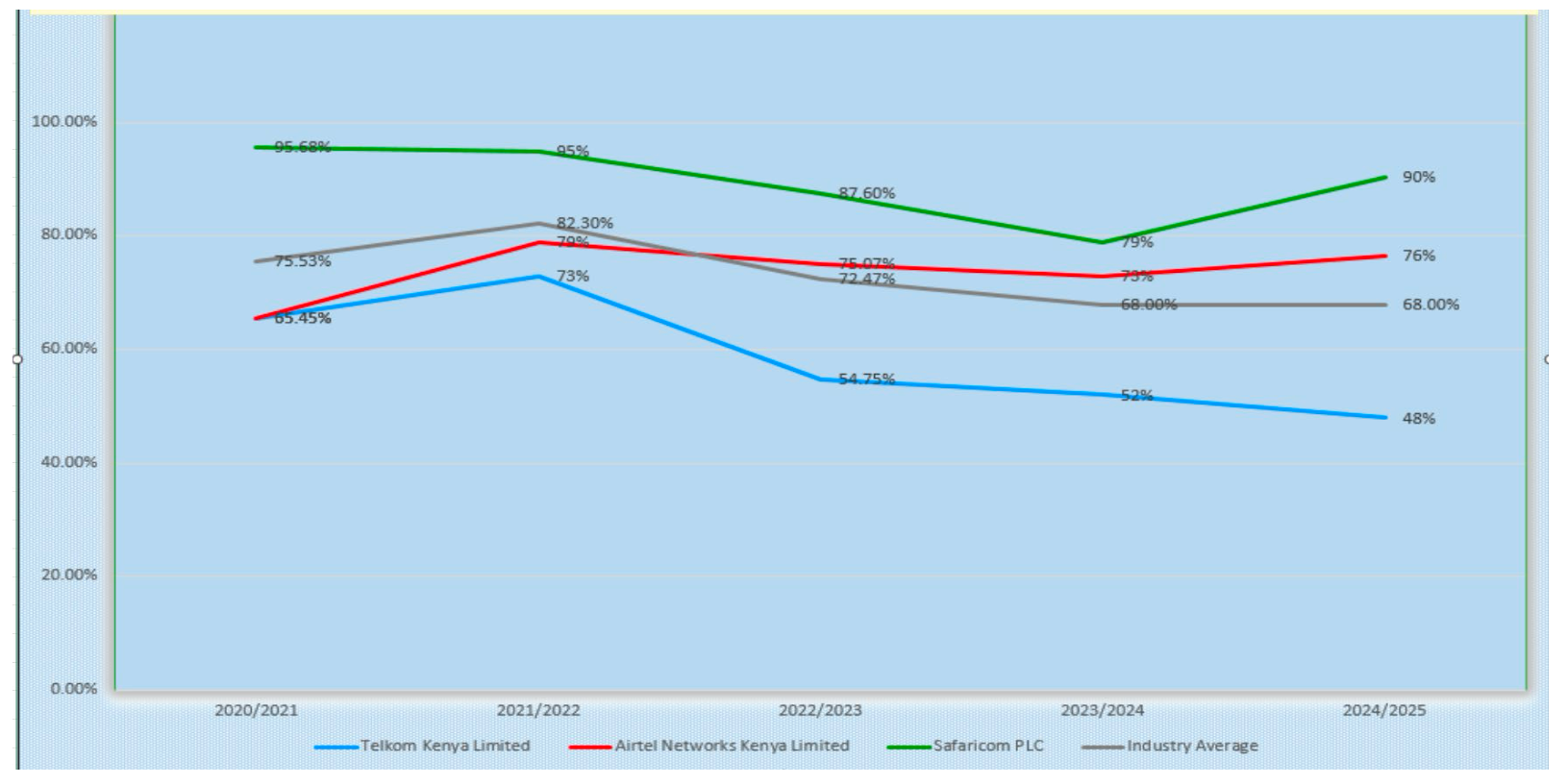
The decline paints a troubling picture of Telkom’s infrastructure and service delivery.
Ownership wrangles have plagued the critical state company, leaving it unable to focus on its core mandate. The Network Performance System analysis revealed specific technical failures.
READ: Telkom Service Outages: The Cumulation of Bad Service Provision and Controversy
Telkom’s call drop rate of 6.86% was more than three times the 2% regulatory target and drastically higher than Safaricom’s 0.51% and Airtel’s 0.22%.
Additionally, the operator’s data service availability of just 73% fell well short of the 85% target, while both competitors exceeded 95%.
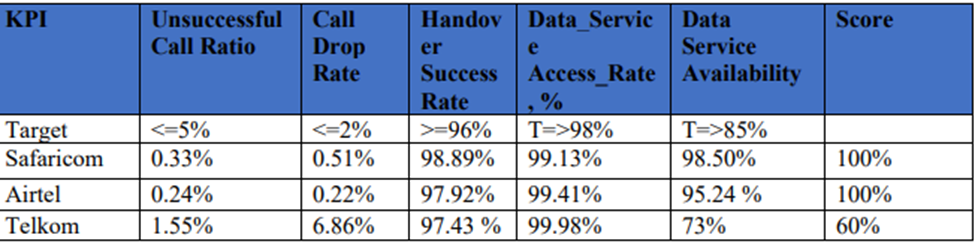
Quality of Experience surveys, measuring customer satisfaction with network coverage, call quality, internet speeds, and customer service, showed Telkom scoring 60%, the lowest among the three operators and down from 64.2% the previous year.
Telkom’s Declining Customer Base
Customers particularly criticized call connectivity reliability and internet quality. Those customers’ complaints and quality challenges come against the backdrop of a market base reacting by seeking services elsewhere.
CA data indicates Telkom serves just 868,788 total subscribers, 858,650 prepaid and 10,138 postpaid customers. This means Telkom accounts for just over 1% of mobile subscriptions in Kenya.
For context, in the FY12/13, the telco had 2,132,447 subscribers, representing a market share of 6.80%. Even with a 156.36% increase in mobile subscribers across all providers to reach 78,315,384, Telkom’s subscriber base is lower today than it was in 2013.
Telkom’s downturn has been exceptionally sharp, with its performance gap widening significantly with each passing year and affecting the industry’s average.
READ: Traditional Phone Calls Are Dying and WhatsApp Is Replacing Them
In the last four years, industry-wide QoS of service has fallen from 86.44% to 68%. Only Safaricom has registered improvement after a decline, with the second largest operator, Airtel Kenya, holding steady.
“This implies the need for more investment in network quality improvement to meet the increasing consumer demands and expansion in mobile service coverage,” CA writes in its report.
