


Saturday 28th March, 2026 08:07 AM|

Kenya’s financial markets came under pressure in the week ending March 26, 2026, as global economic developments weighed on investor sentiment.
Data from the Central Bank of Kenya’s Weekly Bulletin released on March 27 shows that key equity indices at the Nairobi Securities Exchange (NSE) declined during the period under review.
The Nairobi All Share Index (NASI) dropped by 6.21 per cent, while the NSE 25 and NSE 20 share indices declined by 7.85 per cent and 5.86 per cent, respectively. Market capitalisation also fell by 6.91 per cent, reflecting a decline in the value of listed companies.
Despite the fall in share prices, trading activity increased. Total shares traded rose by 17.92 per cent, while equity turnover increased by 35.13 per cent during the week.
“At the Nairobi Securities Exchange, the NASI, NSE 25 and NSE 20 share price indices decreased by 6.21 percent 7.85 percent and 5.86 percent, respectively, during the week ending March 26, 2026. Market capitalization also decreased by 6.91 percent while total shares traded and equity turnover increased by 17.92 percent and 35.13 percent respectively,” read the CBK bulettin in part.
Equity market activity rises
NSE data shows that investors traded more shares even as the market recorded declines in the main indices. Total deals in the equity market remained active, indicating continued participation by investors during the period.
The rise in trading volumes alongside falling share prices reflected increased market activity as investors adjusted their portfolios.
The CBK bulletin also showed that the domestic secondary bond market recorded lower turnover. Bond turnover declined by 35.34 percent during the week, pointing to reduced activity in the local fixed-income market.
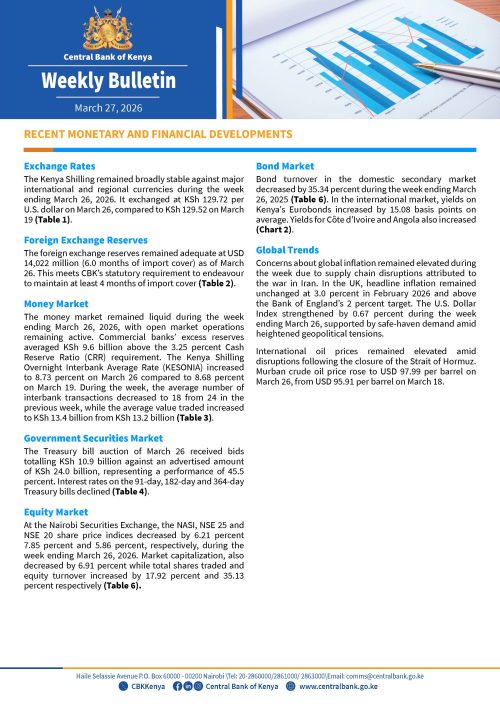
In the international market, yields on Kenya’s Eurobonds increased by an average of 15.08 basis points. Similar movements were observed in other African issuers, including Côte d’Ivoire and Angola.
Global factors influence markets
The CBK bulletin also indicated that global developments continued to influence financial markets.
The US Dollar Index strengthened by 0.67 per cent during the week as investors sought safe-haven assets. At the same time, international oil prices rose, with Murban crude increasing to Ksh 12,714 per barrel on March 26 from Ksh 12,445 the previous week.
Higher oil prices have implications for import costs in oil-importing economies. In the United Kingdom, headline inflation remained at 3.0 per cent in February 2026, above the Bank of England’s target of 2 per cent.
Domestic indicators
Domestic indicators remained relatively stable during the week under review. The Kenyan shilling traded at Ksh129.72 against the US dollar on March 26. Foreign exchange reserves stood at Ksh 1.82 trillion, equivalent to 6.0 months of import cover.
The money market remained liquid, with the Kenya Shilling Overnight Interbank Average (KESONIA) rising slightly to 8.73 per cent.
Treasury bill auctions recorded lower bids compared to the advertised amount, while average interest rates on the 91-day, 182-day and 364-day Treasury bills declined.
Government domestic debt stood at Ksh7,140.44 billion as of March 20, 2026, with treasury bonds accounting for the largest share of government securities. Financial corporations, particularly commercial banks, remained the largest holders.
