
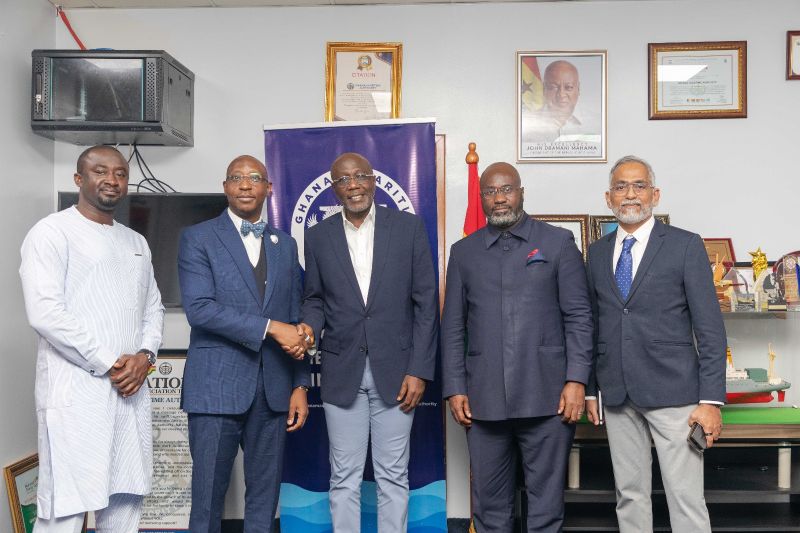
When Nigerian company RusselSmith sat down with Ghana’s maritime authority recently, the pitch was straightforward: replace the country’s aging wooden boat fleet with 3D printed vessels.
Held in Accra, the meeting brought the asset management and advanced manufacturing company’s officials face to face with Dr. Kamal-Deen Ali, Director-General of the Ghana Maritime Authority (GMA). Facilitated by the Commonwealth Enterprise and Investment Council (CWEIC), whose Ghana Head of Mission Dr. John Appea accompanied the delegation, the talks were led on RusselSmith’s side by Co-founder Kayode Adeleke.
At the center of the proposal is a 3D printing facility on Ghanaian soil capable of producing vessels up to 12 m in length. The case against the status quo is practical: traditional wooden boat construction drives deforestation, and the boats themselves are expensive to keep running. 3D printed vessels are faster to produce and cheaper to maintain.
“The GMA is increasingly focused on placing Ghana among the world’s leading ‘Blue Nations’ by prioritising maritime safety and environmental sustainability, and these efforts are being aligned with global environmental standards to reduce the sector’s overall carbon footprint,” Dr. Ali said.

From Imported Parts to Local Production
But the pitch goes further than just building boats. The same technology would be used to print spare parts locally for vessel and machinery repairs.
The materials side of the proposal extends further still: refining locally sourced iron ore into the high-grade powders that serve as feedstock for industrial 3D printing. This approach would support a circular economy and allow for fully digitised inventory management.
RusselSmith is currently commissioning a “Phase Two” industrial 3D factory in Lagos and planning a flagship “Mega Omni” facility elsewhere in Nigeria later this year, with Ghana being considered as its next market.
For now, nothing is signed. The GMA will open internal board-level discussions and designate a focal person to work through the technical feasibility before any formal commitment is made.
The authority is also separately in early talks with partners from Norway and Denmark on green fuel adoption. Longer term, inland water connectivity to Ghana’s northern sector using eco-friendly vessels remains a priority the GMA intends to pursue.
3D Printing Addresses Maritime Constraints
The interest is not incidental. West Africa’s maritime and inland water operators have long faced a structural problem: there is no significant local industrial capacity to manufacture vessels or produce the components needed to maintain them. When parts fail, replacements are sourced internationally, a process that is both expensive and slow. That dependency has kept operational costs high and left fleets in poor repair across the sub-region.
Other maritime sectors have been grappling with the same constraints. In 2020, the Indian Navy partnered with 3D printing firm think3D to produce vessel components on demand, cutting a three-month international procurement cycle down to two days at 40% lower cost. At the time of reporting, Think3D was building a digital repository of parts for the Navy, printable on demand, which is precisely the digitised inventory model RusselSmith is proposing for West Africa.

The technology is also being applied to vessel manufacturing itself, with decarbonisation increasingly driving the agenda. In the UK, a government-backed programme worth £700,000 is combining large-format 3D printing with artificial intelligence to design and build vessels faster and at lower cost, explicitly targeting the maritime sector’s emissions reduction commitments.
3D Printing Industry is inviting speakers for its 2026 Additive Manufacturing Applications (AMA) series, covering Energy, Healthcare, Automotive and Mobility, Aerospace, Space and Defense, and Software. Each online event focuses on real production deployments, qualification, and supply chain integration. Practitioners interested in contributing can complete the call for speakers form here.
To stay up to date with the latest 3D printing news, don’t forget to subscribe to the 3D Printing Industry newsletter or follow us on LinkedIn.
Explore the full Future of 3D Printing and Executive Survey series from 3D Printing Industry, featuring perspectives from CEOs, engineers, and industry leaders on the industrialization of additive manufacturing, 3D printing industry trends 2026, qualification, supply chains, and additive manufacturing industry analysis.
Featured image shows RusselSmith officials at GMA during the courtesy call in Accra. Photo via GMA.

