

Richard Collins, Johannesburg branch manager, Corrocoat
In a country besieged by failing infrastructure, resulting in water interruptions, floods and drought, safeguarding and extending the life of critical water infrastructure is no longer optional. Kirsten Kelly speaks to Corrocoat South Africa about corrosion. “The current Gauteng water crisis is not due to a lack of water. It is due to a lack of maintained, functioning infrastructure that can reticulate water to the end user,” explains Richard Collins, Johannesburg branch manager, Corrocoat. He goes on to add that corrosion is a silent killer of water infrastructure. “Corrosion rarely announces itself. It does not arrive as a dramatic flood or a visible structural collapse. Instead, it works slowly and invisibly, weakening pipes, pumps, valves, reservoirs and treatment structures from the inside out until failure becomes inevitable.” The phrase ‘rust never sleeps’ is commonly used in engineering, however, it is more accurate to state that one can never fully stop corrosion, it can only be slowed down. Steel begins corroding the moment it is produced. This irreversible process entails entropy generation, intrinsically linked to corrosion-induced material degradation, returning the material to its natural oxide state. The role of corrosion protection and organic coatings is to extend the useable life of materials of construction by slowing down the rate of corrosion and degradation.
Rehabilitation vs replacement
If infrastructure is not rehabilitated or maintained, it will collapse. The good news is that according to Corrocoat South Africa, the wholesale replacement of broken infrastructure is not always necessary.
“Due to our expertise and extensive product range, we have the ability to rehabilitate infrastructure back to its original condition and then further increase its lifespan.”
In South Africa, economic reality has forced a different mindset from some international markets. Instead of discarding assets like pumps and valves after a few years, operators increasingly seek to refurbish and extend service life. Corrocoat’s business model leans heavily into this. Salvage yards filled with worn pumps, valves and casings are seen not as scrap, but as opportunity. Corrocoat often strips, rebuilds and relines the equipment for their clients, where a percentage of assets can often be returned to service at a fraction of their replacement cost, offering real recycling potential. “In the water sector, Corrocoat has successfully implemented extensive carbon fibre and woven roving glass-fibre wrapping, using carbon fibre reinforced polymer (CFRP) as well as glass-fibre reinforced polymer (GFRP) systems to strengthen and extend the life of pipes, tanks and other assets without replacing them. Carbon fibre wrapping is particularly valuable where pipelines cannot be taken offline, excavation is impractical, or there is a risk of catastrophic failure. In the water sector, this is especially relevant for bulk water pipelines that supply power stations, treatment works and major metropolitan areas, where shutdowns are simply not feasible,” adds Collins.
Stumbling blocks
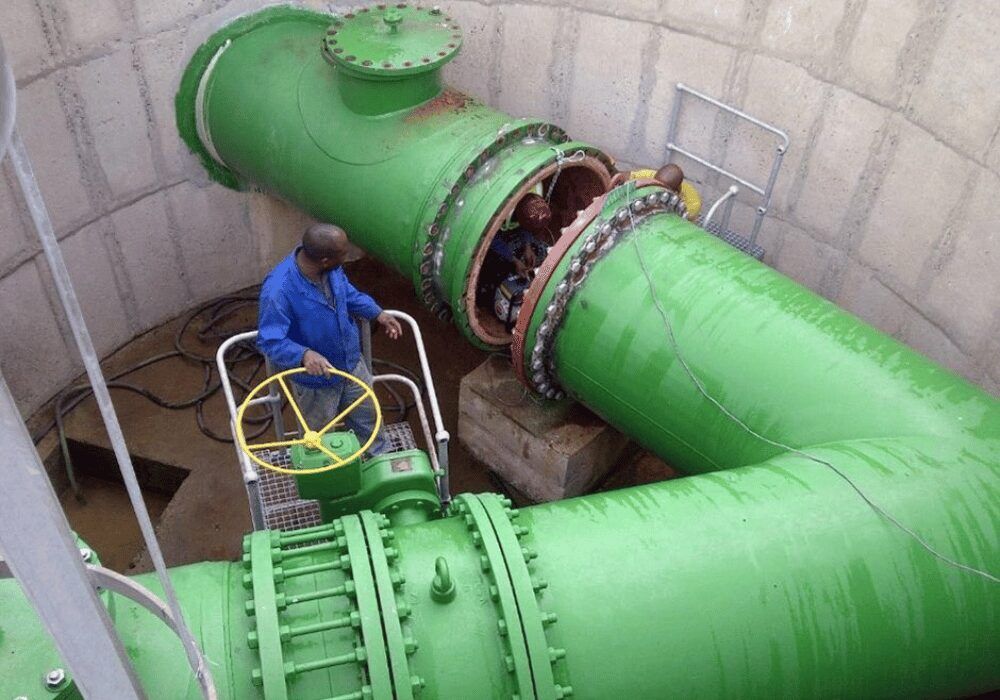
Access constraints in a valve pit
While ample technology exists to rehabilitate and structurally reinforce critical infrastructure without costly replacement, its implementation is often constrained by systemic challenges. Specification and procurement practices remain a major hurdle. Many public sector corrosion protection specifications are outdated, sometimes copied and pasted from decades old documents. In some cases, obsolete materials (like red lead) are still referenced. Rather than placing the responsibility on the manufacturer or applicator to assess the operating conditions and recommend the most suitable system, specifications are often rigidly prequalified. “There should be a greater focus on the required performance outcome rather than specifying an exact product type or coating thickness,” states Collins. He says that sometimes, a corrosion protection and refurbishment contract may be awarded to a ‘middleman’ generally with very little or zero corrosion expertise, but who may win the contract and then apply, often incorrectly, the cheapest available product and usually including an exorbitant markup. “The same person supplying stationery and toilet paper may also be appointed to supply particularly specialised and technically difficult corrosion protection coatings. The result is that technical performance takes a back seat to procurement convenience and margin. Application standards are not met, and no one takes long-term accountability for asset performance. In the end, the coating fails prematurely, maintenance costs escalate and the client pays far more than if the correct specification and experienced applicator had been appointed from the outset.” Corrosion protection coatings can also fail due to poor surface preparation. “Success is largely determined by the quality of surface preparation. Corrocoat have licensed applicators for a few of our less technical products. But we have a reputation to protect and will typically apply the more technically difficult coatings in high-risk environments ourselves, in order to ensure that the fully warranted maintenance and rehabilitation service offers continuous corrosion protection for decades to come,” explains Collins.
Standards and specifications

Louis Pretorius, MD, Corrocoat South Africa
This insistence on correct preparation, competent application and accountability reflects a wider industry push to raise standards across the water sector. According to Louis Pretorius, the MD of Corrocoat South Africa, significant progress has been made over the past decade in standardising corrosion protection specifications and practitioner qualifications.
“I served as chairman of the South African Qualifications and Certifications Committee for Corrosion Protection and president of the Corrosion Institute of Southern Africa, and was asked to participate in a multi-stakeholder committee. Comprising technical experts from the private sector, major metros, water boards and the Department of Water and Sanitation (DWS), the committee was tasked with to improving competence, clarifying specifications and ultimately strengthening the long-term performance of water infrastructure.”
The wording of the specification required consensus from all committee members. The resulting framework has fed into updated national standards processes and departmental specifications. The specification has been submitted to the South African Bureau of Standards (SABS) for accreditation and should be released into the marketplace for comment shortly. This will ultimately result in the withdrawal of SANS 1217 and the resubmission of SANS 1217 version 3. It has already been adopted by most players within the water sector and is available for download as Revision 2 DWS 9900. At its core, the value of this work lies in specification clarity. For example, the standard provides clear guidance on the type of paint or coating to apply to specific infrastructure, the correct method of application and the expected service life of the coating. “Coating selection, specification and application quality are critical, as asset owners may not have another opportunity to access that infrastructure for many years. In the case of a pipeline, for example, sections often have to be isolated, drained and in some instances completely decommissioned for the duration of surface preparation and coating application,” adds Pretorius.
Constant evolution
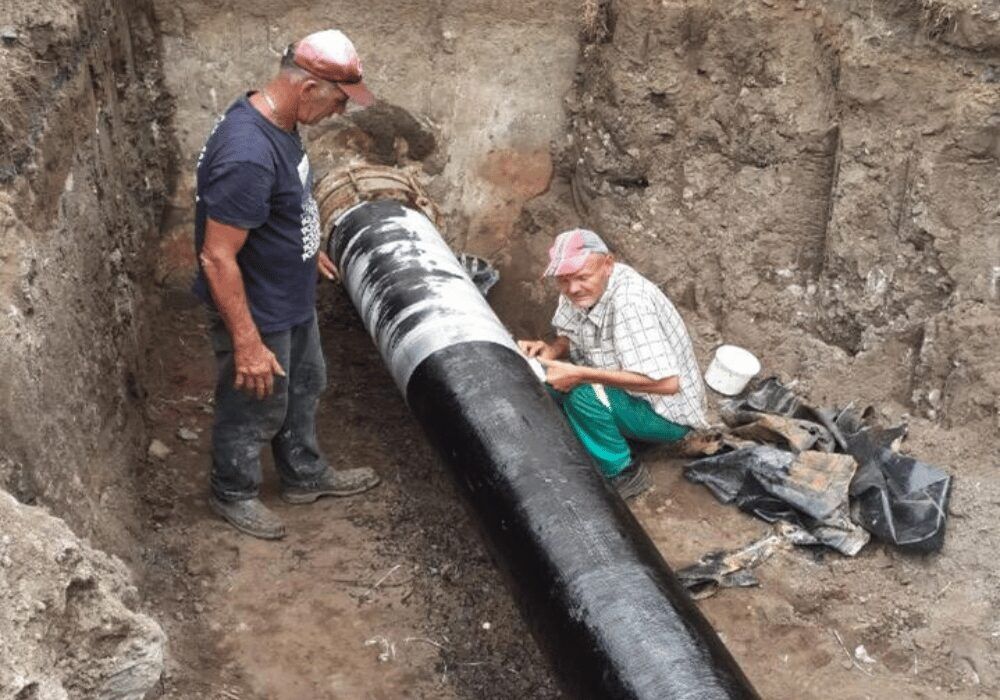
Carbon fibre wrapping to pipe external
This reality also underscores the importance of deep technical expertise and ongoing innovation in corrosion protection. “Corrocoat has always strived to ensure that our management and staff become the most educated and knowledgeable people in the industry in terms understanding the mechanisms of corrosion as a science, thereby offering the absolute best in terms of long-term protection of infrastructure. Our research and development team is constantly assessing new ways to solve problems as well as achieving improved and more cost-effective ways of solving the old ones. If we do not have an existing product suited to a particular issue or operating environment, our superb research and development facilities in the United Kingdom allows us the flexibility to develop a bespoke solution to comprehensively address that particular issue or environment,” explains Collins. An example of this innovation was the nano glass flake technology used in the eight-month refurbishment Lesotho Highlands Water Project’s tunnel system, whereby the glass platelets used in the corrosion protection coating material were as small as 300 nanometres in thickness, a world first. Working across multiple tunnel sites, the company undertook extensive grit blasting to Sa 3 white-metal standard, completed steel repairs, and applied 43 000 ℓ of solvent-free, glass-flake epoxy coating to nearly 20 000 m² of ageing steel liners. The work was executed under challenging conditions that included constant water ingress, high humidity and low temperatures, including micro-condensing conditions and requiring continuous pumping, dehumidification and strict quality control. With 100% third-party inspection, high-voltage spark testing and non-destructive testing of all weld repairs, the upgraded lining system has extended the tunnels’ service life by 30 to 50 years, safeguarding water supply to Gauteng and supporting Lesotho’s hydropower generation for decades to come. The scale and success of this project highlights a broader lesson for the sector: sustainable corrosion management demands proactive intervention, not reactive repair.
A mindset shift
“The biggest misconception about the effects of corrosion in the water infrastructure industry is that maintenance can wait. Because failure is gradual, it is often deprioritised. If left untreated, corrosion does not resolve itself; it progressively worsens over time until it reaches the point of no return” says Collins.
Yet the real cost of inaction is clearly visible across our country, culminating in burst pipelines, critical supply interruptions and emergency repair budgets. The alternative is not glamorous, but it is effective: early intervention, lifecycle costing and partnerships with technically competent specialists. For companies like Corrocoat South Africa, every project is different. No two corrosion challenges are identical. That variability, and the agility to design tailored solutions rather than rely on cut and paste specifications, is what enables infrastructure owners to pro-actively assume the mantle of accountability by achieving longer asset life, lower lifecycle costs and sustained reliability in performance and plant up-time. In a country where infrastructure reliability underpins economic stability and social wellbeing, undertaking extensive and comprehensive corrosion protection is not just a technical exercise, it is a national imperative.
About Corrocoat
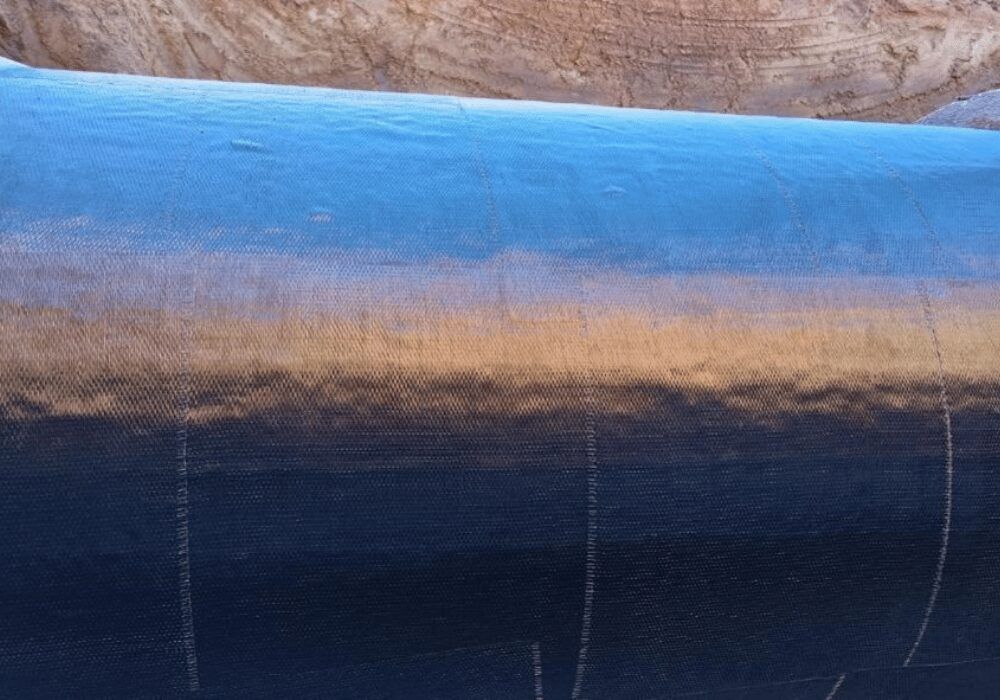
Carbon fibre wrapping of concrete pipe
Corrocoat began in the mid-1970s in the UK with a simple yet powerful idea: use glass flake in resin systems to create exceptionally durable anti-corrosion coatings. Glass flakes are ultra-thin plates that form a dense, tortuous barrier in coatings, dramatically slowing the rate of moisture vapour transmission or moisture vapour permeation, as well as boosting abrasion resistance, structural stability and ultraviolet protection. Corrocoat has evolved into a global corrosion protection innovation pioneer, with its range of approximately eighty different and specialised corrosion protection materials now protecting the very harshest industrial environments, including water infrastructure, worldwide. They operate in 38 countries and produce as much as 80% of the world’s glass flake. Corrocoat South Africa operates out of three workshops in Durban, Cape Town and Johannesburg. All three workshops are fully equipped for abrasive blast cleaning, as well as a full range of specialist coating work. The Johannesburg workshop is also equipped with a sintered fluoropolymer lining installation plant and ovens and is also the only branch within the group to offer a full range of rubber lining services and solutions for storage tanks, pipelines and processing equipment. In celebration of Corrocoat’s 50 year Anniversary, Corrocoat South Africa has recently purchased a range of particularly specialised surface preparation equipment including high pressure and ultra-high pressure water Jetting equipment up to 2800 bar; concrete floor wheel abraders of various sizes and configurations; specialist dry ice blast cleaning equipment; laser-cleaning equipment for intricate and delicate surfaces such as turbine blades, robotic internal pipe blast cleaning and coating equipment; the latest ultra-high definition camera equipment for pipe inspection purposes; magnetic tank crawler blast cleaning and coating robotics; a new fleet of diesel compressors; inter-link horse and trailer trucks and “cherry-picker” type hydraulic lifts with a safe reach up to 20 metres high. Corrocoat South Africa have invested in this new equipment as a means of differentiating ourselves as a unique corrosion protection and value engineering service provider for the next 50 years in South Africa and the African continent.
