


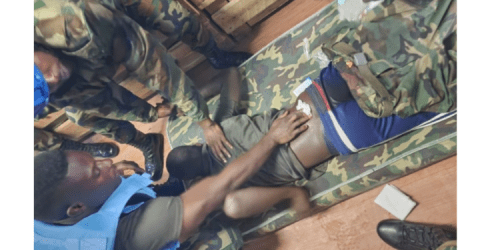
Two Ghanaian soldiers serving with the United Nations Interim Force in Lebanon (UNIFIL) are in critical condition after their battalion headquarters in southern Lebanon was struck by two missiles on Friday evening, prompting Ghana to lodge a formal diplomatic protest at the United Nations in New York and demand a full international investigation.
The Ghana Armed Forces confirmed that the Ghanaian Battalion Headquarters came under two separate missile strikes within a seven-minute window on the evening of 6 March, between 17:45 and 17:52 local time. Two soldiers sustained critical injuries and a third suffered psychological trauma. The camp’s Officers’ Mess took a direct hit and was completely destroyed by fire.
The injured soldiers were moved to the Level One Medical Bunker at the base where they are currently stable, while arrangements are underway to evacuate them to the UNIFIL Headquarters Referral Hospital for further treatment. The Ghana Armed Forces said remaining troops had taken shelter in underground bunkers and were safe.
Irish Defence Forces personnel of the 127th Infantry Battalion, stationed approximately four kilometres away at Camp Shamrock in Al-Qaouzah, responded immediately and provided both casualty evacuation and fire-fighting assistance. Irish Taoiseach Micheál Martin condemned the attack and praised the professionalism of the Irish peacekeepers who came to the aid of their Ghanaian colleagues.
On Saturday, Ghana’s Foreign Affairs Minister Samuel Okudzeto Ablakwa issued a formal protest on behalf of the government to UN Secretary-General António Guterres, describing the attack as a grave violation of international law and calling for those responsible to be identified and held accountable. Ghana urged the United Nations to take all necessary measures to ensure the safety and security of the Ghanaian contingent and all other personnel operating in the UNIFIL mission area.
The attack drew immediate political reaction at home. Ranking Member on Parliament’s Defence and Interior Committee, Rev. Ntim Fordjour, used the incident to renew calls for President John Dramani Mahama to appoint a substantive Minister of Defence, arguing that a dedicated minister would have better monitored troop safety in an escalating conflict zone. Legal practitioner Kofi Bentil called for a comprehensive review of Ghana’s participation in UN peacekeeping missions in volatile theatres, while his colleague Martin Kpebu described the soldiers’ injuries as deeply unfortunate, noting that attacks on clearly marked peacekeeping installations should carry serious international consequences.
The Israeli Ambassador to Ghana, Roey Gilad, had publicly cautioned Ghanaian UNIFIL troops to remain inside their bases due to rising tensions less than 24 hours before the attack. On Saturday, the Ambassador issued a statement wishing the injured soldiers a speedy recovery, describing the incident as unfortunate.
Lebanon was drawn into the broader Middle East conflict on 3 March when Hezbollah fired rockets at Israel, triggering a new Israeli offensive against the group. The Ghana Armed Forces statement did not identify who fired the missiles. UNIFIL confirmed the strike and said it is investigating the circumstances.
Ghana is one of the longest-standing contributors to UNIFIL, having maintained a battalion-sized deployment in southern Lebanon for decades. The country has also been one of Africa’s most consistent contributors to UN peacekeeping operations globally, deploying troops to missions across the continent and the wider Middle East. Friday’s attack is one of the most serious direct strikes on Ghanaian peacekeeping personnel in the mission’s recent history.
