



Follow-up to NewsGhana’s reporting on the COCOBOD crisis
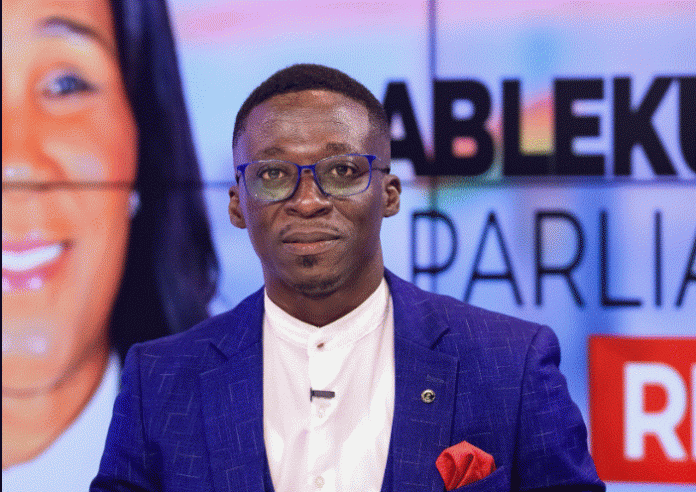
Legal practitioner and policy commentator Austin Kwabena Brako-Powers has delivered a pointed two-front critique of the Ghana Cocoa Board (COCOBOD) crisis, dismissing the board’s salary cuts as a publicity stunt with serious legal risks while simultaneously warning the opposition New Patriotic Party (NPP) against converting the institution’s structural difficulties into a political scandal.
Speaking on Tuesday, February 24, Brako-Powers described the decision by COCOBOD’s executive management to accept a 20 percent salary reduction, and senior staff a 10 percent cut effective February 16, 2026, as a “needless public relations gimmick” that fails to address the core challenges confronting Ghana’s cocoa sector. He said the move raises significant legal questions that have not been adequately considered.
He argued that unilateral adjustments to contracted staff salaries, even when framed as voluntary, open the institution to legal exposure if the reductions are applied in a manner inconsistent with employment contracts or without proper board authorisation. Rather than offering genuine institutional relief, he said, the gesture risks creating a new layer of administrative and legal complications on top of an already fragile situation.
COCOBOD has said the salary adjustments are part of broader cost-containment measures aimed at saving approximately GH¢5 million monthly, as part of a wider rescue effort for an institution carrying a total loan liability estimated at GH¢17.8 billion, of which the current administration has paid GH¢3.4 billion since taking office in January 2025.
Turning his attention to the NPP, Brako-Powers urged the opposition to resist the temptation to frame COCOBOD’s difficulties as a scandal manufactured by the current government. He said the institution’s challenges are structural and have accumulated over many years, and that exploiting them for political gain would serve neither the farmers nor the sector.
“The difficulties confronting COCOBOD are structural and long-standing, and require sober, non-partisan analysis rather than political theatre,” he said, urging instead a national conversation focused on sustainable solutions.
His caution to the NPP lands at a politically charged moment. The opposition has called for the removal of COCOBOD Chief Executive Dr Randy Abbey, citing the 28.6 percent producer price cut from GH¢3,625 to GH¢2,587 per 64-kilogram bag and the failure to clear outstanding payments to farmers, with some growers reporting they had gone up to six months without receiving funds for their produce. The NPP has also alleged that COCOBOD delayed cocoa bean sales in anticipation of higher global prices, a claim disputed by the ruling National Democratic Congress (NDC) and rejected as politically motivated by legal analyst Martin Kpebu.
Brako-Powers has been one of the most consistent independent voices on the COCOBOD story. In early February 2026, he also dismissed claims that the government’s indebtedness to cocoa farmers was the result of COCOBOD mismanagement or a lack of syndicated loans, describing that framing as politically driven and misleading.
His remarks on Tuesday add a rare voice of cross-partisan caution to a debate that has increasingly become defined by blame allocation rather than remedial action, at a time when more than one million Ghanaian cocoa farmers are waiting for the institutional crisis to translate into visible improvements in their livelihoods.
