


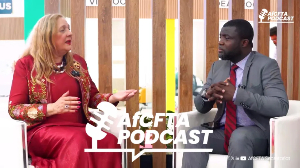
 Dr Amany Asfour (L) speaking on the AfCFTA
The president of the Africa Business Council, Dr Amany Asfour has called for African governments to reserve at least 40% of public procurement for continental businesses, arguing that preferential treatment for African firms is essential to implementing the African Continental Free Trade Area (AfCFTA) agreement.
Speaking during a session on the AfCFTA podcast, Dr Amany Asfour said the policy would ensure that products available on African soil are purchased from African suppliers rather than imported from outside the continent.
“When I have something on the African soil, we should not bring it from outside the African soil,” Dr. Asfour proposed, pointing to Egypt’s 400 medical consumer supply industries as an example of existing capacity being overlooked in favour of imports.
The recommendation emerged from the African Union Private Sector Forum, which the Africa Business Council leads, and represents a bold attempt to translate the AfCFTA’s trade liberalisation commitments into concrete industrial development outcomes.
Dr Asfour used two commodities to illustrate a stark picture of Africa’s position in global value chains.
Africa exports shea butter worth $90 million annually, whilst the global cosmetics industry that uses shea butter exceeds $500 billion, leaving African producers capturing a fraction of the value their raw materials create.
Similarly, the continent exports cocoa beans worth $5.7 billion annually, whilst the global chocolate industry exceeds $217 billion.
She argued that without processing and value addition, African countries remain at the bottom of lucrative value chains.
To operationalise its strategy, the Africa Business Council has established 25 clusters covering sectors including trade, investment, energy, agriculture, infrastructure, and natural resources development.
Dr Asfour highlighted mineral resources as particularly urgent, given global competition for Africa’s deposits of critical minerals needed for the energy transition.
“All the world is really fighting for Africa’s minerals,” she observed. “How are we going to add value to our minerals? Not exported as raw material, but as an end product like lithium batteries.”
She noted that by 2030, the world will need approximately 300 million electric vehicles, creating enormous demand for lithium batteries. The question, she posed, is who will manufacture these batteries and whether Africa will capture that value.
Each of these 25 clusters aims to integrate private sector actors across the continent, identifying existing resources, industrial capabilities, investment opportunities, technology requirements, and financing needs to produce finished products with market access.
Dr Asfour expressed concerns over the awareness deficit among the very people the AfCFTA aims to serve. Drawing on her experience as chair of COMESA Women in Business, she recounted visiting borders between Zambia and Zimbabwe, Egypt and Sudan, and Ethiopia and Djibouti to speak with cross-border women traders.
“I asked the cross-border women traders, do you know anything about Simplified Trade Regime of COMESA? They did not know anything,” she revealed.
The same challenge, she stated, applies to the AfCFTA. Despite representing the continent’s integration architecture, these frameworks remain unknown to many small-scale traders who form the backbone of intra-African commerce.
“If we go now to the cross-border women traders on the ground and ask them, do you know something about AfCFTA? They don’t know,” Dr Asfour said.
The President of the African Business Council suggested coordinated outreach through regional and national chambers of commerce, private sector organisations, and specialised networks for women entrepreneurs, youth, and specific sectors as major approach to addressing the awareness deficit as the AfCFTA transition intop the implementation phase.
