

 Domestic and international cooperation is needed in tackling corruption
Ghana’s anti-corruption efforts continue to yield limited results, as the country scored 43 out of 100 and ranked 76th out of 182 countries in the 2025 Corruption Perceptions Index (CPI) released by Transparency International.
In a press release dated February 10, 2026, the findings show that Ghana remains trapped in a cycle of persistent corruption, weak enforcement of laws, and fragile state institutions mandated to combat graft.
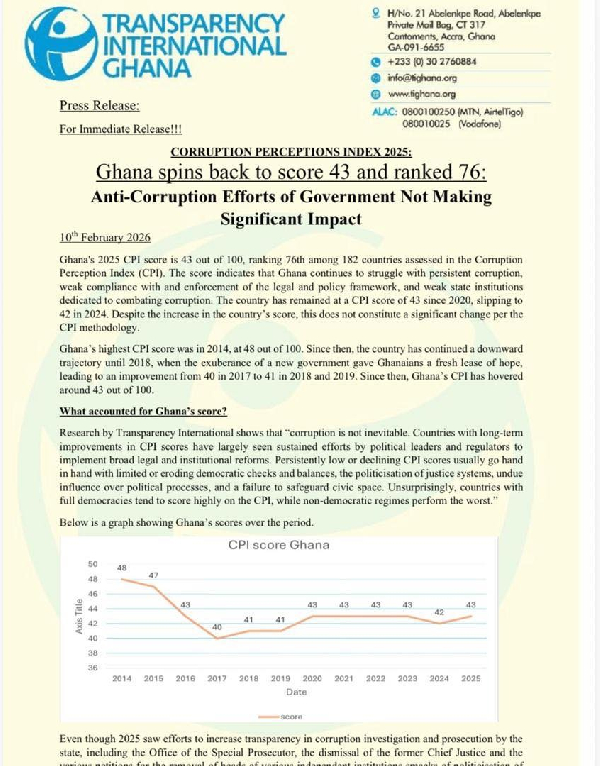
Although the country’s score improved from 42 in 2024 to 43 in 2025, Transparency International notes that this change is not statistically significant under the CPI methodology.
Transparency International emphasised the need for both domestic and international cooperation in tackling corruption.
“In an interconnected world, we need both national action and multilateral cooperation to protect the public interest and tackle shared challenges like corruption. At a time when we’re seeing a dangerous disregard for international norms from some states, we need to protect a rules-based global order that is grounded in transparency, accountability to citizens and respect for human rights,” the statement said.
Ghana’s corruption score declines in latest 2024 Corruption Perception Index ranking
Ghana has effectively plateaued on the index, maintaining a score of 43 since 2020, an indication that recent anti-corruption initiatives by successive governments have not translated into meaningful institutional reform or public sector accountability.
Historically, Ghana’s best CPI performance was in 2014, when it scored 48 out of 100. The score declined steadily in the years that followed, reaching 40 in 2017.
A brief rebound occurred between 2018 and 2019, when optimism surrounding a new government helped lift the score to 41, before inching up to 43, where it has since stagnated.
Explaining what drives CPI outcomes, Transparency International’s research underscores that corruption is not inevitable. Countries that record sustained improvements typically benefit from strong political will, robust legal and institutional reforms, and independent regulators.
Conversely, the organisation notes that persistently low or declining CPI scores, such as Ghana’s, are often linked to eroding democratic checks and balances, politicisation of the justice system, undue influence over political processes, and weak protection of civic space.
“Unsurprisingly, Transparency International observes, countries with full democracies tend to score highly on the CPI, while non-democratic regimes perform the worst,” the statement said.
For Ghana, the 2025 CPI results reinforce growing public concerns that anti-corruption rhetoric has yet to be matched by decisive action capable of restoring confidence in governance and public institutions.
Read the full statement below
MRA/VPO
Understanding Ghana’s stock market and how to invest | BizTech

