


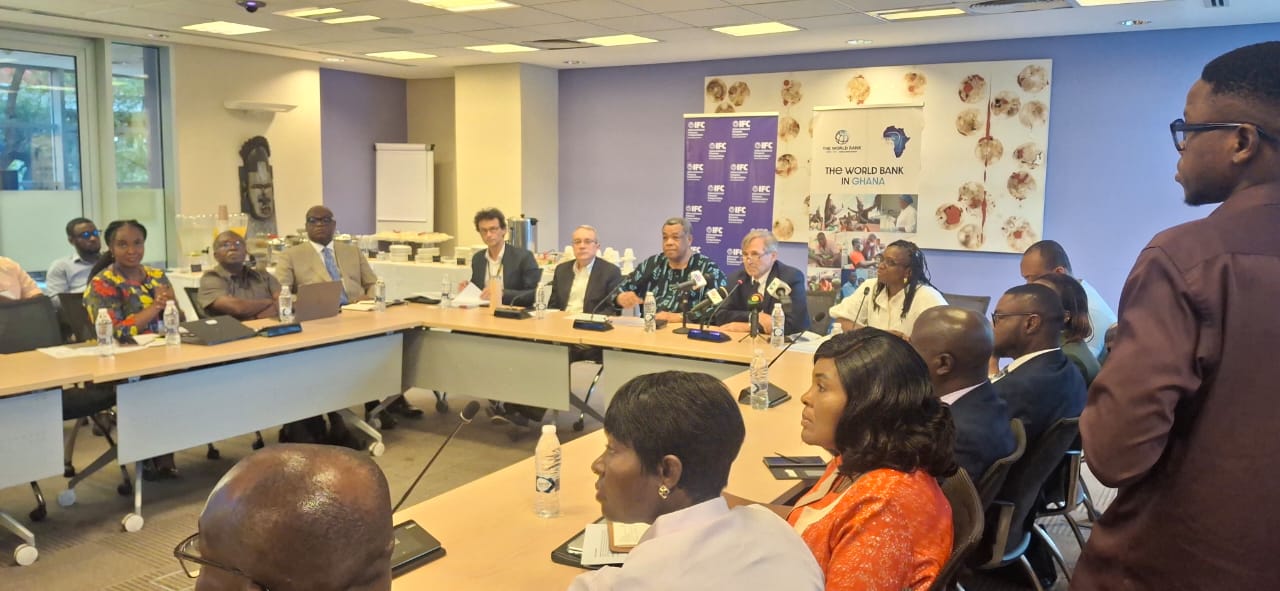
The World Bank Group and the International Finance Corporation have released the B-READY report on Ghana, offering a detailed assessment of the country’s business readiness and the structural constraints shaping private sector growth. The findings were discussed at a high level working session themed “B-READY Ghana 2026: Bottlenecks, Solutions, and Public-Private Troubleshooting for Accelerating 24H+ Delivery.” The discussion brought together senior government officials, selected private sector leaders and World Bank Group teams.
The report presents a mixed picture of Ghana’s business environment. Performance varies significantly across pillars, with Financial Services recording a strong 72 percent, while Market Competition remains a major weak spot, scoring just 34 points out of 100 and placing Ghana in the bottom 20 percent of all measured economies. Across all services, Ghana scored about 50 points, while Operational Efficiency stood at 52 points, both in the bottom 40 percent. The Regulatory Framework pillar, however, performed relatively well, earning 69 points and placing Ghana in the top 60 percent globally.
In Financial Services, the report notes that Ghana benefits from well developed secured transactions regulations and a solid framework governing electronic payments. Labour market performance stands out as one of the country’s strongest areas. With 71 points out of 100, Ghana ranks in the top 20 percent of measured economies. According to the report, effective labour dispute resolution mechanisms are positively influencing job reallocation and productivity.
Despite these strengths, the B-READY assessment underscores the need for urgent reforms in market competition. Ghana’s low score reflects weaknesses in competition law and enforcement, both in absolute terms and relative to peers. The report points to the need to strengthen investigative and sanctioning powers of the Competition Authority, as well as its capacity to review mergers, in order to foster a more competitive business environment.
Speaking on the findings, IFC Senior Country Manager for Ghana and Liberia, Kyle Kelhofer, said the assessment provides a clear, evidence based view of where Ghana’s business conditions are strong and where they fall short.
“The updated B-READY assessment gives us a clear and evidence based view of where those conditions are strong and where they are not,” he said. “It highlights the bottlenecks affecting food and agri processing, light manufacturing, and trade facilitation, three sectors that are foundational to Ghana’s economy. Importantly, the findings highlight administrative, regulatory, and coordination improvements that can unlock growth quickly.”
Mr Kelhofer stressed that high quality investors consistently seek predictable systems, efficient public services, strong governance and consistent implementation. “These translate directly into lower costs, reduced risks, and faster expansion of business operations. For Ghana, strengthening these fundamentals is central to delivering the jobs that the economy urgently needs,” he added.
The report also sheds light on why Ghana continues to lag in attracting global capital at scale. According to Robert Taliercio, World Bank Division Director for Ghana, Liberia and Sierra Leone, the gap between strong rules and weak execution remains a critical concern.
“Across pillars, Ghana’s Regulatory Framework score is 69, while Operational Efficiency is 52. This gap between strong rules and slower delivery shapes how investors assess risk, cost, and predictability,” he said. “This gap matters because the real win is jobs, and jobs at scale come from investment.”
Mr Taliercio noted that gross capital formation in Ghana is about 10 percent of GDP, far below levels seen in economies that are successfully industrialising. In Morocco, for example, investment in productive assets reaches around 30 percent of GDP. He said the B-READY report helps explain why capital investment has not flowed at the scale required to generate jobs rapidly, despite relatively strong underlying rules.
Trade and logistics emerge as key constraints. The report finds that imported goods take about 23 days to clear all border control agencies in Ghana, while exports take around nine days. In contrast, imports clear in about seven days in competitor countries such as Morocco and Vietnam. For manufacturers that rely on imported inputs, these delays can result in missed delivery windows and lost export orders.
The assessment also highlights challenges in business location and property transfer. While Ghana’s legal framework is relatively strong, transferring property takes about 182 days and obtaining a building permit takes roughly 125 days. In Morocco, property transfers can be completed in about 10 days, with building permits issued within 35 days. Such timelines, the report notes, raise the cost and uncertainty of investment in Ghana.
Infrastructure reliability further compounds these challenges. B-READY data show that firms experience an average of three power outages each month, and only about half of firms report not experiencing internet disruptions. This poses a significant risk to sectors such as global business services, including IT support centres, accounting hubs and analytics operations, which depend heavily on reliable electricity and stable internet to create high skill jobs.
Mr Taliercio linked these findings directly to the government’s 24 Hour Economy agenda. “A truly essential part of the 24 Hour Economy programme is addressing these constraints. The programme is not about working endlessly. It is about system readiness. It is about ensuring that ports, utilities, regulators, and public services operate with the reliability required by modern industry and global services,” he said.
DISCLAIMER: The Views, Comments, Opinions, Contributions and Statements made by Readers and Contributors on this platform do not necessarily represent the views or policy of Multimedia Group Limited.
DISCLAIMER: The Views, Comments, Opinions, Contributions and Statements made by Readers and Contributors on this platform do not necessarily represent the views or policy of Multimedia Group Limited.
