Close Menu
  • Home
  • Latest News
  • Top stories
  • Local News
  • Politics
  • Business
  • Entertainment
  • More
    • Sports
    • Nollywood
    • Tech
    • Editorial
    • Health
    • World
    • Lifestyle
  • Africa
    • Kenya
    • Nigeria
    • South Africa
Sports

New Signings: Ghana FA confirms 2026-27 player and coach transfers

September 2, 2026

GPL 2026-27: Kwesi Appiah sends a goodwill message to Asante Kotoko

September 1, 2026

Messi Retires From Int’l Football

September 1, 2026
Facebook X (Twitter) Instagram
Ghanamma.comGhanamma.com
  • Home
  • Latest News

    South Africa vs New Zealand: Rassie Erasmus and Dave Rennie's war of words escalates with series finely poised – Sky Sports

    September 2, 2026

    News Comments Kenya Simbas back-rower joins French club – Mozzart Sport Kenya

    September 2, 2026

    ‘I didn’t go there for a beauty contest’ – Asiedu Nketiah on wearing wife’s coat to Germany

    September 2, 2026

    New Signings: Ghana FA confirms 2026-27 player and coach transfers

    September 2, 2026

    BoG, SEC warn public over fake video using President Mahama’s images in promoting crypto scam

    September 2, 2026
  • Top stories
  • Local News
  • Politics
  • Business
  • Entertainment
  • More
    • Sports
    • Nollywood
    • Tech
    • Editorial
    • Health
    • World
    • Lifestyle
  • Africa
    • Kenya
    • Nigeria
    • South Africa
Facebook X (Twitter) Instagram Pinterest Vimeo
Subscribe
Ghanamma.comGhanamma.com
Home»Business»Banks to Fund Sixty Percent of Government Infrastructure Spending
Business

Banks to Fund Sixty Percent of Government Infrastructure Spending

Ghana NewsBy Ghana NewsFebruary 3, 2026No Comments3 Mins Read
Facebook Twitter Pinterest LinkedIn Tumblr Email
Share
Facebook Twitter LinkedIn Pinterest Email Copy Link

Capital Expenditure
Capital Expenditure

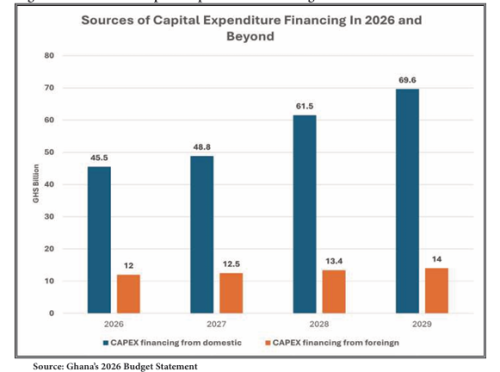
Commercial banks are expected to finance about 60 percent of government capital expenditure (CAPEX) from 2026, placing them at the centre of the development agenda with what the Ghana Association of Banks (GAB) describes as a “double-edged sword” for the economy, according to its 2026 Industry Outlook.

CAPEX is projected to rise sharply from about GH¢32.7 billion in 2025 to GH¢57.5 billion in 2026, before increasing steadily to more than GH¢83 billion by 2029 based on projections from the 2026 Budget Statement cited in the report. The heavy reliance on domestic banks to fund this expansion reflects limited access to foreign financing and a policy preference for local funding, but it also deepens the link between fiscal outcomes and bank balance sheets.

For banks, the arrangement offers both opportunities and risks. Increased government borrowing boosts interest income and provides a predictable outlet for liquidity. However, heavy domestic financing of infrastructure spending risks crowding out private sector credit, as banks redirect funds away from businesses toward sovereign instruments. This reallocation can push up lending rates, weaken private investment and slow broad economic expansion.

“This cautions that while CAPEX can be growth-enhancing, excessive reliance on domestic financing without careful structuring risks may deprive the private sector of adequate credit for growth and expansion,” the Outlook says.

The Ghana Association of Banks (GAB) notes that Ghana’s fiscal position is entering a phase of nominal expansion, driven by rising revenues and higher public spending. Total government revenue is projected to increase from about GH¢230 billion in 2025 to GH¢268.1 billion in 2026, rising steadily to nearly GH¢392 billion by 2029, according to the report.

This improvement is underpinned largely by stronger tax mobilization, with tax revenues projected to grow from GH¢190 billion in 2025 to GH¢224 billion in 2026, reaching close to GH¢335 billion by 2029. GAB argues this revenue trajectory is positive for the banking system because it reduces fiscal uncertainty and strengthens the sovereign’s capacity to meet obligations.

For banks, elevated interest payments have direct implications for sovereign risk assessment. The Outlook notes that constrained fiscal space means any slippage in revenue mobilization could translate quickly into higher financing needs. Interest payments are projected to stabilize around GH¢57 to GH¢59 billion in 2026 and 2027, then rise again to about GH¢70 billion by 2028 and over GH¢80 billion by 2029.

Encouragingly, the outlook suggests some easing of pressure on domestic banks over time. Total government financing needs are projected to decline from about GH¢64 billion in 2026 to around GH¢44.6 billion in 2027 before fluctuating moderately through 2029. While banks are expected to provide GH¢38.3 billion in 2026 and GH¢46.6 billion in 2027, their contribution is projected to fall thereafter to about GH¢29 billion by 2029.

This gradual reduction in reliance on commercial banks is expected to create scope for a measured reallocation of balance sheet capacity toward private enterprises, particularly small and medium sized firms linked to infrastructure delivery, supply chains and productive sectors. Still, the association warns that risks remain, noting that the structure and sustainability of public debt remain central to sovereign risk assessments, which feed directly into banks’ capital adequacy, risk weighting of government exposures and stress testing frameworks.

Share. Facebook Twitter Pinterest LinkedIn Tumblr Email
Ghana News
  • Website

Related Posts

From Kayayei to Green Enterprise: Unlocking commercial value in Ghana’s circular economy – thebftonline.com

September 2, 2026

Non-interest banking not religious doctrine – Governor Asiama

September 2, 2026

Education Ministry postpones placement results to September 4

September 2, 2026
Leave A Reply Cancel Reply

You must be logged in to post a comment.

Top Posts

Ghana’s One Million Coders Programme Begins ICT Trainers’ Training

September 1, 20260 Views

Prof Peprah urges MMDAs to leverage technology, build adolescent friendly cities  

August 31, 20260 Views

Innovation at Scale: Ghana’s Ed-Tech Leaders Convene to Reshape Digital Learning

August 31, 20260 Views

Sena Institute of Technology moves towards university status

August 28, 20261 Views

Ghana must tap AfCFTA for climate finance, green technology – Zanetor

August 27, 20261 Views
About Us
About Us

Ghanamma is an independent digital news platform delivering timely updates and reliable information across politics, business, technology, health, entertainment, sports, and world affairs, helping readers stay informed through trustworthy journalism and meaningful insights.

Facebook X (Twitter) Pinterest YouTube WhatsApp
World News

South Sudan’s leader sacks aides after dead man appointed

February 4, 2026

South African white separatists claim land acquired from Zulu king then lost to British

February 2, 2026

Muhoozi’s outbursts expose Uganda’s unease with funding Somalia war

February 2, 2026
Top stories

University of Ghana Attributes Fee Increases to Student Leadership Charges

January 2, 20263 Views

Sam Jonah, 3 Others Cleared Of Criminal Charges In River Park Estate Dispute In Nigeria

January 2, 20264 Views

GCNH donates health logistics to Ho Municipal Health Directorate  

January 2, 20261 Views
  • About Us
  • Contact Us
  • Cookies Policy
  • Privacy Policy
  • Terms & Conditions
  • Disclaimer
© 2026 Ghanamma. Designed by Ghanamma.

Type above and press Enter to search. Press Esc to cancel.